Your birthdate can absolutely generate playable lottery numbers, and for millions of players the personal connection makes the game more enjoyable. The real trade-off isn't whether the method works — it's that date-based picks tend to cluster with other players' choices, which raises the chance of splitting a jackpot if those numbers hit. Research published in The Conversation confirms that human-picked tickets concentrate heavily on popular combinations, including birthday ranges, and that avoiding those clusters can improve your expected payout even though your raw odds of winning stay exactly the same. Tools like Lotto Oracle from Lottooracleapp are built to generate personalized birthdate, numerology, and astrology-based sets while helping you sidestep the most crowded picks.
Three things to do right now:
- Compute your core birthdate numbers using the methods below
- Adapt them to your game's full number range (not just 1–31)
- Mix in at least one number above 31 to lower splitting risk without losing personal meaning
Table of Contents
- How do you convert a birthdate into playable lottery numbers?
- How do astrology overlays work with birthday numbers?
- Do date-based picks change your odds or your payout?
- Two-minute workflow from birthdate to ticket
- What birthdate numbers can't do, and how to play responsibly
- Key Takeaways
- Why personalization still matters even when the math is neutral
- Lotto Oracle turns this workflow into a one-step process
- Sources and further reading
How do you convert a birthdate into playable lottery numbers?
There are three practical methods, and they work for any major U.S. game.
Method A: Direct birthday mapping
Pull the day, month, and two-digit year from your birthdate. For a birthday of July 14, 1988, that gives you 07, 14, 19, and 88. Most U.S. games cap at 69 (Powerball main pool) or 70 (Mega Millions), so 88 needs adjustment. Subtract 31 or divide and take the remainder: 88 − 69 = 19, giving you a second 19. Swap one for a derived number instead (see Method B). Your working set might become 7, 14, 19, 42, 55 — still anchored to your birthday but spread across the full pool.
Method B: Numerology reductions (Life Path and Name numbers)
Numerology guides map Life Path numbers to specific number families — for example, Life Path 5 maps to 5, 14, 23, 32, and 41. To find your Life Path, add every digit in your full birthdate and reduce to a single digit (or master number 11, 22, 33).
Example: July 14, 1988 7 + 1 + 4 + 1 + 9 + 8 + 8 = 38 → 3 + 8 = 11 (master number, keep as-is or use 11 directly)
Life Path 11 maps to 11, 22, 33, 44, and 55 — all valid Powerball picks. Add your Name (Expression) number by assigning each letter a value (A=1 through Z=26, then reduce), and you get a second family of numbers to draw from.
Method C: Hybrid approach
Keep two or three direct birthday digits for personal meaning, then fill the remaining picks with numerology-derived numbers. This spreads your set across the full pool while preserving the birthday connection. Hybrid generator approaches that combine personal numbers with pattern-breaking mechanics are specifically designed to balance personalization with variety.
| Method | Ease | Personalization | Crowding risk | Best fit |
|---|---|---|---|---|
| Direct birthday mapping | High | Very high | High (1–31 heavy) | Pick 3, Pick 4, smaller pools |
| Numerology reduction | Medium | High | Medium | Powerball, Mega Millions |
| Hybrid | Medium | High | Lower | Any multi-number game |
Pro Tip: If your birthday digits all fall between 1 and 31, swap at least two of them for numerology-derived numbers above 31. You keep the personal meaning and immediately reduce your overlap with the thousands of players using pure birthday sets.
How do astrology overlays work with birthday numbers?
Astrology adds a second layer of personalization without requiring a full birth chart reading.
Sun-sign lucky numbers are the simplest entry point. Each zodiac sign carries a traditional set of associated numbers — Cancer (July birthdays) is linked to 2, 7, and 11; Scorpio to 8, 11, and 18; Aries to 1, 9, and 19. Swap one or two of your birthday digits for your sun-sign numbers to add an astrological dimension. For a full sign-by-sign lucky number breakdown, the Lottooracleapp blog has a practical worksheet.
Planetary degree reduction goes a step further. A common astrologer technique converts a planet's degree to a single digit — if your natal Venus sits at 23°, that becomes 2 + 3 = 5, which you can use as a seed or replacement number. Run this across your Sun, Moon, and rising sign for a set of single-digit seeds, then expand each to game-range multiples (5 → 5, 15, 25, 35, 45).
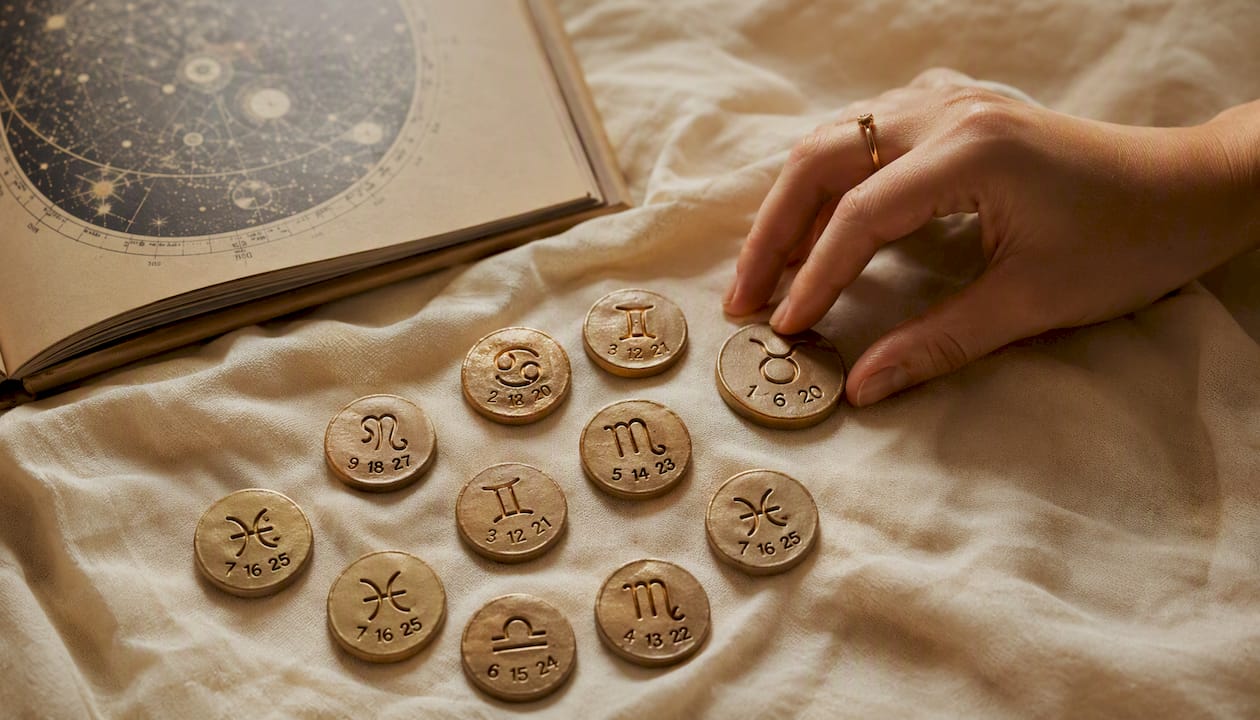
Astrology associates each zodiac sign with a traditional set of lucky numbers that players use, ranging across both lower and higher lottery number ranges.
One honest note: astrology provides ritual and meaning, not a documented statistical edge. No planetary configuration changes the draw's randomness. Use these overlays because they make the game feel personal, not because they shift the odds.
Pro Tip: Treat your astrology numbers as a filter, not a formula. Pick the one or two that fall outside your birthday's 1–31 range and use those as your "spread" picks. You get the symbolism and a better-distributed set.
Do date-based picks change your odds or your payout?
Your probability of matching the draw is identical whether you pick 7, 14, 19, 22, 31, 42 or any other valid combination. The draw is random, full stop.
What changes is what happens if you win. The Conversation's analysis found that human-picked tickets cluster heavily on popular combinations, identifying the 40 most-favored six-tuples and a spreadsheet of the 5,000 most common combinations among real players. Birthday ranges dominate that list because millions of players worldwide use the same logic you do.
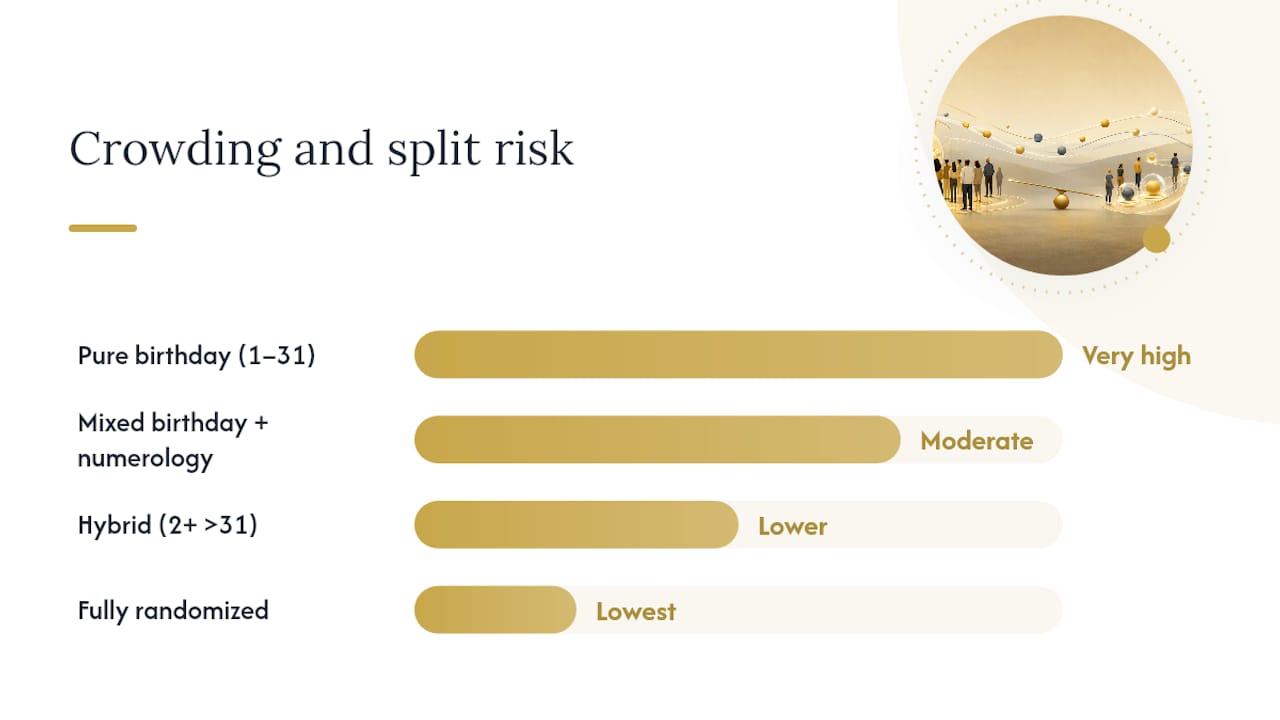
Crowding risk in numbers: The Conversation identified the 40 most-favored six-tuples and documented 5,000 of the most common human-picked combinations — the majority of which are concentrated in the 1–31 birthday range.
| Combination type | Estimated player overlap | Jackpot-split risk |
|---|---|---|
| Pure birthday set (all 1–31) | Very high | High |
| Mixed birthday + numerology | Moderate | Moderate |
| Hybrid with 2+ numbers above 31 | Lower | Lower |
| Fully randomized | Lowest | Lowest |
The practical implication: a jackpot split between 10 winners pays each one-tenth of the advertised prize. A $200 million Powerball jackpot becomes $20 million before taxes when shared that way. Avoiding the most crowded combinations doesn't improve your chance of winning, but it can meaningfully improve what you'd actually take home. For a deeper look at lottery probability basics, the Lottooracleapp blog covers the math in full.
Two-minute workflow from birthdate to ticket
- Write down your day, month, and two-digit year.
- Calculate your Life Path number (sum all digits, reduce to single digit or master number).
- Check your game's number range.
- Swap any birthday digit above the pool cap using the subtraction method (digit minus pool max).
- Replace one or two numbers with Life Path multiples that fall above the typical birthday range.
- Run the set through a quick randomizer or shuffle them mentally to break pattern bias.
- Record the set, buy your ticket, and set a rotation reminder (refresh regularly to keep it fresh).
Budget note: Playing the same set repeatedly costs the same per draw. Most players find rotating every month keeps the game fresh without abandoning their personal numbers entirely.
Template to copy:
- Birthday digits: __, __, __
- Life Path multiples: __, __
- Astrology swap (optional): __
- Final set: __, __, __, __, __, __
What birthdate numbers can't do, and how to play responsibly
Birthdate-based methods add personal meaning and make the selection process more engaging. They do not alter the draw's randomness or improve your mathematical probability of winning.
Lottery draws are governed by certified random number generators or physical ball machines audited by state regulators. No selection method, numerological or otherwise, influences which numbers are drawn.
A few grounding rules:
- Set a fixed weekly or monthly budget before you play, and treat it as entertainment spending, not investment.
- Never chase losses by increasing your stake after a losing run.
- U.S. lotteries are state-regulated. Minimum age (typically 18, though a few states require 21), ticket purchase rules, and prize-claim procedures vary. Check your state lottery's official site before playing.
- If gambling stops feeling like entertainment, the National Council on Problem Gambling helpline is available at 1-800-522-4700.
This article is general information, not financial or legal advice. Confirm current rules with your state lottery authority.
Key Takeaways
Birthdate lottery numbers are personal and playable, but pure date-based sets cluster heavily in the 1–31 range and raise jackpot-sharing risk — mixing in numerology-derived numbers above 31 reduces that risk without losing personal meaning.
| Point | Details |
|---|---|
| Odds don't change | Your win probability is identical regardless of selection method; only payout distribution shifts. |
| Crowding risk is real | The Conversation identified the 40 most-favored six-tuples and 5,000 of the most common human-picked combinations, dominated by birthday ranges. |
| Hybrid sets perform better | Replacing two birthday digits with Life Path multiples above 31 lowers your overlap with other players. |
| Two-minute workflow | Compute core numbers, check game range, swap high numbers in, randomize order, then buy. |
| Lottooracleapp automates this | Lotto Oracle generates personalized birthdate and numerology sets adjusted for your game's range in one step. |
Why personalization still matters even when the math is neutral
The conventional wisdom in lottery circles is that any pick is as good as any other — so why bother with birthdate methods at all? That framing misses something. The research on sharing risk actually validates a more thoughtful selection process. If pure randomness and pure birthday picks carry different expected payouts (because of how jackpots split), then how you pick genuinely matters for what you'd walk away with.
What I'd push back on is the idea that numerology and astrology are either magic or meaningless. They're neither. They're a structured way to generate a consistent, repeatable set that feels personal — and that consistency is what keeps players engaged without chasing losses or playing impulsively. The ritual of computing a Life Path number or checking a planetary degree slows the decision down, which is almost always better than buying a quick-pick in a rush.
The smartest approach combines both: start with your birthdate and numerology core, then deliberately push two numbers above 31 and run a light randomization pass. You keep the symbolism, you reduce the split risk, and you have a set you can actually remember and track over time.
Lotto Oracle turns this workflow into a one-step process
Most players who try the birthdate-to-ticket workflow above hit the same snag: the math is manageable once, but recalculating Life Path multiples, checking game ranges, and running a randomizer every week gets tedious fast.
Lottooracleapp built Lotto Oracle specifically for this. Enter your birthdate, choose your game (Powerball, Mega Millions, or state lotteries), and select numerology or astrology mode. The app generates a ticket-ready set that blends your personal numbers with higher-range picks, automatically avoiding the most crowded birthday clusters. Daily luck readings, trend tracking, and zodiac overlays are all included in the subscription. No ticket sales, no gambling services — just smarter, more personal number guidance.
Start generating your personalized set and see how your birthdate translates into a full, game-ready pick in under a minute.
Sources and further reading
- Can picking personal Lotto lines change the odds of winning? We ran the numbers
- Dream Numbers and Numerology for Lottery: Fun Methods vs. Mathematical Reality | DrawAnalytics Lottery Blog
- Unveiling the Secrets: How to Pick Lottery Numbers Using Numerology
- Lucky Numbers Based On Astrology