
Prediction apps do not reliably forecast lottery draws or provably-fair casino outcomes. Full stop. The randomness built into those systems is not a gap in the data — it is the design. That said, prediction technology does work in specific, well-defined domains, and understanding the difference protects your wallet.
Three things worth knowing up front:
- Where prediction can work: In structured forecasting tasks, LLM augmentation improved human accuracy by 24–28% in controlled experiments. Clinical tools like Accu-Chek SmartGuide Predict achieve high validated sensitivity for low-glucose events. These gains exist because the underlying data contains a real, learnable signal.
- Where it cannot work: True lottery draws and provably-fair casino rounds are cryptographically or statistically independent. No app can predict them, regardless of how the marketing reads.
- The practical takeaway for players: Treat any lottery or gambling prediction app as entertainment, not investment advice. Apps like Lotto Oracle offer pattern-inspired picks and numerology overlays for fun — not guaranteed wins.
Key Takeaways
Prediction apps cannot reliably forecast lottery draws or provably-fair casino outcomes, but they can add entertainment value and, in non-gambling domains, AI forecasting has demonstrated real, measurable accuracy gains.
| Point | Details |
|---|---|
| Lottery prediction verdict | No app can reliably predict independent lottery draws or cryptographically sealed casino rounds. |
| Where AI forecasting works | LLM augmentation improved structured forecasting accuracy by 24–28%; clinical tools like Accu-Chek SmartGuide Predict show validated sensitivity of 87–94%. |
| How to evaluate any app | Check for out-of-sample backtests, calibration metrics, independent audits, and a clear refund policy before paying. |
| Entertainment-first rule | Set a fixed budget, never sideload APKs, and use prediction apps for fun rather than financial strategy. |
| Lottooracleapp | Lotto Oracle offers personalized picks and numerology overlays as an entertainment subscription, with no ticket sales and transparent limits. |
Table of Contents
- Do prediction apps work? How each method actually holds up
- What the research actually shows about forecasting accuracy
- Why casino "predictors" are impossible and how scams work
- How to evaluate any prediction app before you try it
- Risks of using prediction apps and how to reduce harm
- What Lotto Oracle actually offers lottery players
- An evidence-first perspective on prediction apps
- Lotto Oracle: try it with clear expectations
- Sources
Do prediction apps work? How each method actually holds up
Most prediction apps fall into one of four method categories. The gap between what each one claims and what it can actually deliver is where players lose money.
Astrology, numerology, and tarot-style outputs assign meaning to birth dates, zodiac signs, or symbolic card draws. What feels accurate is largely the Barnum/Forer effect — vague statements that feel personal because we fill in the gaps ourselves.
Pattern analysis and statistical heuristics scan historical draw results for "hot" or "cold" numbers. The problem: each lottery draw is statistically independent. Past results carry zero predictive weight for future draws, a point covered in detail in lottery probability basics. Seeing a number appear five times in a row does not raise or lower its odds on draw six.
Machine learning and AI forecasting can genuinely improve predictions when the domain has a real signal — structured human judgment tasks, clinical glucose monitoring, financial time series. The requirement is always the same: a learnable pattern in the input data that correlates with the outcome. Lottery balls and cryptographic seeds do not provide that.
"Predictor" apps for crash and Aviator-style casino games are the most dangerous category. These apps claim to read live game data and call the next crash point. They cannot, for reasons explained in the next section.
| Method | Typical claim | Evidence level | Realistic outcome |
|---|---|---|---|
| Astrology / numerology | Cosmic alignment guides picks | None (symbolic only) | Entertainment |
| Pattern / stat heuristics | Hot/cold numbers signal future draws | None (independent draws) | Entertainment |
| ML / AI forecasting | AI learns from data to improve accuracy | Strong in valid domains | Probabilistic insight (non-gambling) |
| Casino crash predictors | Reads live rounds to call next result | None (cryptographically impossible) | Financial risk / scam |
What the research actually shows about forecasting accuracy
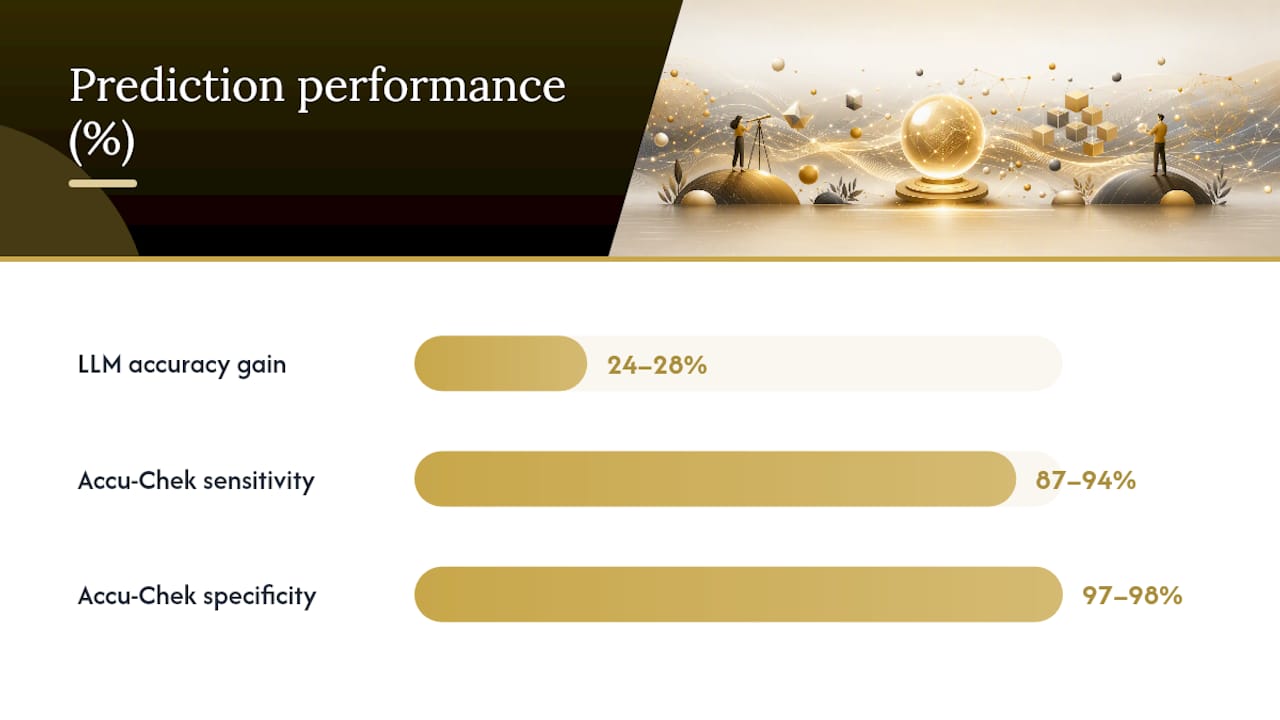
The clearest evidence that prediction technology works comes from domains where the data contains a real signal. In a controlled study with 991 participants, LLM-augmented forecasting improved accuracy by 24–28% over unassisted human judgment, with the largest gains coming from assistants designed around superforecasting principles.
Clinical prediction offers an even sharper example. The Accu-Chek SmartGuide Predict app's Low Glucose Predict feature was evaluated in a pooled clinical analysis and achieved:
- Sensitivity of 87–94% and specificity of 97–98% against clinical reference standards
- An ROC-AUC of 0.9787
- A mean lead time extending several minutes before a low-glucose event
In silico simulations using digital twins suggested the app's features could reduce time below 70 mg/dL, increase time-in-range noticeably, and substantially cut daily hypoglycemia alarms.
The pattern behind every validated prediction system: high-quality sensor input, a clearly defined outcome, and a behavior model that translates the prediction into a safe action. Lottery and crash-game apps have none of these.
These results do not generalize to gambling. Lottery draws are statistically independent events. Provably-fair casino rounds are cryptographically sealed before play begins. There is no signal to learn from, which means no model — no matter how sophisticated — can outperform chance over time.
Why casino "predictors" are impossible and how scams work
Provably-fair casino games compute each outcome using a formula: HMAC-SHA256(serverSeed, clientSeed:nonce). The server seed is committed as a SHA-256 hash before the round starts and revealed only after. Because the seed is hidden until play ends, no external app can know the result in advance — the math makes it impossible, not just unlikely.
Empirical testing confirms this. Eight popular Aviator predictor apps tested across 800+ rounds produced win rates consistent with pure chance, ranging from roughly 41% to 53% depending on the app. That spread is exactly what random selection looks like.
Common scam mechanics to recognize:
- Fake APKs and modded clients that alter the user interface to show fabricated "predictions" while the real game runs normally underneath
- Telegram signal groups posting cherry-picked screenshots with no auditable win/loss record
- Paid subscriptions with unverifiable backtests — no independent audit, no out-of-sample data, no way to check the claimed record
- Malware and credential theft bundled into sideloaded apps from third-party sites
To verify a provably-fair game honestly: after a round ends, the casino reveals the server seed. You can then run the HMAC-SHA256 calculation yourself using a public verifier tool to confirm the outcome matches what was committed before play. That is transparency. Any app that asks you to trust its predictions instead of the verifiable math is a red flag.
How to evaluate any prediction app before you try it
A few concrete checks separate credible apps from noise:
- Method transparency: Can the app explain exactly how it generates outputs? Vague claims like "AI-powered" with no further detail are a warning sign.
- Out-of-sample backtest data: Past performance on training data means nothing. Look for results on data the model never saw during development, with honest reporting of losses, not just wins.
- Independent audits or peer-reviewed references: Clinical tools cite published studies. Gambling predictors almost never do. Check AI lottery prediction limits for a breakdown of what legitimate evaluation looks like.
- Calibration metrics: Brier score and ROC-AUC tell you whether a model's confidence matches its actual accuracy. An app that never mentions calibration has probably never measured it.
- Clear refund policy and real user reviews: Not curated testimonials — verifiable reviews on independent platforms.
- Minimal permissions: A number-generation app has no reason to request access to your contacts, camera, or location.
Pro Tip: When reading a backtest, look specifically for the losing cases. Any record that shows only wins is fabricated or cherry-picked. A credible backtest includes the full distribution of outcomes, states the sample size, and separates training data from test data.
Start with a free or demo tier. Run the app for several weeks and track whether its outputs show any reproducible pattern against actual results. If they do not, no subscription price makes them worth paying.
Risks of using prediction apps and how to reduce harm
Financial loss is the most direct risk. Players who treat predictions as reliable signals tend to increase wager sizes, chase losses, and escalate over time — a pattern that compounds quickly.
Privacy and security risks are less obvious but equally real. Sideloaded APKs from unofficial sources frequently carry malware. Some apps request biometric data (palm scans, facial images) under the guise of personalized readings, then store or sell that data without clear disclosure. The AI predicting apps technology review notes that CV-based palm-reading apps raise specific privacy concerns around biometric data handling.
Psychological risks compound the financial ones. Confirmation bias means players remember the hits and forget the misses, creating a false sense of accuracy over time. This is the same mechanism behind horoscope belief — and it can push gambling behavior toward addiction without the player noticing the shift.
Practical mitigations:
- Never sideload APKs from third-party sites; use official app stores only
- Set a fixed entertainment budget before using any prediction app and do not exceed it
- Review app permissions before installing; revoke anything unnecessary
- Use a credit card rather than a debit card or bank transfer for any subscription, so disputes are recoverable
- If gambling feels compulsive rather than recreational, GambleAware offers free, confidential support and resources
Sports forecasting sits in a different category. Statistical signals do exist in sports data, and NBA prediction games illustrate how structured forecasting with real historical signal differs from lottery or crash-game prediction.
What Lotto Oracle actually offers lottery players
Lotto Oracle is an entertainment-first subscription app, not a guaranteed-win system. Here is what it actually provides:
- Personalized number generation combining astrology, numerology, and historical pattern analysis
- Daily luck readings and zodiac-based overlays for players who enjoy that framing
- Trend and pattern tracking across past draws, presented as context rather than prediction
- Sports matchup overlays for players who want a single platform for multiple game types
- No ticket sales — Lotto Oracle generates picks and insights; you buy tickets through official channels
It suits players who want an engaging, personalized way to choose numbers and enjoy the ritual of playing — not players expecting a mathematical edge. The app does not claim to predict provably-fair outcomes or guarantee lottery wins. For players curious about pattern-inspired picks or who want lightweight analytics alongside their regular play, it is a well-designed option in a category where most alternatives offer far less transparency.
An evidence-first perspective on prediction apps
The honest read is this: prediction technology is genuinely impressive in the right domains and genuinely useless in others. The domains where it fails are not edge cases — they include every lottery draw and every provably-fair casino round most players encounter. Apps that claim otherwise are not just wrong; they are exploiting the same psychological shortcuts (confirmation bias, the Forer effect, selective memory) that make horoscopes feel accurate. Lottooracleapp's approach — building an entertainment product that is transparent about its limits — is the right model for this space. The risk is not in using a prediction app for fun. The risk is in believing it.
*— amsd
Lotto Oracle: try it with clear expectations
Lotto Oracle gives you personalized lottery picks, numerology overlays, and daily luck readings in one clean subscription platform. It is built for players who want more engagement with their numbers, not a shortcut to guaranteed wins.
Visit Lotto Oracle to explore the subscription options. Start with the lowest tier, treat it as an entertainment budget, and keep wagers small. Check the site's current terms for trial and refund details before subscribing.
Sources
- In silico evaluation of Accu‑Chek SmartGuide Predict features (PubMed)
- Provably fair predictors: Why they can't work (ProvenlyFair)
- Aviator predictor: 8 apps tested — no evidence they work (CrashBetAdvisor)