
Keno number patterns do not predict future draws. Every draw is an independent random event, and each number carries a 25% probability of appearing in any given 80-ball game regardless of what happened before. Patterns are useful as selection shortcuts and entertainment rituals — nothing more.
What patterns offer:
- A structured, repeatable way to pick numbers without agonizing over a blank ticket
- A personal ritual that makes the game feel more engaging and meaningful
What patterns cannot offer:
- Any change to the underlying probability of a number being drawn
- Predictive power over future results
Table of Contents
- Why do you keep seeing patterns in random keno draws?
- Which number trends do keno players actually track?
- What can patterns actually change about your keno odds?
- Practical rules for using patterns as responsible entertainment
- How to track and test keno patterns yourself
- How Lottooracleapp approaches personalized pattern and astrology picks
- Key Takeaways
- The ritual matters more than the math
- Lottooracleapp: personalized picks for entertainment-first players
- Further reading and authoritative sources
Why do you keep seeing patterns in random keno draws?
The short answer is apophenia: the human brain is wired to find meaningful connections in unrelated data. When number 17 shows up three draws in a row, it feels significant. To the RNG, it is three independent coin flips that happened to land the same way.
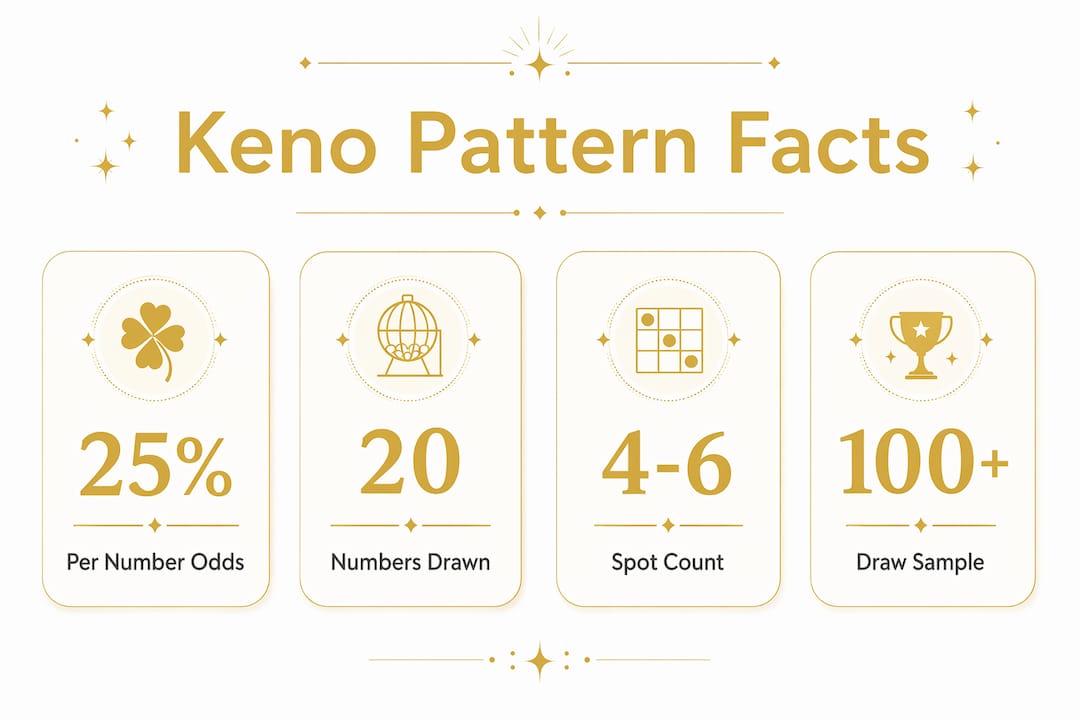
In standard 80-ball keno, 20 numbers are drawn each round, giving every number a 20/80 probability — exactly 25% — per draw. That probability does not shift based on history. A number appearing 15 times in 100 draws instead of the expected 25 is completely normal short-sample variance, not a signal. Over hundreds of thousands of draws, every number converges toward that 25% rate, not because the machine "corrects" itself, but because future draws dilute past variance.
The gambler's fallacy is the flip side of apophenia. Cold-number believers think a number that missed 50 draws is "due." Hot-number believers think a number on a streak will keep rolling. Both camps are wrong for the same reason: the draw has no memory.
Pro Tip: Keep a simple tally of your tracked numbers across 100 draws. You will almost certainly see some numbers hit 30+ times and others hit 18 times. That spread is variance doing exactly what math predicts — not a pattern worth betting on.
Which number trends do keno players actually track?
Players have developed a surprisingly rich vocabulary for number selection. Here is what each approach actually involves:
- Hot numbers: Numbers drawn frequently in recent rounds. If 23 appeared in 4 of the last 10 draws, it is "hot." Hot/cold lists reflect short-term variance, not future probability.
- Cold numbers: Numbers absent from recent draws. Some players bet on them expecting a correction. There is no correction mechanism in an independent draw.
- Streaks and due numbers: A subset of hot/cold thinking. A number on a five-draw streak feels "locked in." It is not.
- Clusters and spatial patterns: Picking numbers grouped together on the ticket grid — a corner block, a center square, a diagonal line. The visual grouping is for the player's benefit; the RNG treats every number as a distinct integer.
- Consecutive sequences: Numbers like 14, 15, 16, 17. No statistical advantage, but easy to track and satisfying when they partially hit.
- Birthday and personal-significance picks: Numbers tied to dates, ages, or anniversaries. Entirely valid as a selection ritual.
- Numerology picks: Numbers derived from name values, birth paths, or master numbers (11, 22, 33). The number 7 carries luck associations across dozens of cultures; 8 is prized in Chinese numerology for its sound resemblance to prosperity. These are entertainment choices, not math-based edges. If you want to explore how numerology maps to personal numbers, that framework can make your picks feel genuinely personal.
- Zodiac and astrological overlays: Assigning numbers to planetary positions, birth signs, or lunar cycles. A Leo might favor fire-sign numbers; a Scorpio might track water-sign sequences. Pure ritual, and a fun one.
What can patterns actually change about your keno odds?
Nothing about the probability of any individual number. The combinatorics are fixed: in 80-ball keno, the number of ways to draw 20 from 80 is a hypergeometric distribution that does not bend to pattern selection.
What does change your session experience is spot count. Picking 4 spots versus 8 spots produces a completely different risk profile:
| Spot count | Approx. odds of hitting all spots | Payout shape |
|---|---|---|
| 4 spots | — | Frequent small wins; partial-match payouts common |
| 8 spots | — | Rare large wins; long dry spells between payouts |
The same spot count can also pay very differently across providers. Paytables vary by provider, meaning two games with identical spot counts can carry meaningfully different house edges. Always pull up the paytable before committing to a session.
Different keno variants — 36-ball games, 70-ball games — change the combinatorics entirely, so strategy advice calibrated for 80-ball keno does not transfer directly.
Certified RNGs produce draws that are statistically independent. No pattern-tracking method can alter that independence or improve your expected return per ticket.
Practical rules for using patterns as responsible entertainment
Casino strategy analysts are consistent on one point: the decisions that actually shape your session are bankroll management and spot-count discipline, not number selection. Here is a prioritized set of rules to keep pattern play fun rather than costly.
- Set a session bankroll before you sit down. Decide the maximum you will spend. Write it down.
- Choose your spot count and keep it. Consistent spot count prevents risk escalation from switching mid-session and makes your tracking data meaningful.
- Check the paytable before playing. Prioritize variants that pay on partial matches — they sustain your bankroll through dry spells.
- Timebox your session. Volume creep is real: keno runs fast, and it is easy to lose track of spend. Set a timer or a draw count limit.
- Never chase losses. A cold streak is variance, not a signal that a win is imminent.
Picking 4–6 spots is the widely recommended balance between hit frequency and payout potential for players who want sustained entertainment rather than lottery-style long shots.
Pro Tip: Pre-commit your ticket size before each session and use your phone's timer app to enforce a hard stop. Decide both in writing before the first draw.

| Session budget | Suggested spot count | Approx. ticket cost | Draws at budget |
|---|---|---|---|
| $20 | 4–5 spots | $1–$2 per draw | 10–20 draws |
| $50 | 5–6 spots | $2–$3 per draw | 17–25 draws |
| $100 | 6 spots | $2–$5 per draw | 20–50 draws |
How to track and test keno patterns yourself
Use small-sample testing to measure entertainment value, not to prove predictive power. A few hundred draws will show you how your chosen pattern performs against the paytable — and will almost certainly confirm that variance, not pattern, drives the results.
- Choose your spot count and lock it in for the entire test.
- Define the pattern you want to track (e.g., "I will always play the same 6 hot numbers from the previous 10 draws").
- Record at least 500 draws. Fewer than that and variance swamps any signal.
- Log each draw in a spreadsheet with these columns: draw number, date, drawn numbers, your ticket picks, matches, and payout.
- Compute simple metrics after every 100 draws: hit frequency, average payout per ticket, bankroll change per 100 draws.
| Metric | What to track | Why it matters |
|---|---|---|
| Hit frequency | Matches per 100 draws | Shows whether your spot count is performing near expected probability |
| Avg. payout per ticket | Total payout ÷ tickets played | Tells you your actual return rate against the paytable |
| Bankroll change / 100 draws | Running balance shift | The clearest measure of session sustainability |
| Streak length | Longest win/loss run | A volatility proxy; long loss streaks are normal at higher spot counts |
Testing requires a large enough sample to observe normal variance. One hundred draws is not enough. Five hundred is a reasonable floor; a thousand is better.
How Lottooracleapp approaches personalized pattern and astrology picks
Lottooracleapp's Lotto Oracle app takes the entertainment value of pattern tracking seriously without pretending it changes the math. The app generates personalized number suggestions by layering astrology, numerology, historical trend overlays, and randomization into a single daily pick experience.
Key features:
- Personalized profiles: Your zodiac sign, birth path number, and lucky-number preferences shape every suggestion.
- Daily luck readings: Astrological and numerological context for the day's picks, so your numbers feel connected to something larger than a random grid.
- Trend and pattern tracking: The app surfaces recent frequency data so you can see which numbers have been running hot or cold in your tracked game.
- Customizable spot-count presets: Lock in your preferred spot count so every suggestion stays consistent with your session design.
- Exportable tracking data: Pull your history into a spreadsheet and run the metrics from the section above yourself.
If you are curious how tarot archetypes connect to astrological timing, that same symbolic layer informs how Lotto Oracle frames daily readings.
Lotto Oracle is an entertainment and insight app. It does not sell lottery tickets and does not guarantee any outcome. All suggestions are generated for fun and personal engagement, not financial gain.
Key Takeaways
Keno draws are statistically independent events, and no pattern-based method changes that — but patterns used as entertainment rituals, combined with disciplined spot-count and bankroll rules, make the game genuinely more engaging.
| Point | Details |
|---|---|
| Patterns are entertainment only | No selection method changes the 25% per-number probability in 80-ball keno. |
| Spot count drives your experience | Pick 4–6 spots to balance hit frequency and payout; higher counts mean longer dry spells. |
| Check the paytable first | Identical spot counts can carry very different house edges across providers. |
| Test with 500+ draws | Fewer draws produce noise, not signal; track hit frequency and bankroll change per 100 draws. |
| Lottooracleapp for personalized picks | Lotto Oracle layers astrology, numerology, and trend data into daily picks for entertainment-focused players. |
Canadian responsible-gambling note: The legal gambling age varies by province (18 or 19). If you need support, contact the Responsible Gambling Council (rgco.org) or ConnexOntario at 1-866-531-2600.
The ritual matters more than the math
Pattern-based play gets a bad reputation because critics focus entirely on predictive failure. That is the wrong frame. Nobody seriously argues that wearing a lucky jersey helps your hockey team win on a molecular level — but the ritual still has real psychological value. It creates focus, reduces decision fatigue, and makes the experience feel personal.
The same logic applies to astrology and numerology overlays on keno. Choosing numbers tied to your birth path or your rising sign does not alter the RNG. But it gives you a reason to care about those specific numbers, which makes a hit feel more meaningful and a miss easier to absorb. The danger is not the ritual. The danger is confusing the ritual for a predictive system and betting more because you "feel" a win coming. Keep the ritual. Ditch the expectation.
Lottooracleapp: personalized picks for entertainment-first players
Pattern tracking is more fun when the picks feel like yours. Lottooracleapp's Lotto Oracle builds personalized number suggestions from your zodiac profile, numerology birth path, and recent trend data — so every ticket starts with a pick that actually means something to you.
The app does not sell tickets and makes no guarantee of outcomes. It is a subscription-based entertainment tool designed for players who want structure, personalization, and a little cosmic context in their number selection. You can explore the features, see how your profile shapes a daily pick, and decide whether the overlay adds to your game.
Visit Lotto Oracle to get started. Set your session budget before your first draw, and treat every pick as what it is: an entertaining ritual backed by smart design, not a financial strategy.
Further reading and authoritative sources
Math and statistics:
- How to Play Keno: Odds, Payouts, and How to Win — Casino.org: Clear breakdown of 80-ball keno probability and payout mechanics.
- Keno Number Strategy Guide — LiveCasinos.com: Detailed walkthrough of why no number is statistically superior to another.
- Best Keno Numbers: Hot Numbers, Cold Numbers and the Truth — BaccaratProTips: Rigorous debunking of online "most-drawn numbers" lists with Law of Large Numbers context.
Psychology of pattern perception:
- Keno Patterns Debunked: Do Hot and Cold Numbers Matter? — CryptoGambling.com: Explains apophenia and the gambler's fallacy in the context of RNG-based keno.
Strategy and bankroll:
- Keno Strategy Guide — BetMGM Blog: Practical bankroll and spot-count advice from casino strategy analysts.
- Keno Strategy: 7 Proven Tips — XoLotto: Covers RTP selection, partial-match paytables, and the 4–6 spot recommendation.
- Keno Strategy Explained — Casimatic: Focuses on timeboxing and consistent spot-count discipline.
Canadian responsible gambling:
- Responsible Gambling Council — rgco.org: Canada's leading independent responsible-gambling organization; self-assessment tools and support resources.
- ConnexOntario — connexontario.ca: Free, confidential health services information for Ontario residents; gambling support line 1-866-531-2600.
- Provincial lottery operators (OLG in Ontario, BCLC in British Columbia, Loto-Québec in Quebec) publish official keno draw histories and responsible-play guidelines on their respective websites.