Most Canadian lottery winners cannot stay fully anonymous. Provincial lottery corporations publish winner details as standard practice, and full anonymity is granted only in rare, documented safety cases. The Canada Revenue Agency doesn't tax your winnings, but that's a separate question from whether your name gets published. As of 2026, both BCLC and OLG have scaled back to first-name-and-last-initial disclosures instead of full names, a real shift in your favor.
Before you do anything else:
- Check your provincial lottery corporation's claims and publicity page for the current disclosure policy.
- Call the claims office before you travel to claim, and ask directly what will be published and when.
Key Takeaways
Full anonymity after a Canadian lottery win is rare; most winners get partial privacy through first-name-and-last-initial disclosure and must act fast to protect themselves from scams.
| Point | Details |
|---|---|
| Anonymity is the exception | Only documented safety cases, like threats or witness protection, typically qualify. |
| Provinces differ | OLG and BCLC now use first name plus last initial; WCLC and ALC largely haven't changed. |
| Winnings aren't taxed | The CRA doesn't tax lottery prizes, but interest earned afterward is taxable. |
| Move slowly after claiming | Build a legal and financial team before making major purchases or public statements. |
| Document group pools | Written rules and receipts protect you if coworkers dispute a shared win. |
Table of Contents
- Why Provincial Lottery Corporations Publicize Winner Information
- What Information Gets Published After You Claim
- Provincial Rules and What Changed in 2026
- When Full Anonymity Is Actually Possible
- How the Claim Process Actually Works
- Are Lottery Winnings Taxable in Canada?
- Protecting Your Privacy and Safety After Claiming
- If You Won as Part of an Office Pool
- What Winners Wish They'd Known Sooner
- Where to Check Right Now
- Frequently Asked Questions
- Sources
Why Provincial Lottery Corporations Publicize Winner Information
Lottery corporations publish winner details for one core reason: proof. Publicizing names, cities, and prize amounts shows the public that jackpots actually get paid out, which protects trust in the entire system and discourages fraud claims against the lottery itself.
- Transparency demonstrates that prizes are real and paid.
- Publicity deters fake-winner scams and internal fraud allegations.
- Corporations now acknowledge that permanent online records raise real privacy risk.
Lottery corporations have started limiting published identifiers specifically because online permanence and impersonation scams have made full-name disclosure a liability for winners, even as the corporations still want to preserve public accountability.
What Information Gets Published After You Claim
Expect a fairly standard package of details once you claim a prize. BCLC's own policy spells out what it may release, and most other provinces follow a similar pattern.
- First name and last initial (increasingly the norm since the 2026 policy shift)
- City or town of residence
- Prize amount and the specific game
- A photo, usually taken at the claims office
- A short winner story or quote for media use
You'll still see full names surface occasionally. A Surrey winner was reported simply as "Susan F." because BCLC won't give full names, which is exactly the abbreviated format now common in B.C. coverage. On photos: even where face masks are tolerated, commissions generally still require an unmasked photo on file for internal documentation, whether or not that image goes public.
Provincial Rules and What Changed in 2026
Where you bought your ticket determines which rulebook applies, and the differences matter more than most winners expect.
- OLG (Ontario): Now uses first name plus last initial in most releases, though OLG's website still posts full names for prizes over $1,000 for a limited posting window.
- BCLC (British Columbia): Publishes first name and last initial by default; anonymity requests get reviewed case by case but are rarely approved.
- WCLC (Western Canada): Practices have stayed largely unchanged, with fuller name disclosure still common for major prizes.
- Atlantic Lottery (ALC): Similarly conservative, with less movement toward the abbreviated-name model seen in Ontario and B.C.
- Loto-Québec: Continues its own longstanding disclosure practices, distinct from the rest of the country.
CBC's reporting on the 2026 changes frames this as a direct response to scam and impersonation risk, not a retreat from transparency.
Pro Tip: Don't assume your province follows Ontario or B.C.'s newer rules. Call your provincial claims office directly and ask what specific identifiers will appear before you show up with your ticket.
When Full Anonymity Is Actually Possible
Genuine anonymity is the exception, not a request you can casually check off on a claim form. CP24's reporting on Ontario confirms the bar is high and evidence-based, not discretionary.
- Documented threats to personal safety on file with police
- Witness protection status or an active protection order
- Battered-spouse or domestic-violence situations with supporting documentation
- Undercover or active law enforcement roles where disclosure creates operational risk
Anonymity requests are considered case-by-case, but exceptions remain rare, meaning most applicants without documented safety evidence will still be publicized in the standard format.
In practice, you'll likely need a lawyer to contact the lottery corporation on your behalf, submit supporting documentation, and wait for internal review before the corporation confirms whether an exception applies.
How the Claim Process Actually Works
Claiming in person is still the standard path across Canada, and it comes with a few non-negotiable steps. You'll need the signed ticket and government-issued ID, and OLG in particular requires a photo as proof the prize was actually claimed before releasing a major payout.
- Bring your signed ticket and valid photo ID to the designated claims center.
- Expect a photo session, since disguises like wigs or sunglasses are typically not permitted even where masks are tolerated.
- Ask about claim windows: unclaimed prizes are eventually reallocated to future games or promotional draws.
Pro Tip: Call the claims office before you travel. Confirm hours, required documents, and whether they can accommodate a low-profile claim so you're not blindsided at the counter.
Are Lottery Winnings Taxable in Canada?
No. The CRA is clear that lottery winnings themselves are not taxable income in Canada.
- Winnings don't need to be reported on your tax return in most cases.
- The exception: if the prize counts as income from employment, business, or property, it becomes taxable.
- Interest or investment income you earn after receiving the winnings is fully taxable and must be reported going forward.
Protecting Your Privacy and Safety After Claiming
Once your name is out, the risks shift from privacy to security and responsible gambling. CBC's coverage notes that scams and impersonation attempts spike once a winner's identity becomes public.
- Change your phone number, lock down social media, and set a neutral voicemail message.
- Avoid big purchases or public statements for several weeks while you get organized.
- Bring in a financial advisor and a lawyer; some winners set up trusts or corporate claim structures on advice.
- Screen calls and visitors, hold your mail or open a PO box, and involve police if any contact feels threatening.
Pro Tip: The quiet period right after claiming is your best window to build a support team before anyone else knows your number has changed.
If You Won as Part of an Office Pool
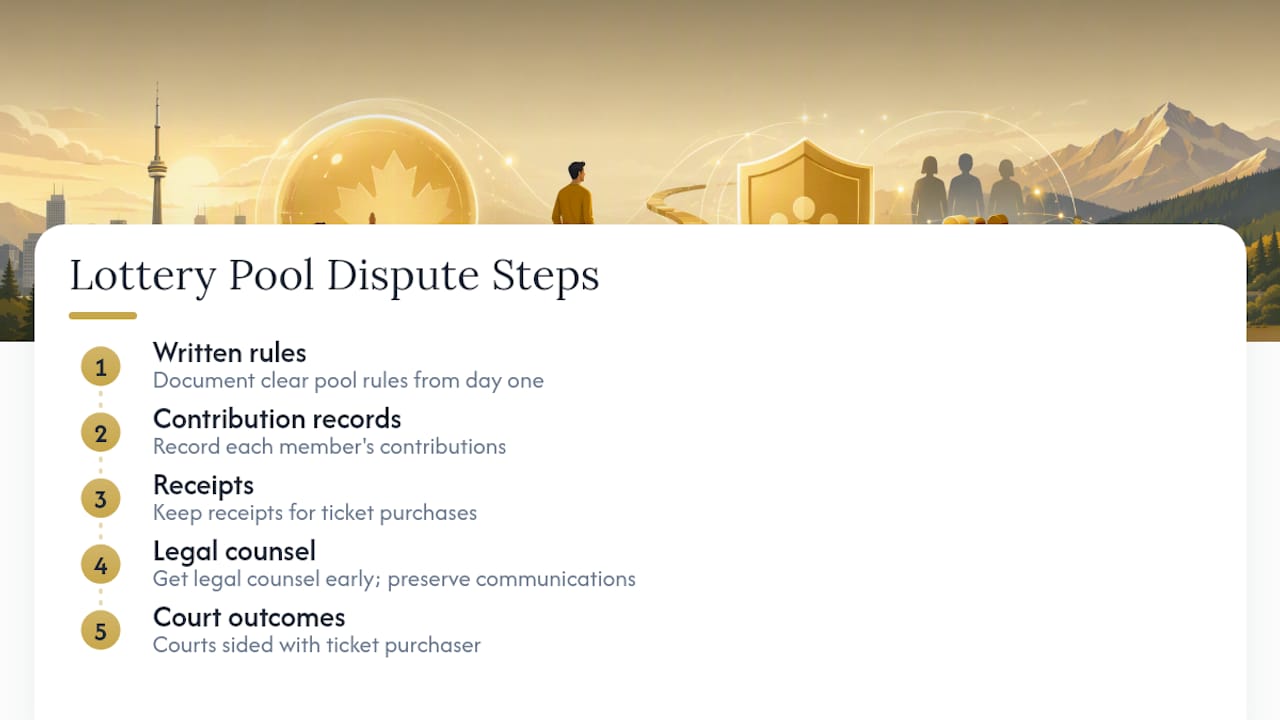
Group wins create their own risk, and it's almost always a paperwork problem, not a legal gray area. Keep written pool rules, records of who contributed and how much, receipts, and ideally a witness to the agreement, before you ever buy a ticket together.
- Draft written rules for how numbers are picked and how winnings get split, before the draw.
- Keep receipts and contribution records for every pool round.
- If a dispute erupts, involve a lawyer early, preserve every text and email, and consider mediation before court.
In a reported B.C. case, the person who actually bought the ticket kept the full $2 million payout after coworkers who claimed a pool arrangement had their case dismissed in court, underscoring how much clean records matter.
Sources: National Post
What Winners Wish They'd Known Sooner
Winners often make the same two mistakes: spending fast and posting online before thinking it through. What actually helps is treating the first few weeks as planning time, not celebration time. Assemble your lawyer, financial planner, and security contacts before you make a single major decision. Financial advisors call this stretch the "winner's fog," and it's real: judgment gets fuzzy right after a big claim, so slowing down is the smartest move you can make.

Where to Check Right Now
Before you claim, spend ten minutes on these official sources.
- CRA's guidance on non-taxable amounts for the exact tax treatment of your prize.
- BCLC's publicizing policy page for what B.C. specifically discloses and how anonymity requests are handled.
- CP24's breakdown of Ontario's anonymous-claim process for OLG-specific procedures.
- CBC's national coverage of the 2026 privacy changes for context on why policies shifted.
Call your provincial claims office directly before you travel to claim. Policies change, and a five-minute call beats a wasted trip. If you're weighing your numbers before that call, Lotto Oracle's personalized number insights combine numerology and pattern analysis to help you approach your next play with more intention, whether you're chasing a jackpot or just enjoy the ritual of picking with purpose.
Frequently Asked Questions
Can I claim a lottery prize anonymously in Canada? Rarely. Provincial lottery corporations publish winner details as a default policy, and full anonymity is granted only in documented safety cases like witness protection or credible threats.
What does OLG publish about lottery winners? OLG typically uses first name and last initial, though it still posts full names on its website for prizes over $1,000 during a limited window, per CP24's reporting.
Do I have to pay tax on lottery winnings in Canada? No. The CRA doesn't tax lottery winnings, though interest earned on the money afterward is taxable.
How do I request anonymity when claiming a Canadian lottery prize? You'll generally need a lawyer to contact the lottery corporation directly with documentation supporting a safety-related exception. Approval isn't guaranteed and reviews happen case by case.
What happens if my lottery pool disagrees over a shared win? Keep written rules, contribution records, and receipts from day one. If a dispute happens, get legal counsel early and preserve all communication, since courts have sided with the ticket purchaser in reported cases when documentation was lacking on the other side.
Are winner photos mandatory even if I want privacy? Usually, yes. Most corporations require an unmasked photo for internal records even if the released public image is limited, and disguises like wigs or sunglasses are typically not allowed.
This article is general information, not a substitute for advice from a qualified lawyer. Consult a qualified legal professional about your own circumstances before acting on anything here.
Sources
- Canada
- Publicizing Lottery Winners | BCLC
- Who won the lottery? Why you may never know the full name of some jackpot winners going forward | CBC News
- Can you claim a winning lottery ticket in Ontario anonymously? | CP24
- BC man gets to keep $2M lotto winnings after workplace pool cries foul | National Post