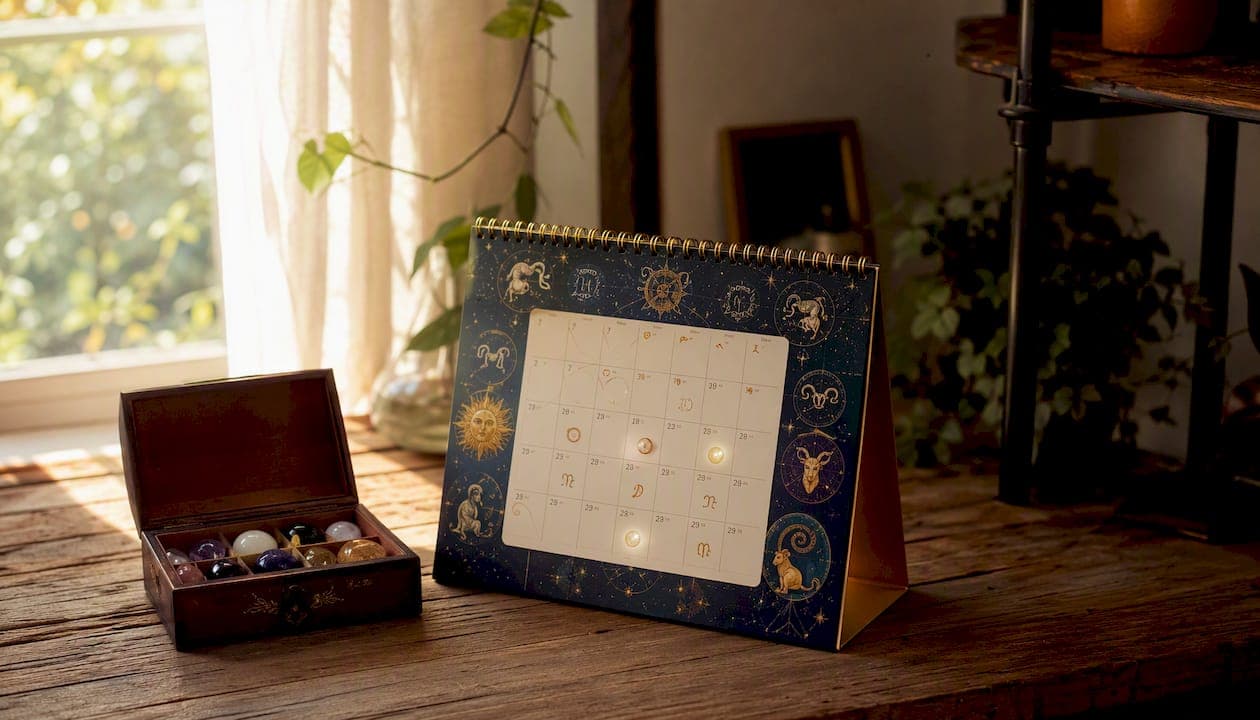
If you're a Scorpio, your single luckiest gambling day this year lands on a highlighted October date. Aries players should circle a peak July date. For everyone else, the sign-by-sign calendar below gives you the exact weekdays and one highlighted date to prioritize for lottery plays, casino sessions, and sports bets in 2026.
Three things to keep in mind before you use any luck calendar for gambling:
- Astrological timing is an entertainment and planning tool, not a probability modifier. The house edge on blackjack is still around 0.5%, and a slot's RNG doesn't read your birth chart.
- Daily luck scores are explicitly entertainment-only and do not change actual odds. Use them to decide when to play, not how much to risk.
- On a high-confidence lucky day, a reasonable rule is to cap your session at your normal bankroll, not more. Luck signals are a timing cue, not a green light to increase stakes.
Key Takeaways
A luck calendar for gambling is most valuable as a planning and filtering tool: use it to decide when to play and when to skip, never to justify larger stakes.
| Point | Details |
|---|---|
| High-signal days = timing, not stakes | On peak dates and luckiest weekdays, play your normal session bankroll, never more. |
| Multiple signals beat single ones | Days with overlapping planetary icons, favorable Moon phase, and numerology alignment carry the strongest signal. |
| Track at least 20 sessions | Fewer than 20 sessions is too small a sample to distinguish luck from variance. |
| Game type should match signal type | High-variance signals favor lotteries and slots; Jupiter-style days favor blackjack and strategic poker. |
| Lottooracleapp automates the workflow | The app generates sign-based numbers, sends daily luck notifications, and logs sessions for monthly review. |
Table of Contents
- How your luck calendar for gambling works sign by sign
- How astrology and numerology define "lucky" gambling days
- Three practical methods to generate lucky numbers you can actually play
- Which games fit which astrological signals
- Practical rules for using lucky days: planning, bankroll, and responsible play
- How to track and test your luck calendar over time
- Methodology and credibility: how this calendar was built
- Why I use luck calendars as a planning tool, not a prediction system
- Lottooracleapp puts your luck calendar on autopilot
- Sources
How your luck calendar for gambling works sign by sign
The table below maps each zodiac sign to its luckiest weekday(s) for gambling and one highlighted peak date for 2026. Sign-by-sign weekday mappings are a standard feature of gambling horoscopes, with short rationales tied to each sign's ruling planet.
| Aries | Tuesday, Friday | A July date. Sports betting, poker | | Taurus | Monday, Friday | A June date. Slots, scratch cards | | Gemini | Wednesday, Friday | A July date. Keno, lotteries | | Cancer | Monday, Thursday | An August date. Table games, bingo | | Leo | Sunday, Thursday | A July date. Roulette, high-stakes poker | | Virgo | Wednesday, Saturday | A September date. Blackjack, lotteries | | Libra | Friday, Wednesday | An October date. Roulette, card games | | Scorpio | Tuesday, Thursday | An October date. Poker, sports betting | | Sagittarius | Thursday, Sunday | A November date. Lotteries, slots | | Capricorn | Saturday, Tuesday | A November date. Blackjack, table games | | Aquarius | Saturday, Wednesday | An August date. Keno, lotteries | | Pisces | Thursday, Monday | A September date. Slots, bingo |
How to read this table: Find your sign, note the weekday(s), and mark the peak date in your calendar. The peak date is the single day this year when multiple favorable indicators align for your sign. Horoscope identifies these single highlighted dates as moments of peak timing for breakthroughs. The "Best Game Type" column reflects the energy profile of your ruling planet, not a guarantee of wins.
- On your luckiest weekday, prefer games that match your sign's energy (high-action for fire signs, strategic for earth signs).
- On the peak date, treat it as your highest-confidence session of the year. Keep stakes at your normal level.
- If your peak date falls on your luckiest weekday, that overlap is the strongest signal in your calendar.
For a deeper look at how zodiac traits translate into specific number-selection strategies, the zodiac lottery strategy guide breaks it down sign by sign.
How astrology and numerology define "lucky" gambling days
Three core signal types drive most luck calendars, and understanding them helps you spot the strongest days rather than treating every entry as equal.
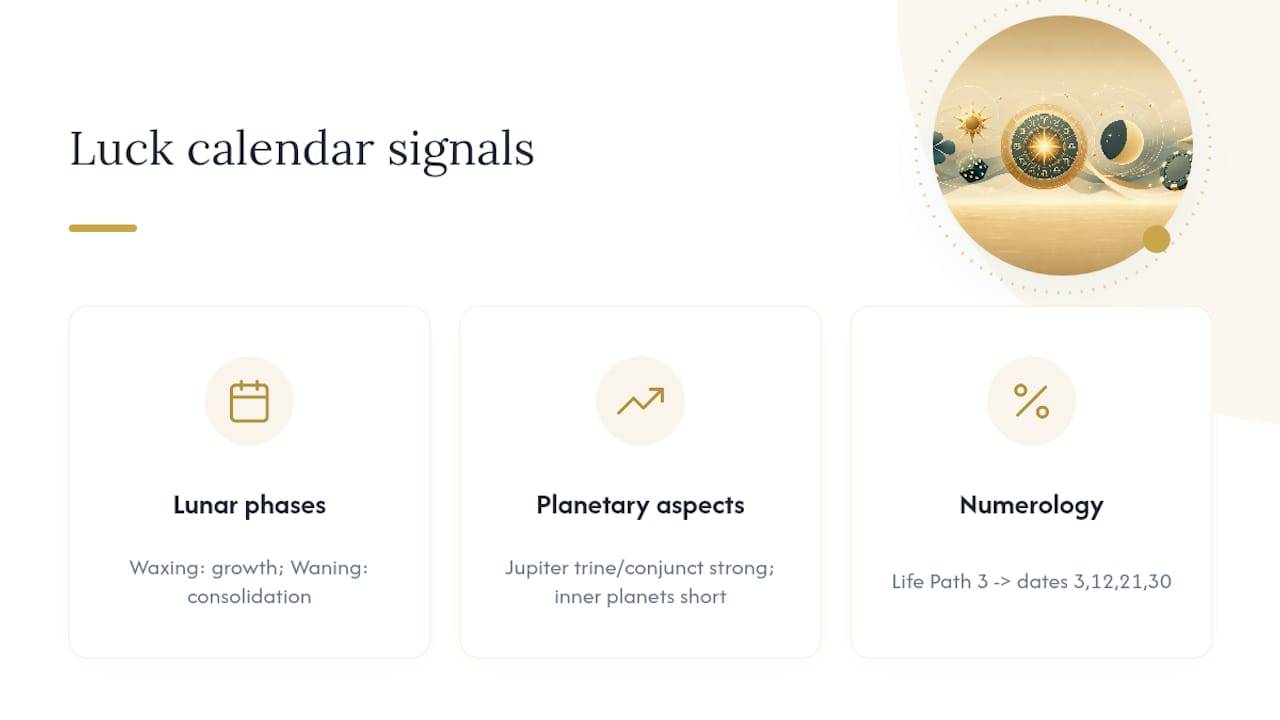
Moon phases and transits are the most frequently used signal. A waxing Moon (new to full) is traditionally associated with growth and expansion, making it favorable for games where you're building a pot or accumulating wins. A waning Moon favors consolidation, which maps better to conservative play or avoiding high-variance games altogether.

Planetary aspects and Jupiter transits are the second layer. Jupiter is the planet of expansion and fortune in both Western and Vedic astrology. When Jupiter forms a trine or conjunction with your natal Sun or Moon, most astrologers treat that as a high-confidence period. Inner-planet aspects (Venus trine your natal Venus, for example) tend to produce shorter windows, sometimes just a few hours.
Nakshatra and Tarabalam are Vedic concepts worth knowing briefly. Tarabalam measures the strength of the Moon's current Nakshatra relative to your birth Nakshatra. A strong Tarabalam reading means the Moon's position actively supports your natal chart. Calendareto's Lucky Days Calculator uses Muhurta principles including Tarabalam and Chandrabalam to compute favorable days from a birth chart, which is more precise than generic daily horoscopes.
Numerology rules work alongside planetary timing. Your Life Path number (derived from your birth date) has natural resonance with certain calendar dates. A Life Path 3 player finds dates that reduce to 3, 12, 21, or 30 naturally aligned.
When signals align vs. conflict: Cafe Astrology's Good Days Calendar flags days with multiple planetary icons as more energetically significant. A day showing both a harmonious Venus aspect and a favorable Moon phase is a stronger signal than either alone. A day where a harmonious aspect and a stressful one appear together is a mixed signal. On mixed days, lower your stakes and shorten your session.
Pro Tip: When you see three or more favorable icons on the same calendar date, that's the day to schedule your highest-priority session. One icon is a nudge; three is a signal worth acting on.
Three practical methods to generate lucky numbers you can actually play
The calendar tells you when to play. These three methods tell you what to play.
Method A: Birth-date numerology reduction
Add all digits of your full birth date until you reach a single digit. That's your Life Path number, and it's your anchor for number selection.
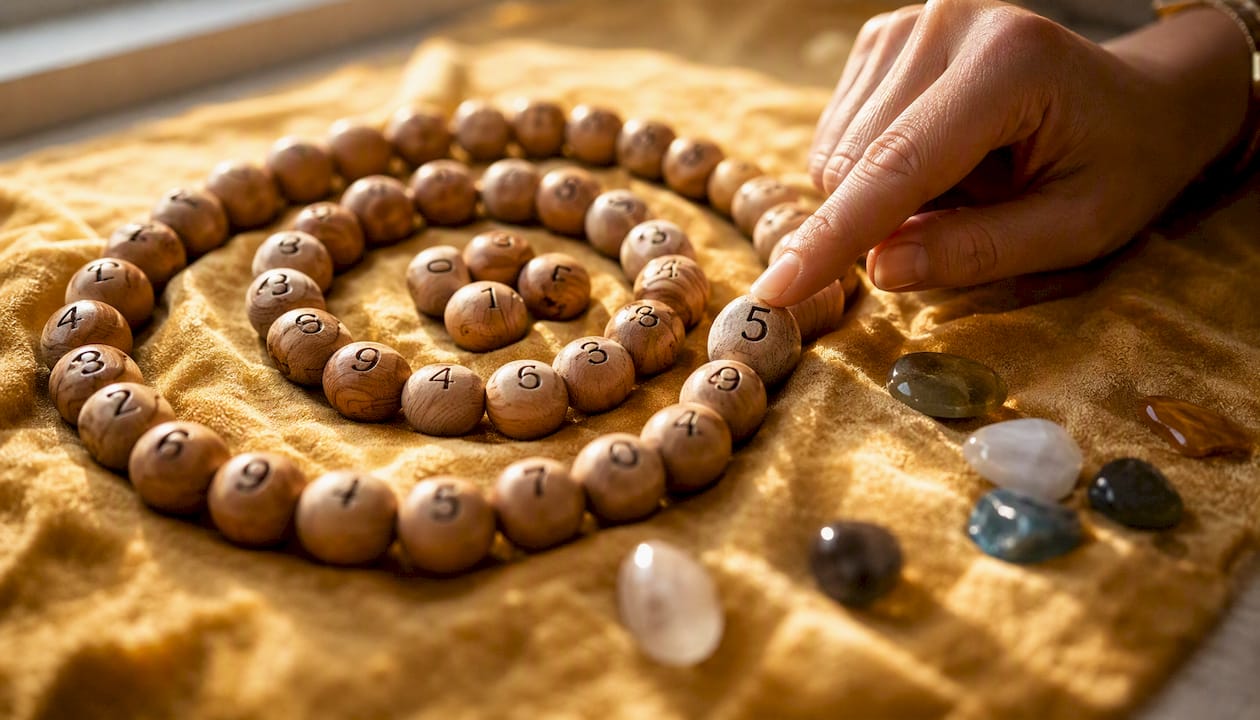
Example: Born March 14, 1990 → 3 + 1 + 4 + 1 + 9 + 9 + 0 = 27 → 2 + 7 = 9
A Life Path 9 player's core lucky numbers are 9, 18, 27, 36, and any number that reduces to 9. For a 6/49 lottery draw, you'd include at least two of these in your ticket. The 2026 numerology guide walks through daily number generation using this same reduction method.
Method B: Planetary ruler numbers
Each planet carries a classical number:
- Sun = 1, Moon = 2, Mars = 9, Mercury = 5, Jupiter = 3, Venus = 6, Saturn = 8
Find your sign's ruling planet, then build a number set around its digit. VedicDream's lucky-day calculator maps weekdays to planetary rulers and recommends scheduling important actions during the first hora after sunrise on that day, which classical Vedic practice treats as the most potent window.
Example: Sagittarius is ruled by Jupiter (3). A Sagittarius player on a Thursday (Jupiter's day) would favor numbers 3, 12, 21, 30, and 33 in their picks.
Method C: Quick mixed method
Combine your luckiest weekday's planetary number with your Life Path digit, then use a randomizer to fill the remaining picks.
Example: Life Path 9, playing on Friday (Venus = 6). Core picks: 9 and 6. Fill remaining slots with a randomizer or use a tool like Lottooracleapp's number generator. This hybrid approach keeps your personal numerology in the mix while avoiding the trap of playing only "meaningful" numbers and missing coverage.
- For lottery wheels that organize multi-number plays around these core picks, the lottery wheel systems guide shows how to structure your tickets efficiently.
- If you want an intuition-based layer on top of these methods, dream-derived numbers pair well with astrology picks.
Which games fit which astrological signals
Not every lucky day calls for the same game. The type of luck signal matters as much as its strength.
High-variance signals (strong Mars or Uranus aspects, fire-sign peak dates) favor lotteries and slots. These are short-burst, high-volatility games where a single outcome can be transformative. Fire signs (Aries, Leo, Sagittarius) on their peak dates tend to feel the pull toward these games naturally.
Patient, Jupiter-style days are better suited to low-house-edge games. Poker on a Jupiter day is particularly well-matched because Jupiter governs judgment and expansion, both useful at a poker table.
Practical tips by game type:
- Slots: Best on high-energy, fire-sign days. Set a hard stop-loss before you sit down. A 30-minute session cap on a "lucky" day prevents the common mistake of chasing after an early win.
- Roulette: Air and water signs (Libra, Aquarius, Cancer, Pisces) tend to favor roulette's rhythm. Stick to even-money bets (red/black, odd/even) on moderate-signal days; inside bets only on peak dates.
- Poker: Earth and water signs on Jupiter-influenced days. Patience and reads are rewarded. Poker tournament scheduling aligns well with this approach if you want to plan tournament entries around your peak dates.
- Lotteries: Any sign on its peak date. Buy your ticket during the first hora after sunrise for the classical timing advantage.
- Blackjack and table games: Earth signs (Taurus, Virgo, Capricorn) on Saturn or Mercury days. Basic strategy is non-negotiable regardless of how favorable the day looks.
When to avoid high-variance games even on a "lucky" day: If your calendar shows a mixed signal (one harmonious and one stressful planetary icon), skip lotteries and slots entirely. A mixed day is fine for low-variance play but not for swinging for a jackpot.
Weekdays often have fewer crowds and can carry operator promotions, which Harrington Raceway & Casino notes as a practical timing advantage independent of astrology.
Practical rules for using lucky days: planning, bankroll, and responsible play
The calendar is only useful if you use it with discipline. Here's a simple framework.
- Mark your dates at the start of each month. Pull your sign's luckiest weekdays and the peak date. Block those sessions in your calendar the same way you'd schedule anything else.
- Set a session bankroll before you look at the luck reading. The bankroll comes from your entertainment budget, not from the confidence level of the day. A high-confidence day does not justify a larger stake.
- Use the luck signal to decide whether to play, not how much. On a low-signal day, skip the session or reduce it to a minimum. On a high-signal day, play your normal session. Never scale up because the stars look good.
- Apply the three-loss rule. Three consecutive losses in a session is a stop signal, regardless of what the calendar says. Luck signals are probabilistic tendencies, not session guarantees.
- Review monthly. At the end of each month, compare your session log against the calendar. Did high-signal days produce better outcomes than low-signal ones? That review is the only honest way to know if the calendar is adding value for you personally.
Responsible-gambling checklist:
- Play only with money you can afford to lose entirely.
- Set time limits before each session, not during.
- Never chase losses on a "lucky" day. The day's energy doesn't reset after a loss.
- If gambling stops feeling like entertainment, contact the National Problem Gambling Helpline at 1-800-522-4700.
Superstitions and rituals are pervasive in casino culture and can affect player confidence, as Tachi Palace's overview of casino superstitions notes. Confidence is real; it can improve decision-making. But it doesn't move the odds. Keep both things true at once.
How to track and test your luck calendar over time
A luck calendar you never test is just a decoration. Here's a simple logging workflow that tells you whether the signals are correlating with your results.
- Log every session. Date, your sign's signal level for that day (high/medium/low/mixed), game played, starting stake, ending balance, and one note about how the session felt.
- Rate signal confidence. High = peak date or luckiest weekday with multiple planetary icons. Medium = luckiest weekday, no additional signals. Low = any other day. Mixed = conflicting icons.
- Tally monthly. After 20+ sessions, calculate your average outcome (win/loss as a percentage of stake) for each signal level. If high-signal days are consistently outperforming low-signal days, that's a pattern worth continuing to track.
- Adjust the calendar. If a particular weekday is consistently underperforming for your sign, downgrade it. If a game type is consistently better on certain signal days, note that in your profile.
Sample log template:
| Date | Signal Level | Game | Stake | Outcome | Notes |
|---|---|---|---|---|---|
| July 15 | High | Lottery | $20 | +$45 | Peak date, first hora |
| July 16 | Low | Slots | $30 | -$30 | Off-day, should have skipped |
| July 17 | Medium | Blackjack | $50 | +$10 | Steady session |
Pro Tip: Don't draw conclusions from fewer than 20 sessions. With small samples, random variance looks exactly like a pattern. Track for at least two months before deciding the calendar is or isn't working for you.
The probability basics guide explains why small-sample patterns are unreliable and how to think about luck calendars as entertainment tools rather than predictive systems.
Methodology and credibility: how this calendar was built
Sources used to build the calendar:
- Traditional good-days calendars (Cafe Astrology's planetary-icon system)
- Vedic Muhurta principles including Tarabalam, Chandrabalam, and Nakshatra strength
- Moon-phase overlays (waxing/waning, full/new Moon timing)
- Classical weekday-to-planet mappings (Vedic and Western)
- Numerology reduction rules (Pythagorean system)
- Editorial calibration against published 2026 sign-specific peak dates
What this calendar is not:
- A system that improves your mathematical odds. It doesn't.
- A substitute for responsible bankroll management.
- A guarantee of any outcome on any date.
This calendar is an entertainment and planning tool. The peak dates in the sign-by-sign table are drawn from published astrological sources and editorial consensus, not proprietary algorithms. The weekday mappings reflect classical planetary rulership, a system with centuries of use in timing-based decision-making.
Limitations: Astrological signals are interpreted, not calculated with mathematical precision. Two astrologers can read the same transit differently. The calendar above represents one coherent interpretation of 2026 planetary movements applied to gambling timing. Treat it as a starting point for your own tracking, not a final authority.
For readers who want to understand how algorithmic prediction tools integrate with astrology-based timing, the AI lottery predictions guide covers what those systems do and don't do.
Why I use luck calendars as a planning tool, not a prediction system
The most common mistake people make with a luck calendar for gambling is treating a high-signal day as permission to play bigger. That's backwards. The calendar's real value is in the no days. Knowing that Wednesday is a low-signal day for your sign gives you a reason to skip a session you might otherwise have played out of habit or boredom. That's where the calendar actually saves money.
The psychological side is real too. Rituals and timing frameworks give players a sense of structure, and structure tends to produce better decisions than impulsive play. If marking your lucky days on a calendar means you play fewer, more deliberate sessions, the calendar has done its job regardless of whether Jupiter was actually in a favorable position.
Where I'd push back on the typical luck calendar article: most of them present the weekday mappings as settled fact without acknowledging that different astrological traditions disagree. Vedic and Western astrology don't always assign the same lucky days to the same signs. The table above uses the most widely cited Western gambling horoscope mappings, but if you have a detailed Vedic birth chart, Tarabalam calculations from a tool like Calendareto may give you a more personalized read.
The honest version of this: use the calendar to plan, track your results honestly, and let the data tell you whether it's adding value. Two months of logs will tell you more than any single peak date.
Lottooracleapp puts your luck calendar on autopilot
Marking dates manually works, but it's slow. Lottooracleapp generates personalized lucky numbers using your zodiac sign, numerology profile, and historical pattern analysis, then delivers daily luck readings so you always know where you stand before a session.
The app's daily notifications flag your high-signal days automatically, so you're not cross-referencing planetary calendars every morning. The built-in logging feature tracks your sessions against your luck profile, which means the monthly review described above happens inside the app rather than in a spreadsheet. The subscription model gives you unlimited number generation, trend analysis, and sports matchup overlays, all in one place.
If you've been using a luck calendar manually and want the tracking and number generation handled for you, try Lottooracleapp and see how your sign's signals look today. Lottooracleapp is an entertainment platform. It does not sell lottery tickets or guarantee any gambling outcome.
Sources
These are the primary sources used to build this calendar, organized by what they give you.
Calculators and personalized tools:
- Good Days Calendars | Cafe Astrology .com
- Is Today My Lucky Day to Gamble? · Free (2026) · Toolita
- 2026 astrology days lucky dates by sign
- Gambling Horoscope 2026 | Lucky Days To Gamble
Good-days calendars and sign-specific peak dates:
Gambling horoscopes and entertainment tools:
Responsible gambling: