
Responsible gambling in Canada means treating gambling as entertainment, not income, and staying inside limits you set before you play. If you're worried about your own play or a family member's, do three things now: set a firm money and time limit, use your province's self-exclusion or break tool if you need a harder stop, and call a provincial helpline if things feel out of control. Groups like the Responsible Gambling Council and Ontario's AGCO exist specifically to make those three steps easy to find.
TL;DR:
- Setting a monthly gambling limit, avoiding game variety, and not gambling to escape stress are key to staying within safer gambling guidelines, especially for those without mental health risks.
- Provinces offer free, confidential resource centers, self-exclusion tools, and counseling options that should be used immediately if gambling behavior feels out of control.
- Enforced protections on licensed Canadian sites include mandatory limits and effective self-exclusion, unlike unregulated sites that lack enforceable safeguards.
- Managing shared finances and seeking guidance from helplines or counselors can help families act early and prevent gambling-related crises.
- Responsible gambling is about enjoying entertainment without risking financial stability, and tools like Lotto Oracle complement limits by promoting mindful play.
Table of Contents
- Where To Find Help Right Now in Canada
- The Lower-Risk Gambling Guidelines, Explained Simply
- How To Use Self-Exclusion and Limit Tools in Canada
- Getting Treatment, Counseling, and Financial Support
- Regulated vs. Unregulated Gambling Sites: Why the Difference Is Real
- What Families and Friends Can Do Right Now
- Why Responsible Play Actually Matters to Us
- A More Mindful Way To Play the Lottery
- Sources
Where To Find Help Right Now in Canada
If you're reading this because something feels off, tonight, not next week, is the right time to act. Every province runs some version of a player resource centre, and most of them are free, confidential, and staffed by people trained for exactly this conversation.
- GameSense Info Centres (Alberta) put trained advisors on casino floors to talk through limits and warning signs in real time.
- PlaySmart Centres (Ontario) do the same job at OLG properties, with tools for tracking spending and setting personal limits.
- RGIC (Responsible Gaming Information Centres, New Brunswick) and Centre du hasard kiosks (Québec) fill the same role regionally.
- In the territories, where physical centres are scarce, toll-free lines cover the gap, including Northwest Territories 1-800-661-0844 and Nunavut's Kamatsiaqtut Help Line at 1-800-265-3333.
If someone is in immediate crisis, danger to themselves, or in a medical emergency tied to gambling losses, call 911 or your local emergency line first. For everything short of that, the Responsible Gambling Council's help directory links you to the right provincial contact in under a minute.
The Lower-Risk Gambling Guidelines, Explained Simply
Canada has an actual research-backed standard for what "safer" gambling looks like, and it's shorter than most people expect. The Lower-Risk Gambling Guidelines boil down to three rules.
The three guidelines: gambling on no more than a few days per month, avoiding regular play on more than a couple of types of games, and never gambling to escape stress, grief, or other personal problems.
The logic behind each rule is simple. Frequency caps prevent gambling from becoming a daily habit that quietly reshapes your routine. Limiting game variety keeps you from chasing losses across multiple formats at once, which is how a bad night on scratch tickets turns into a worse night on slots. And the "don't use it to escape" rule exists because gambling that numbs emotional pain tends to escalate faster than gambling done purely for fun.
Turning this into a real budget looks like:
- Set a hard monthly dollar cap (say, $60) and withdraw only that amount in cash.
- Pick one or two game types, lottery tickets and one casino game, rather than rotating through five.
- Treat any gambling session driven by a bad day at work or a fight at home as a signal to stop, not a reason to play longer.
One caveat matters here: these guidelines assume a baseline of good mental health. People managing substance use, anxiety, depression, or a history of problem gambling should apply stricter limits than these, or avoid gambling entirely, according to risk-population guidance from the RGC.
How To Use Self-Exclusion and Limit Tools in Canada
Ontario runs two separate self-exclusion systems, and knowing which one applies to you matters. BetGuard covers provincially regulated private online gaming sites, the sportsbooks and casino apps licensed through iGaming Ontario. OLG's My PlayBreak covers OLG-run channels directly, including lottery and OLG.ca. Other provinces run their own equivalents through their lottery corporations.
Signing up follows roughly the same path everywhere:
- Visit your provincial program's site (BetGuard or My PlayBreak for Ontario residents) and choose a self-exclusion length, typically 6 months, 1 year, or 5 years.
- Confirm your identity so the exclusion applies across every account tied to you, not just one site.
- Expect immediate account blocking once enrollment processes, usually within a few business days.
- Watch for a follow-up contact with links to counseling and support resources, since self-exclusion is meant to pair with help, not replace it.
Most operators also offer softer tools that don't require full exclusion: deposit limits, loss limits, wager caps, and session time reminders, all set from your account dashboard.
Pro Tip: Set a deposit limit and a session-time reminder before you ever place a bet, not after a losing streak. Limits set in a calm moment hold up far better than ones set mid session.
Extending or lifting an exclusion typically requires a waiting period and, for longer exclusions, direct contact with the program, deliberately designed to prevent an impulsive reversal.
Getting Treatment, Counseling, and Financial Support
Every province funds addiction and mental health services that treat problem gambling the same way they'd treat any other addiction, through publicly funded counseling, not private-pay clinics only. Your provincial health authority's website lists intake numbers, and most responsible gambling helplines can refer you directly to a counselor without a long wait.
If money has already been lost, the immediate priorities are damage control, not damage reversal:
- Freeze or cancel cards linked to gambling accounts and call your bank to flag the accounts.
- Build a bare-bones crisis budget covering rent, food, and utilities before anything else.
- Reach out to a nonprofit credit counselor if debt from gambling is piling up.
One thing worth saying plainly: there's no legal refund mechanism for gambling losses tied to mental health struggles. The Responsible Gambling Council is direct about this: the path forward is financial and emotional counseling, not a claim against the operator.
Regulated vs. Unregulated Gambling Sites: Why the Difference Is Real
Playing on a site licensed in your province isn't a formality. It's the difference between having enforceable protections and having none. Section 207 of the Criminal Code gives provinces the authority to license and run lotteries and gaming, and that legal structure is what makes provincial oversight enforceable in the first place.
Regulated Canadian sites, overseen by bodies like AGCO and iGaming Ontario, are required to build in specific protections:
- Mandatory deposit, loss, and session limits available on every account.
- Self-exclusion options that actually work across the operator's full platform.
- Advertising rules that restrict how aggressively operators can market to you.
- Dispute resolution processes if a payout or account issue goes wrong.
Offshore or unregulated sites offer none of this by enforceable right. If a payment gets stuck or a dispute arises, you have no regulator you can appeal to. Checking whether a site is licensed in your province takes about thirty seconds: look for the operator's name on your provincial regulator's registered list before you deposit a dollar, a step worth taking before checking provincial legality for sports betting too.
What Families and Friends Can Do Right Now
If you're worried about someone you love, the instinct to wait and watch usually costs more time than it saves. A few concrete moves matter more than a perfect conversation.
- Secure shared finances first: separate joint accounts if needed and keep an eye on shared cards.
- Raise the topic without accusation. "I've noticed you seem stressed about money lately" opens more doors than "You have a gambling problem."
- Call a provincial helpline yourself for guidance on how to approach the conversation before you have it.
- Loop in a financial advisor or counselor early if debt is already involved, rather than waiting for a crisis point.
Pro Tip: You don't need the person to admit a problem before you act. Protecting shared finances and getting your own guidance from a helpline are steps you can take independently, starting today.
Why Responsible Play Actually Matters to Us
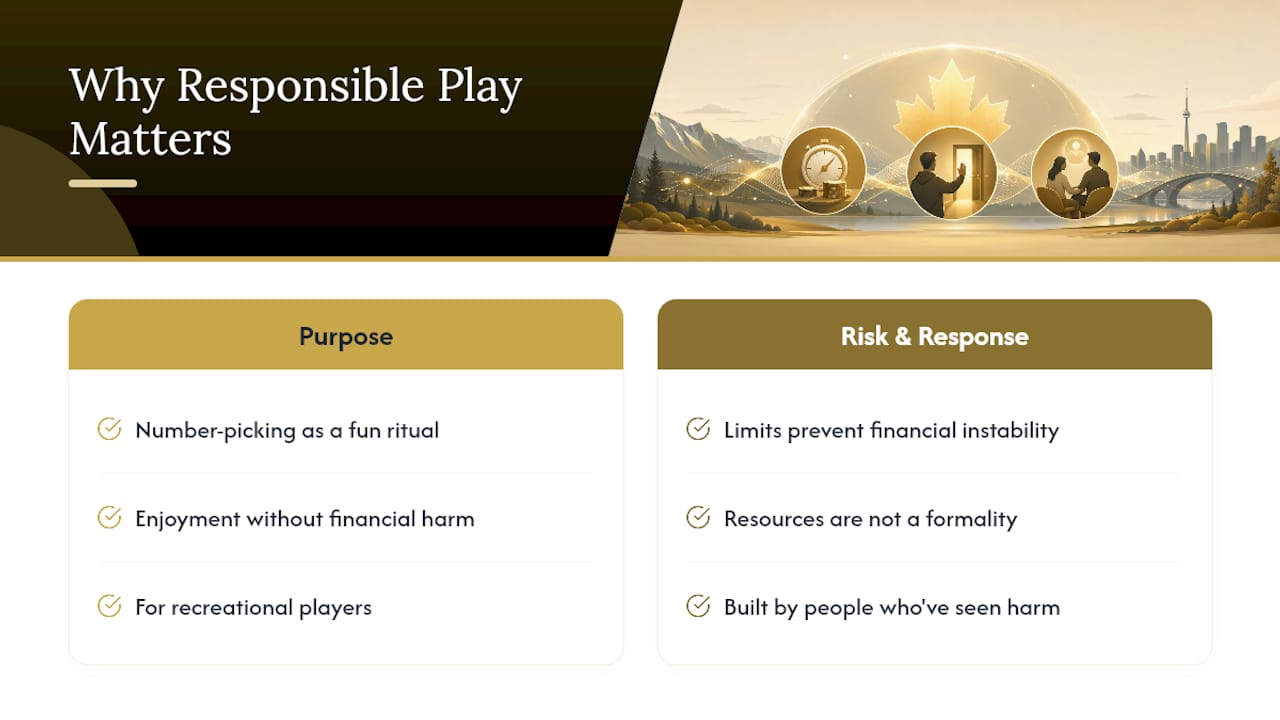
Lotto Oracle exists because picking numbers can be genuinely fun, a little ritual of hope and pattern-spotting that doesn't need to cost anyone their financial stability. We built this app for people who enjoy the game, not people trying to solve their money problems through it. If any part of this article felt uncomfortably familiar, that's worth sitting with. The resources above aren't a formality; they're built by people who've watched what happens when limits disappear.
A More Mindful Way To Play the Lottery
Lotto Oracle gives you a way to engage with lottery play that's built around curiosity and routine, not chasing losses. The app generates personalized number suggestions using astrology, numerology, and pattern analysis, tracks trends over time, and adds a daily luck reading you can check the way you'd check a horoscope. It doesn't sell tickets and it isn't a treatment tool for problem gambling; it's an entertainment layer that sits on top of the limits you've already set using the guidelines above.
Used well, it pairs naturally with the four-day, two-game-type framework from the Lower-Risk Guidelines: pick your numbers through the app once, set your budget, and stop. If you're curious what a prediction tool can realistically do (and what it can't), our breakdown of AI lottery predictions is worth a read before you subscribe. When you're ready, you can check out the app and its privacy details at Lotto Oracle.