
Yes. Single-event sports betting is legal in Canada, and has been since August 27, 2021, when Bill C-218 took effect. Justice Canada and the Canada Gazette confirm the change: betting on the outcome of a single game, not just multi-game parlays, is now permitted under the Criminal Code. What the federal government did not do is build a national sportsbook. Every province and territory decides how betting gets offered, who runs it, and how old you need to be. Ontario built a competitive private market. British Columbia routes everything through PlayNow.
- Federal law: sets the outer boundary (single-event betting allowed)
- Provincial regulators: decide the operator model, platform, and minimum age
- Result: your legal options depend entirely on where you live
Before C-218, Canadians were pushing an estimated $10 to $14 billion a year through offshore and black-market books. That money sat outside any consumer protection, tax base, or licensing oversight, which is a big part of why Ottawa moved on this.
Key Takeaways
Single-event sports betting has been federally legal across Canada since August 27, 2021, but each province controls its own licensing, platform, and minimum age.
| Point | Details |
|---|---|
| Federal law sets the floor | Bill C-218 legalized single-event betting nationwide, effective August 27, 2021. |
| Provinces control access | Your legal options and minimum age depend entirely on which province you're in. |
| Ontario is the exception | It's the only province with a competitive private-operator licensing model. |
| Horse racing stays separate | CPMA regulates pari-mutuel wagering federally, outside the C-218 framework. |
| Prediction apps aren't sportsbooks | Lottooracleapp offers entertainment and pattern insights; actual wagers still go through licensed operators. |
Table of Contents
- What Bill C-218 Changed in the Criminal Code
- Where Can You Legally Bet on Sports in Each Province?
- How Does Online Sports Betting Actually Work in Canada?
- Why Is Horse Racing Regulated Differently?
- What Risks Come From Black-Market and Offshore Sites?
- How Do Prediction Apps Fit Alongside Legal Sports Betting?
- What the Legal Patchwork Actually Means for You
- A Different Kind of Tool for Canadian Bettors
- Frequently Asked Questions About Sports Betting Legality in Canada
- Sources
What Bill C-218 Changed in the Criminal Code
For decades, Canadian law only allowed parlay betting, meaning you had to correctly pick outcomes across multiple games to win anything. Betting on a single game outcome, the way most casual bettors actually want to bet, was a criminal offense. Bill C-218 fixed that by striking out a few words in paragraph 207(4)(b) of the Criminal Code, removing the "not including a single sport event or athletic contest" restriction that had blocked single-game wagers for so long.
The bill received royal assent in June 2021, but a law needs a coming-into-force order to actually take effect. The Canada Gazette published that order, locking in August 27, 2021 as the date the amendment became enforceable.
The amendment did one specific thing: it let provinces authorize single-event sports betting through their own lottery and gaming systems. It did not create a federal licensing body, a national operator, or a single set of rules everyone follows.
Here's how the responsibilities actually split:
- Federal government: amends criminal law, sets the outer legal boundary, retains oversight of pari-mutuel horse racing
- Provincial and territorial governments: license operators, set the legal age, choose between lottery-run or private-operator models, enforce geolocation
- Canadian Pari-Mutuel Agency (CPMA): keeps regulating horse-race wagering federally, separate from everything C-218 touched
That federal-provincial split explains almost every confusing thing you'll read about Canadian sports betting law. The Criminal Code says single-event betting is allowed nationwide. It says nothing about which app you can actually download in Alberta versus Quebec.
Where Can You Legally Bet on Sports in Each Province?
Legal nationwide doesn't mean identical nationwide. Each province picked its own model, and the differences matter the moment you try to deposit money.
Ontario is the outlier worth understanding on its own. Since April 2022, it's run an open, competitive market where multiple private operators can apply for a license through iGaming Ontario, alongside the government's own OLG PROLINE+ platform. That's why you'll see far more sportsbook brands advertising in Ontario than in Manitoba or Nova Scotia, where the lottery corporation is the only legal game in town.
Everywhere else, the provincial lottery corporation runs a single branded platform, and that's your only fully regulated online option. Quebec's Mise-o-jeu stands out for setting the legal age at 18 rather than 19, matching the province's general age of majority.
Before you deposit a dollar anywhere, run through a short checklist:
- Confirm the platform is listed on your province's official lottery or gaming regulator site, not just a search result
- Check that the site domain matches what your provincial regulator publishes (scam sites frequently clone real branding)
- Expect geolocation prompts. If a site lets you sign up without ever confirming your physical location, that's a red flag
- Verify the minimum age matches your province, since 18 in Quebec doesn't carry over to Ontario's 19
How Does Online Sports Betting Actually Work in Canada?
Geolocation is the mechanism that makes provincial control real rather than theoretical. Every licensed betting app uses location services, and sometimes IP-address checks layered on top, to confirm you're physically inside the province that licensed it. Cross a provincial border with your phone, and PlayNow simply stops working until you cross back.

Licensing itself follows two models. Most provinces run a single lottery-operated platform (BCLC's PlayNow, Loto-Québec's Mise-o-jeu). Ontario runs a private licensing model instead, reviewing and approving individual operators through its regulator before they can legally advertise or accept Ontario bettors.
To confirm any operator's standing before you sign up:
- Search your province's official gaming regulator site for a current list of licensed operators
- Cross-check the operator's domain name against that list character for character
- Look for a visible license number or regulator logo on the operator's own site, not just a claim in the footer
- Try the app while briefly outside your home province. If it still lets you place a bet, be suspicious rather than pleased
Pro Tip: Bookmark your provincial regulator's operator list now, before you need it. Offshore sites are very good at mimicking the look of real ones, and the list is the fastest way to tell them apart.
Why Is Horse Racing Regulated Differently?
Horse racing never fell under the old single-event betting restriction because it already had its own system: pari-mutuel wagering, where bettors' money goes into a shared pool and payouts are calculated from that pool rather than fixed odds set by a bookmaker.
Bill C-218 left that system alone entirely. The Canadian Pari-Mutuel Agency continues to regulate pari-mutuel horse racing at the federal level, independent of whatever your province decided about single-event sports betting.
- Horse racing bets run through CPMA-approved pools, not provincial sportsbooks
- The rules and licensing sit with a federal agency, not your provincial lottery corporation
- Bettors researching racing rules should check CPMA's own guidance rather than a provincial gaming site
What Risks Come From Black-Market and Offshore Sites?
Legal, regulated platforms exist for a reason beyond convenience. Offshore sportsbooks operate outside any Canadian consumer protection framework, meaning disputed payouts, frozen accounts, or data misuse have no regulator to appeal to. The billions Canadians spent offshore before 2021 went through exactly that kind of unregulated pipeline, often flowing toward operators with no accountability to Canadian law at all.
A few checks protect you every time:
- Confirm the operator appears on your province's official licensed-operator list before depositing anything
- Look for a secure, verifiable payment process rather than crypto-only or unusual wire transfers
- Treat any site that skips age or location verification as a serious warning sign
- Save the number for your provincial problem gambling helpline before you ever place a bet, not after
If betting stops feeling like entertainment, ConnexOntario and similar provincial services offer confidential support, and every regulated operator is required to link to resources like these directly on their platform.
How Do Prediction Apps Fit Alongside Legal Sports Betting?
Lottooracleapp doesn't take bets, process wagers, or touch your money. It's an entertainment and pattern-analysis tool that layers astrology, numerology, and historical trend data onto lottery numbers and sports matchups, giving subscribers a different angle to think about before they place any wager through an actual licensed operator.
- Predictions are a lens for interest and discussion, not a guarantee tied to real odds
- Responsible use means setting your own budget first, then treating any prediction as one input among many
- Actual wagers still need to go through a provincially licensed sportsbook like PlayNow, PROLINE+, or Mise-o-jeu
Pro Tip: Never let a prediction score talk you into betting more than you planned. Treat it the way you'd treat a friend's tip, interesting, but not a reason to abandon your limit.
For readers who want to dig deeper into how these tools work and where their limits are, Lottooracleapp's blog covers what AI lottery predictions do and don't do, and BetsyScore has a solid breakdown of how fans and bettors should interpret prediction data generally.
What the Legal Patchwork Actually Means for You
The most overlooked part of this whole story isn't the legal change itself, it's how little that change actually simplified things for the average bettor. People hear "sports betting is legal now" and assume one national app, one set of rules, one age limit. That's not what happened. Ottawa handed the keys to ten provinces and three territories, and most of them built different cars.
The conventional advice, "just check if it's legal in Canada," misses the real question, which is whether it's legal in your specific province, on this specific platform, at your specific age. Quebec bettors get in a year earlier than Ontario bettors. British Columbia residents have zero private-operator choice, while Ontario residents have dozens.
If there's one thing worth prioritizing above everything else in this article, it's the habit of checking your provincial regulator's operator list before every new platform, not just the first time. Rules and licensed operators shift; your verification habit shouldn't.
A Different Kind of Tool for Canadian Bettors
Legal sportsbooks handle the wagering. Lottooracleapp handles the fun part before you get there. It's not a betting site and never will be, it's a subscription app built for people who enjoy thinking through numbers, patterns, and matchups before they check the actual odds on a licensed platform.
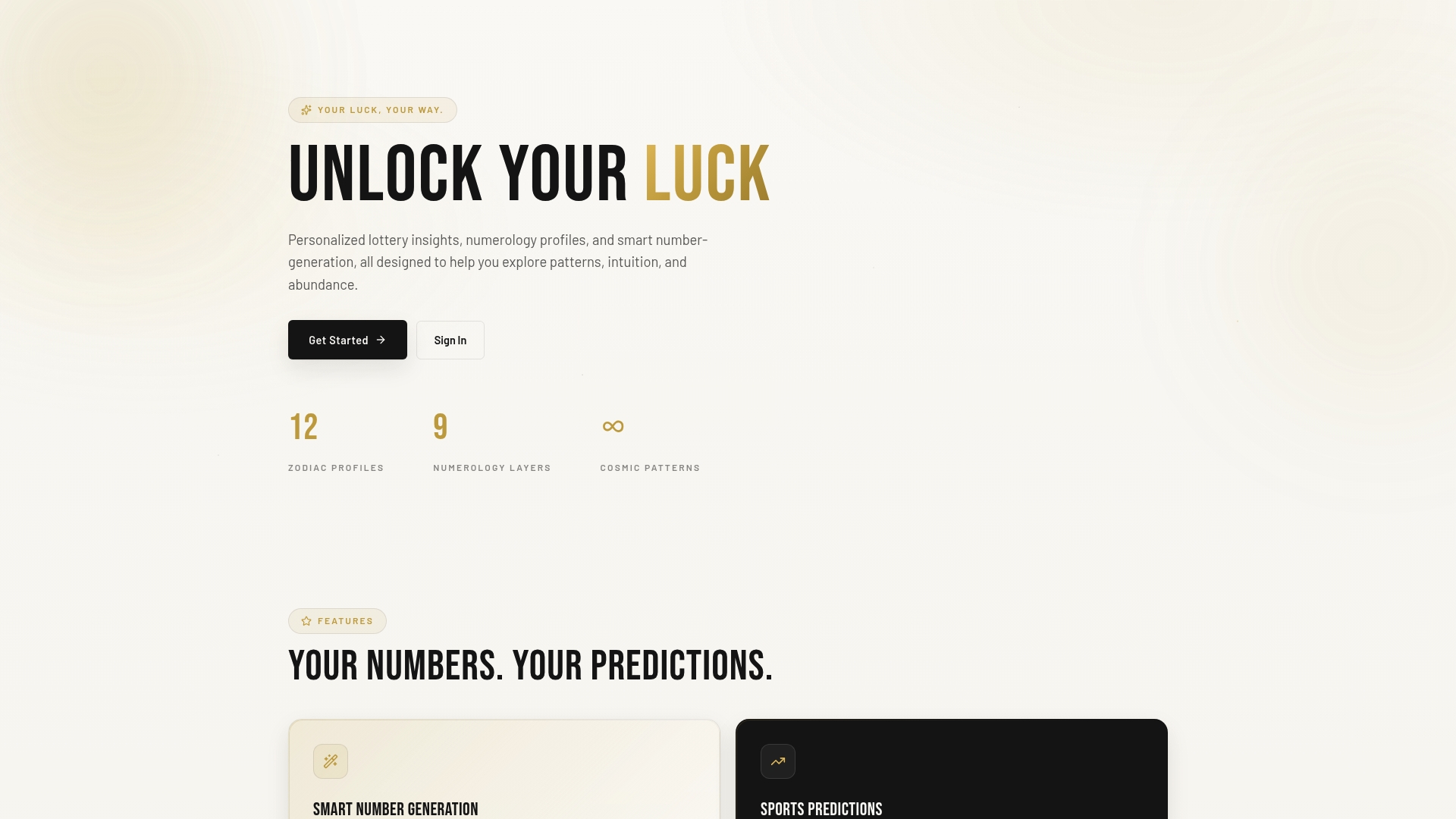
Subscribers get personalized lottery number insights blending numerology and historical pattern tracking, daily luck readings that add a little ritual to game day, and sports matchup overlays that give you something to compare against the lines your provincial sportsbook actually posts. None of it replaces PlayNow, PROLINE+, or Mise-o-jeu, it just makes the lead-up more interesting. If you already enjoy tracking trends or reading your daily numbers before checking a betting slip, start a Lottooracleapp subscription and see how the predictions line up with your own instincts this week.
Frequently Asked Questions About Sports Betting Legality in Canada
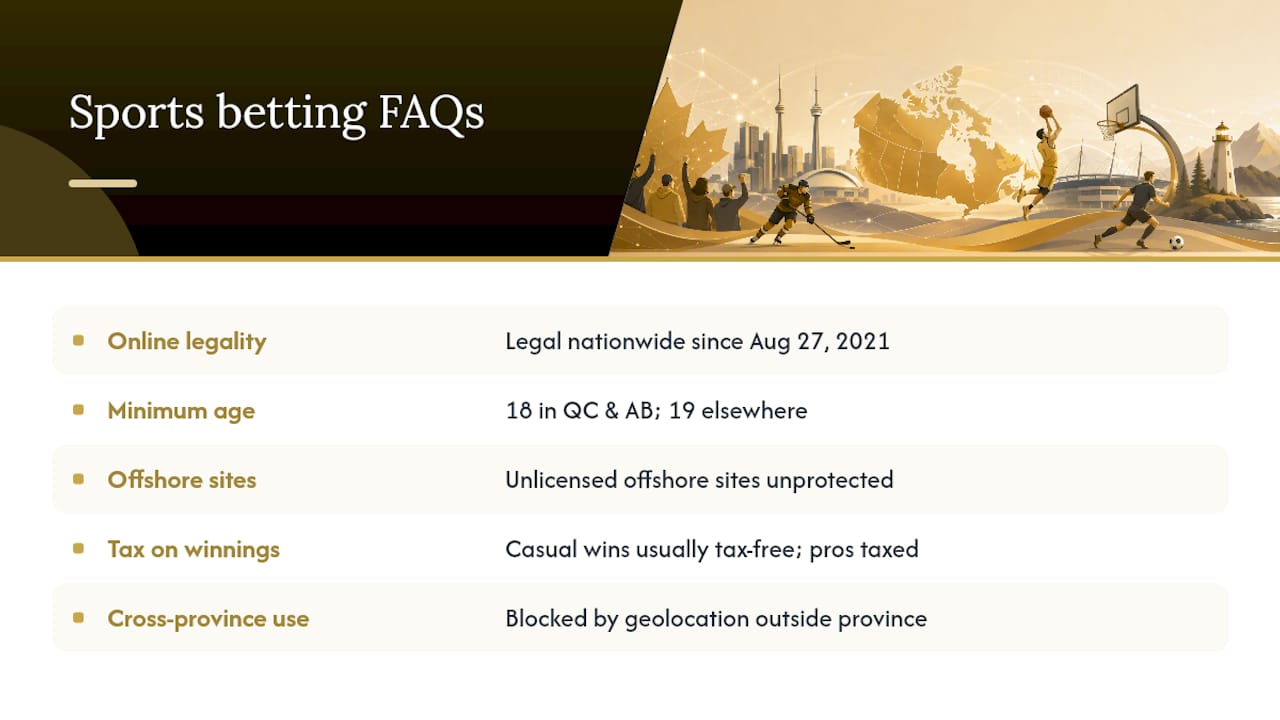
Is online sports betting legal in Canada right now? Yes. Single-event and parlay sports betting are both legal nationwide since August 27, 2021, but which specific apps you can legally use depends on your province.
What's the minimum sports betting age requirement in Canada? It varies by province. Quebec and Alberta set it at 18, while Ontario, British Columbia, Manitoba, Saskatchewan, and the Atlantic provinces require bettors to be 19.
Are offshore sportsbooks illegal for Canadians to use? Using an unlicensed offshore site carries no legal protection under Canadian consumer or gaming law, and these platforms sit entirely outside provincial oversight. Sticking to provincially licensed operators is the safer route.
Do you pay tax on sports betting winnings in Canada? Casual bettors generally don't owe income tax on gambling winnings in Canada, since the Canada Revenue Agency treats recreational wins as windfalls rather than income. Professional gamblers who bet as a business face different rules, and Lottooracleapp's breakdown of lottery winnings tax covers the distinction in more detail.
Can I use a betting app licensed in one province while visiting another? No. Geolocation technology blocks access the moment you leave the province that licensed the platform, regardless of where your account was originally created.
Does federal legalization mean every province offers private-operator betting? No. Only Ontario currently runs a full private-operator licensing market. Every other province and territory offers betting exclusively through its own lottery-run platform, such as PlayNow or Mise-o-jeu.
This article is general information, not a substitute for advice from a qualified lawyer. Consult a qualified legal professional about your own circumstances before acting on anything here.
Sources
- Canada
- Justice
- Canada legalizes single-game sports betting, opening up billion-dollar market - CBC News
- Best Canadian Sports Betting Sites & Apps for August 2026 - Legal Sports Report