
Cap your subscription spend at a fixed monthly allotment pulled from your entertainment budget, never from bills or savings, and start with a trial month before committing longer. A workable range for most players is a modest monthly amount or a reasonable portion of whatever you already set aside for entertainment. Add two rules on top of that number: one-in/one-out (a new subscription only starts after an old one ends) and a calendar reminder a few days before every renewal so you decide instead of getting billed by default.
- Set a fixed dollar cap before you subscribe to anything
- Use a dedicated prepaid card or wallet so the app can't touch your main account
- Try Lotto Oracle's entry tier for a full billing cycle before upgrading
Pro Tip: A household audit from Consumer Reports found combined streaming subscriptions often reach $70 a month, or roughly $840 a year, once you count every small charge. Lottery prediction subscriptions creep the same way if you never total them up.
Key Takeaways
A fixed monthly allotment, tested through a one-month trial and protected by a one-in/one-out rule, is the single most reliable way to budget for a lottery prediction subscription.
| Point | Details |
|---|---|
| Set a hard cap first | Choose $5 to $25 a month or 5% to 15% of your entertainment budget before subscribing to anything. |
| Convert annual to monthly | Convert every annual price into its monthly equivalent before comparing it against your allotment. |
| Enforce one-in, one-out | Cancel an existing subscription before adding a new one to prevent quiet cost creep. |
| Set renewal reminders | Add a calendar alert 3 to 5 days before billing so you control the decision, not the auto-renew. |
| Test before you commit | Lotto Oracle's tiered plans let you trial the entry tier and track usage before upgrading to annual billing. |
Table of Contents
- How Do You Calculate Your Monthly Lottery Budget?
- What Pricing Models Do Lottery Apps Use?
- How Do You Stop Subscription Creep?
- How Do You Know If a Subscription Is Worth It?
- Does Lotto Oracle Fit These Budgeting Rules?
- Try Lotto Oracle Within Your Own Budget Rules
- Frequently Asked Questions
- Sources
How Do You Calculate Your Monthly Lottery Budget?
Start by separating your entertainment budget from everything else. Rent, groceries, debt payments, and savings contributions never touch this number. What's left over for movies, hobbies, streaming, and games is the pool a prediction subscription draws from.
Two methods work well, and both take about five minutes.
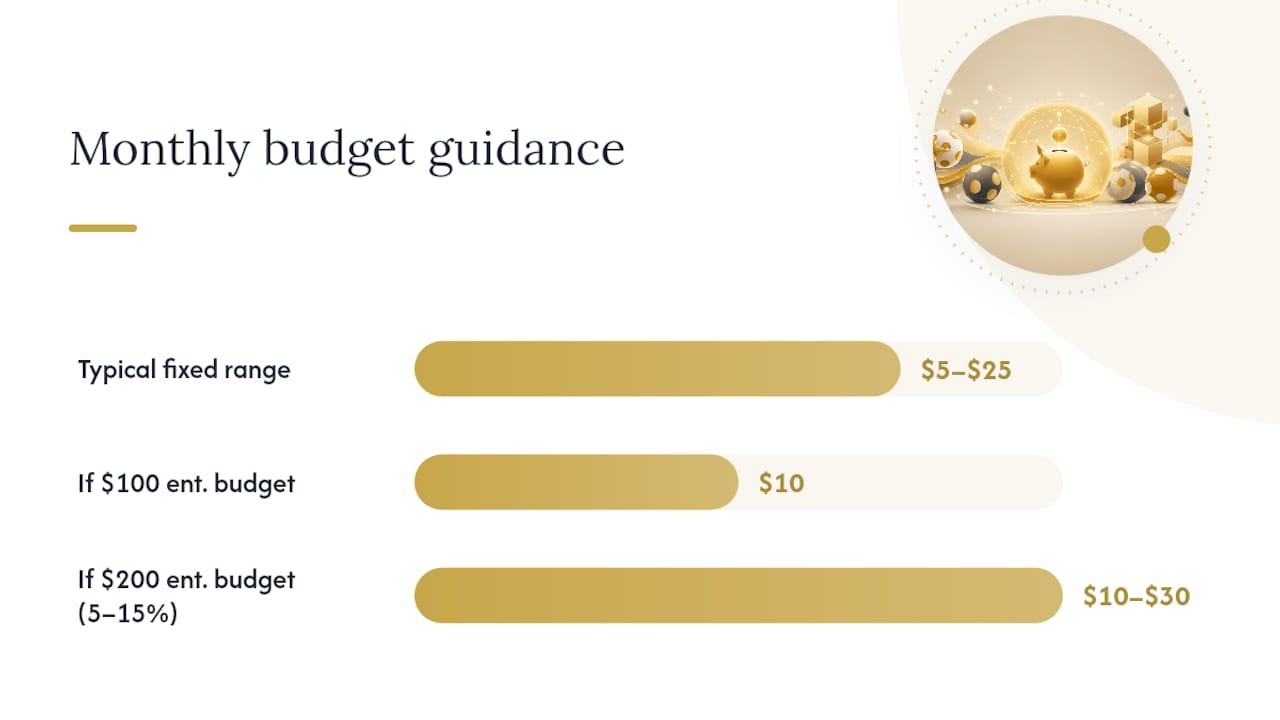
- Fixed-dollar method. Pick a flat number you're comfortable losing without a second thought, typically $5 to $25 a month depending on your overall entertainment pool. If your entertainment budget is $100 a month, $10 for a prediction app is a reasonable slice.
- Percentage method. Take 5% to 15% of your total entertainment spending and dedicate it to the subscription. A $200 monthly entertainment budget puts your ceiling between $10 and $30.
Annual plans complicate this because the sticker price looks smaller than it is. Stripe's guidance on subscription pricing recommends converting every annual price into its monthly equivalent before comparing it against your allotment.
Once you convert the annual number, compare it directly against your fixed-dollar or percentage cap. If the monthly equivalent still fits under your ceiling, the annual plan is often the better deal, as long as you're confident you'll use the app long enough to justify locking in a full year.
What Pricing Models Do Lottery Apps Use?
Most subscription products, including lottery-prediction platforms, fall into a handful of pricing structures, and Zuora's breakdown of subscription pricing models covers the main ones: flat-rate, tiered, and usage-based.
- Flat-rate charges one price for full access, which makes budgeting simple because the number never changes.
- Tiered pricing scales features (personalized picks, trend reports, unlimited generations) across multiple price points, so your bill depends on which tier you pick.
- Usage-based pricing charges by activity, like number of generations per month, which can spike your bill during a heavy-play week.
Billing cadence matters just as much as the model. Monthly billing keeps your cash flow predictable and your exit easy. Annual billing usually costs less per month but locks you in, and canceling mid-year rarely gets you a refund.
Watch for three common traps: auto-renew clauses that silently roll a trial into a paid annual plan, add-on features billed separately from the base tier, and multi-month discounts that look cheap upfront but require a six or twelve-month commitment to unlock.
Pro Tip: Read the cancellation terms before the trial period, not after. Most billing surprises happen because the fine print was never opened.
How Do You Stop Subscription Creep?
Subscription creep is what happens when small recurring charges pile up quietly until you're paying for five things you forgot you signed up for. It's the same pattern Consumer Reports found in streaming bills, and it applies just as easily to prediction apps, trend-report add-ons, and premium numerology features.
Four routines keep it in check:
- One-in, one-out. Before adding a new subscription, cancel an existing one. A NerdWallet Canada experiment tracked this exact rule and reported roughly $800 in annual savings just from enforcing it consistently.
- Pre-renewal reminders. Set a calendar alert 3 to 5 days before every billing date. That window gives you time to cancel, downgrade, or renegotiate before the charge hits.
- A dedicated prepaid card or entertainment wallet. Load it with your monthly allotment and nothing more. When the balance runs out, spending stops automatically instead of relying on willpower.
- A monthly audit. Once a month, list every active subscription, its price, and whether you actually used it. Generic budgeting apps and bank statement filters both work fine for this; you don't need anything specialized.
Pro Tip: Consolidate subscription charges onto one card or account. It makes the audit faster and exposes duplicate services you forgot you had.
How Do You Know If a Subscription Is Worth It?
Track usage the same way you'd track any entertainment purchase: sessions per week, features actually opened, and how many number generations you run. A Stripe-backed insight on trial periods points to starting on the lowest paid tier for a full month before upgrading, since that gives you real usage data instead of a guess.
- Upgrade if you're using the app more than two or three sessions a week and hitting generation limits regularly
- Cancel if you haven't opened it in three or four weeks
- Downgrade if you're paying for trend reports or wheel-system features you never check
One honest caveat matters here: no prediction subscription changes the actual odds of a lottery draw. Consumer-protection commentary on AI lottery claims is direct about this. Paid tools sell convenience, personalization, and entertainment value, not better winning odds. Judge the subscription the way you'd judge a movie ticket or a video game purchase, not an investment.
Does Lotto Oracle Fit These Budgeting Rules?
Lotto Oracle runs on the tiered model outlined above: personalized number generation, daily luck readings, and numerology and zodiac-based insights sit across different price points, with sports matchup predictions available as an add-on layer for players who want that overlay. That structure maps directly onto the fixed-allotment method described earlier.
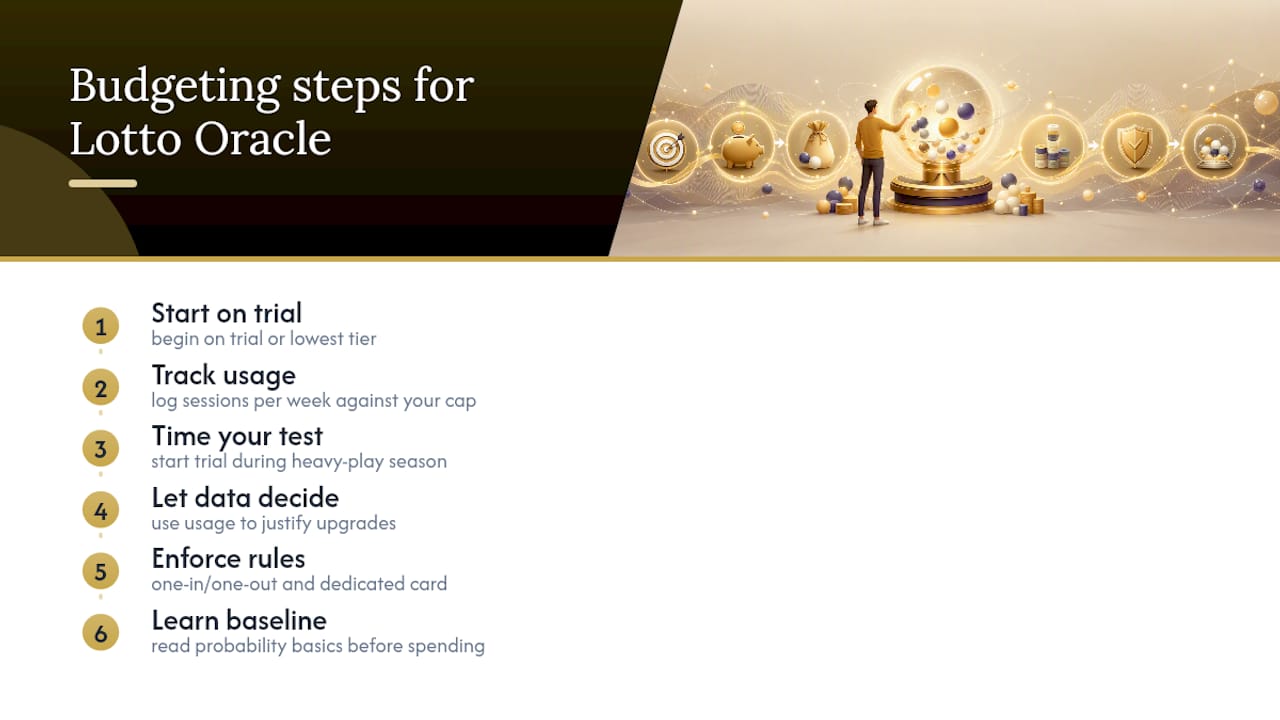
Applying the rules is straightforward. Start on the trial or lowest tier, track your sessions per week against your cap, and let usage decide whether an upgrade makes sense. Readers building probability literacy first can check Lottery Probability Basics for Astrology & Numerology Players, which frames why prediction tools are entertainment products, not odds-changers, an important baseline before spending a cent.
Timing helps too. When Is the Best Time to Buy Lottery Tickets? suggests starting a trial during your heaviest play season, since that window gives you a more honest usage test than a slow month would.
Enforce one-in/one-out, use a dedicated card, and let the data tell you whether to stay.
Try Lotto Oracle Within Your Own Budget Rules
Lotto Oracle is built around the exact math this article just walked through: a tiered subscription where the entry level costs less than most people spend on a single streaming service, and every feature above it is optional. You're not signing up for a black box. You get personalized number generation, daily luck readings, numerology and zodiac-based insights, and trend tracking, all sized to fit inside whatever fixed allotment you already set.
Apply the one-in/one-out rule, load a dedicated card with your monthly cap, and start with the trial tier at Lotto Oracle before you decide whether to go annual. If you haven't used it three or four weeks in, cancel it. If you're checking it daily and hitting your generation limit, that's your usage data telling you to upgrade. Either way, you'll know within one billing cycle instead of guessing.
Frequently Asked Questions
How much should I spend on a lottery prediction app each month?
Is an annual plan a better deal than monthly billing? Often yes, once you convert the annual price to its monthly equivalent and confirm it's still under your fixed allotment. The tradeoff is you lose the flexibility to cancel mid-year without losing money.
What's the fastest way to stop subscription creep? Enforce one-in/one-out before adding anything new, and set a reminder 3 to 5 days before each renewal so you can cancel in time if the subscription isn't earning its spot.
Should I judge a lottery prediction subscription by whether I win? No. These tools don't change the actual odds of a draw. Judge them the way you'd judge any entertainment purchase, by whether the features and experience are worth the price you're paying.
Where should the money for a lottery subscription come from? Strictly from your entertainment budget, never from savings, bills, or essential expenses. A dedicated prepaid card or wallet makes that separation automatic instead of something you have to remember.
Sources
For deeper background: Lottery Wheel Systems: A Canadian Player's Guide and Which Lottery to Play in Canada: Best Odds by Goal cover game-specific strategy. For budgeting mechanics, see the Stripe subscription pricing guide and NerdWallet Canada's subscription-creep experiment. For behavioral spending systems, ADHD Money Management: Build A Hill And Valley Fund offers a structured approach worth adapting.
- How to save money on streaming services
- Subscription pricing models
- Subscription pricing models: a guide for businesses
- How I curbed my streaming app creep and saved $800 - NerdWallet Canada