
Most lottery myths are false: draws are random, and no number-picking system increases your chance of winning. What actually changes is your payout if you do win, and a few tactics that shift your odds of winning something. Playing smaller games, joining a pool, avoiding birthday-heavy number combinations, and entering second-chance drawings all matter more than any "system." The myth-by-myth breakdown below shows exactly why.
TL;DR:
- Buying more tickets does not improve your odds; the probability remains fixed by the game’s structure, regardless of the number of tickets purchased.
- Choosing larger jackpot games does not increase your chances; it only raises the likelihood of sharing a win among more winners.
- Using number selection strategies or systems does not alter the mathematical probability of winning, but avoiding common choices like birthdays can reduce splitting jackpots.
- Physical and digital process safeguards ensure fair draws, with no bias toward certain numbers or patterns; the randomness is kept consistent through supervision and testing.
- Entering second-chance drawings or pooling tickets can increase your chances of winning something or reduce your share of a prize, but they do not impact the odds of matching the winning numbers.
Table of Contents
- Common Lottery Myths, Debunked One by One
- How Lottery Odds and Draws Actually Work
- What Actually Changes Your Payout (Not Your Odds)
- Taxes, Privacy, and What Winners Get Wrong
- What Prediction Apps Can and Can't Do
- Why Lottery Myths Refuse to Die
- Play Smarter With Lotto Oracle
- The Editorial Take: Myths vs. Math
- Sources
Common Lottery Myths, Debunked One by One
Lottery myths persist because they sound like common sense. They're mostly wrong. Here's the reality behind the six beliefs you'll hear most often at gas stations, family dinners, and office pools.
1. "I'm due for a win." This is the gambler's fallacy in its purest form. If you've bought fifty tickets and lost fifty times, your fifty-first ticket has exactly the same odds as your first. Lottery draws don't remember you. Each drawing is a separate, independent event, and the machine has no concept of who "deserves" a win next. Industry myth pages from groups like NASPL list this as one of the most persistent misconceptions in the business, precisely because it feels intuitive even though it's mathematically empty.
2. "Hot numbers are more likely to hit; cold numbers are overdue." Numbers don't have memory or momentum. A ball that came up five times in the last ten draws has the same probability of appearing in the next one as a ball that hasn't shown up in two years. Draw integrity depends on this randomness holding true, which is why regulated lotteries physically test and weigh their balls at certified institutes before they ever touch a drawing machine, a safeguard confirmed by Powerball Canada's explanation of ball testing. If a number pattern existed, that testing process exists specifically to catch and eliminate it.
3. "Quick Pick numbers win more often, so they must have better odds." Backward logic. Quick Pick and self-selected numbers carry identical mathematical probability. Quick Pick tickets win more often for a simple reason: about 70 to 80 percent of all tickets sold are Quick Picks, so naturally most winners bought them. It's a sampling artifact, not a statistical edge. Interestingly, the randomization built into Quick Pick terminals tends to spread selections more evenly across the number field, which slightly lowers your risk of splitting a jackpot with other winners, a genuinely useful side effect, just not the one people assume.
4. "A bigger jackpot means better odds, or worse odds, depending who you ask." Jackpot size has zero effect on your odds. A rollover that pushes a jackpot from $10 million to $70 million doesn't change how the combinations are drawn; it just means more people bought tickets, which increases your chance of sharing a win, not your chance of getting one. PlaySmart's odds explainer breaks this down clearly: the math is fixed by how many numbers you pick and how large the pool is, full stop.
5. "The lottery is basically a tax on people who are bad at math." This one has more nuance than the others. Lottery tickets are a voluntary purchase, not a tax, which is the technical distinction that matters legally. But the criticism isn't baseless: lottery spending does skew toward lower-income households as a share of income, and that's a legitimate policy conversation worth having. It's just a different conversation from "the odds are rigged" or "the math is a scam." The math is transparent. The socioeconomic pattern of who plays is a separate, real issue.
6. "The balls (or machines) are biased toward certain numbers." Regulated lotteries take this seriously enough to build entire verification processes around it. Balls get weighed, measured, and tested repeatedly at government-regulated facilities specifically to catch any physical bias before it could ever skew a draw, according to Powerball Canada. Regulatory bodies, sometimes structured similarly to an Alcohol and Gaming Commission overseeing other regulated products, provide independent oversight on top of that. The system is built to be boring and predictable, which is exactly the point.
How Lottery Odds and Draws Actually Work
Every lottery draw is an independent event, meaning the outcome of one drawing has zero influence on the next. This is the single fact that debunks the majority of lottery superstitions in one sentence: there's no memory, no pattern, no "system" hiding in the data, because each draw starts from a completely clean mathematical slate.
The odds themselves come down to combinatorics, not luck-based intuition. Take a 6/49-style game: you're choosing 6 numbers out of a pool of 49, and the total number of possible combinations is fixed by that structure alone. It doesn't matter if ten people or ten million people buy tickets that week, the odds of any single combination hitting stay exactly the same. PlaySmart's official breakdown confirms this directly: player volume and jackpot size don't touch the underlying probability at all.
Pro Tip: If a "strategy" claims to shift your odds of winning the jackpot, ask whether it changes the combinatorics. If it doesn't, it's changing something else, usually your payout size or your odds of splitting a prize, not your actual chance of matching the numbers.
Fairness safeguards back this up on the operations side:
- Lottery balls are physically weighed and tested at regulated institutes before and during use, to catch manufacturing bias.
- Where digital number generators are used instead of physical balls, certified random number generators (RNGs) undergo independent audits.
- Regulatory bodies oversee draw procedures, often with structures resembling a provincial Alcohol and Gaming Commission, adding a layer of outside accountability beyond the lottery operator itself.
None of this eliminates the odds. A 6/49 jackpot is still a long shot no matter how clean the process is. What it does is guarantee that the long shot is a fair one, not one quietly tilted by a bent ball or a rigged machine.
What Actually Changes Your Payout (Not Your Odds)
Nothing changes your probability of matching the winning numbers. But several real, well-documented tactics change your outcome if you win, and that distinction is where actual strategy lives.
The clearest lever is avoiding numbers between 1 and 31. Because so many players pick numbers based on birthdays and anniversaries, those low numbers get chosen disproportionately often. If you win with a combination heavy on numbers below 32, you're statistically more likely to be splitting the jackpot with someone else who picked the same "meaningful" dates. CasinoCanada's analysis notes this shift can meaningfully change your expected share of a prize, even though it does nothing to your odds of winning outright.
Game choice matters more than most players realize. A large multi-state draw offers a massive jackpot and correspondingly brutal odds. A smaller regional draw game or a daily numbers game offers far better odds of winning something, just at lower prize amounts. Scratch-off tickets work differently altogether: they have a finite, printed number of prizes, and the expected value can actually shift as a game's run winds down and fewer big prizes remain unclaimed relative to tickets sold.
Two more tactics worth building into your routine:
- Pool your tickets. Splitting cost and prize with a group multiplies your combinations covered without multiplying your personal spend, though it does mean sharing any win.
- Enter every second-chance drawing available. Most players skip these entirely, which makes that separate prize pool comparatively easy to win against a smaller field, one of the closest things to free expected value in lottery play.
If you want a mental model for evaluating any of this, think in terms of expected value rather than gut feeling; a breakdown of probability and EV thinking applied to sports picks translates directly to how you should size up lottery decisions too.
Taxes, Privacy, and What Winners Get Wrong
Lottery winnings in Canada are generally not taxed as income, which surprises a lot of new winners who assume the CRA takes a cut the way it does with employment earnings. Confirm this against your own circumstances, since rules can shift depending on how winnings are structured or invested afterward, and the CRA's own guidance on taxable amounts is worth reading directly rather than trusting secondhand summaries.
Publicity requirements are the other major misconception. Plenty of winners assume they're legally forced to do a press conference and hand over their name to every news outlet in the province. That's not universally true; anonymity provisions and structured disclosure options exist in many jurisdictions, and the details vary enough that it's worth checking the specific rules where you live before you claim anything.
A short checklist covers the practical basics:
- Sign the back of your ticket immediately.
- Make copies (photo and physical) before you go anywhere near a claim center.
- Read your specific lottery's claim procedure and deadline.
- Consult a lawyer and an accountant before making any public statement or spending decision.
- Ask about anonymity or trust-based claim options if privacy matters to you.
What Prediction Apps Can and Can't Do
Lotto Oracle builds personalized number suggestions using astrology, numerology, and pattern analysis, layered with historical trend tracking and daily luck readings. That combination gives players a structured, engaging way to organize their number choices, track patterns over time, and get nudges toward less commonly picked combinations, which ties directly into reducing split risk.
What it doesn't do, and what no legitimate tool can do, is change the probability of any given draw. No app, algorithm, or numerology chart alters combinatorics or predicts a genuinely random outcome. Lotto Oracle's own value sits in organization and engagement, not in claiming predictive power over randomness. Readers wanting the deeper math behind this distinction can dig into Lotto Oracle's breakdown of lottery probability basics or its piece on whether tracking patterns actually helps.
Why Lottery Myths Refuse to Die
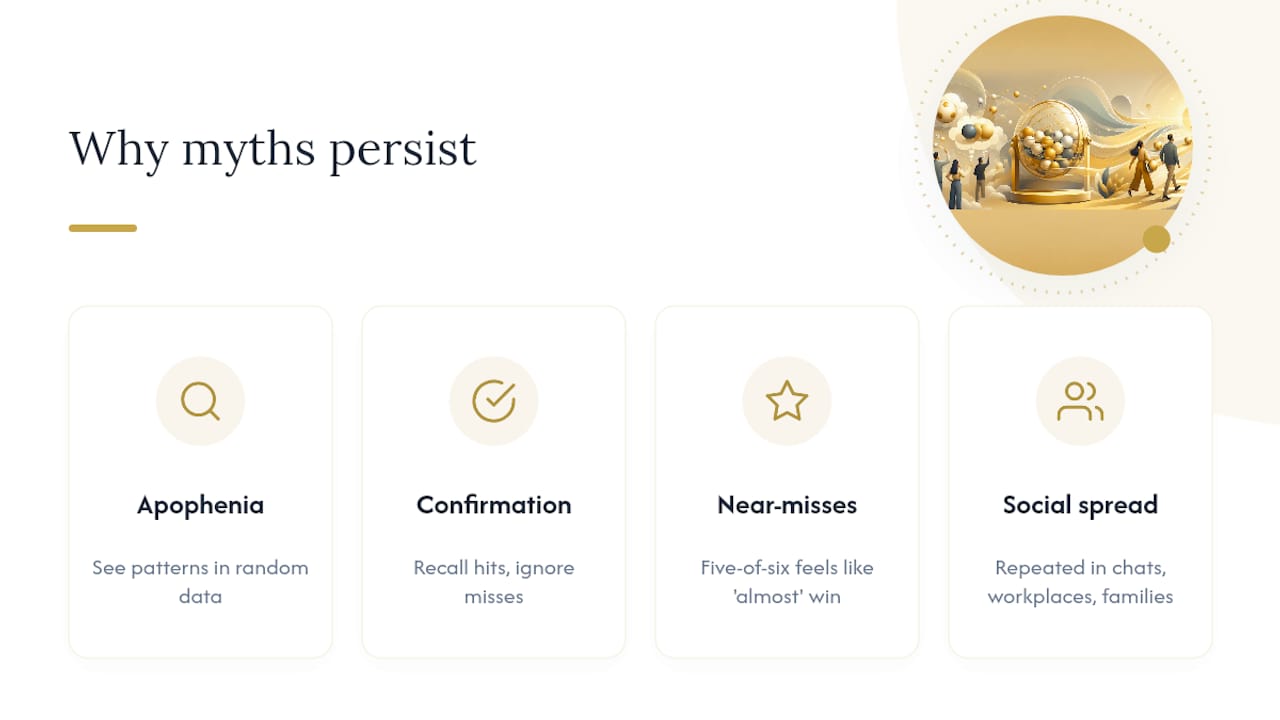
Lottery myths survive because human brains are wired to find patterns, even in pure noise. Psychologists call this apophenia, the tendency to see meaningful structure in random data, and it explains why someone can watch "hot numbers" appear twice in a row and feel certain they've spotted a trend rather than a coincidence.
Confirmation bias does the rest of the work. Players remember the one time their "system" seemed to work and quietly forget the dozens of times it didn't. Near-misses make this worse; matching five of six numbers feels like almost winning, which keeps the brain convinced a strategy is close to paying off, even though a near-miss carries zero predictive weight toward the next draw.
There's also a social layer. Lottery myths get repeated at workplaces, in family group chats, and across generations, and repetition alone makes a claim feel more credible regardless of whether it's true. Add in the emotional pull of hope, wanting to believe effort or cleverness can beat pure chance, and you get a set of beliefs that spreads faster than the math that disproves them.
Play Smarter With Lotto Oracle
None of this math makes the lottery a smart financial bet, and it was never meant to be one. It's meant to be understood clearly enough that you're not chasing phantom patterns or handing your money to a "system" that can't possibly work. Lotto Oracle exists for the part of the game that's actually about you: organizing your picks, tracking trends you find personally meaningful, and steering away from the same crowded birthday numbers everyone else is playing. If you want structured, engaging guidance built around numerology, astrology, and pattern tracking rather than empty promises of predicting a random draw, Lotto Oracle is built for exactly that.
The Editorial Take: Myths vs. Math
The math on lottery myths isn't ambiguous, and treating it as ambiguous is where most advice goes wrong. Draws are independent. Combinatorics set the odds. No system, birthday pattern, or "feeling" changes any of that, and articles that hedge on this point are doing readers a disservice.
Where conventional advice falls short is in conflating "your odds don't change" with "nothing you do matters." That's false. Avoiding heavily played numbers, choosing smaller games with better odds, pooling tickets, and actually entering second-chance drawings are all real, evidence-backed levers, just levers that affect your payout and your odds of winning something, not your odds on any single ticket.
If you prioritize one thing, prioritize game selection over number selection. Chasing a "smarter" way to pick six numbers is a waste of energy. Choosing a game with better structural odds, and entering every free second-chance drawing you're eligible for, is where the real value sits.
— amsd
Sources
For readers who want to verify any of this directly, a few sources are worth bookmarking:
- All about lottery balls — Powerball Canada
- Lottery odds explained | PlaySmart (OLG)
- How to win a lottery — CasinoCanada