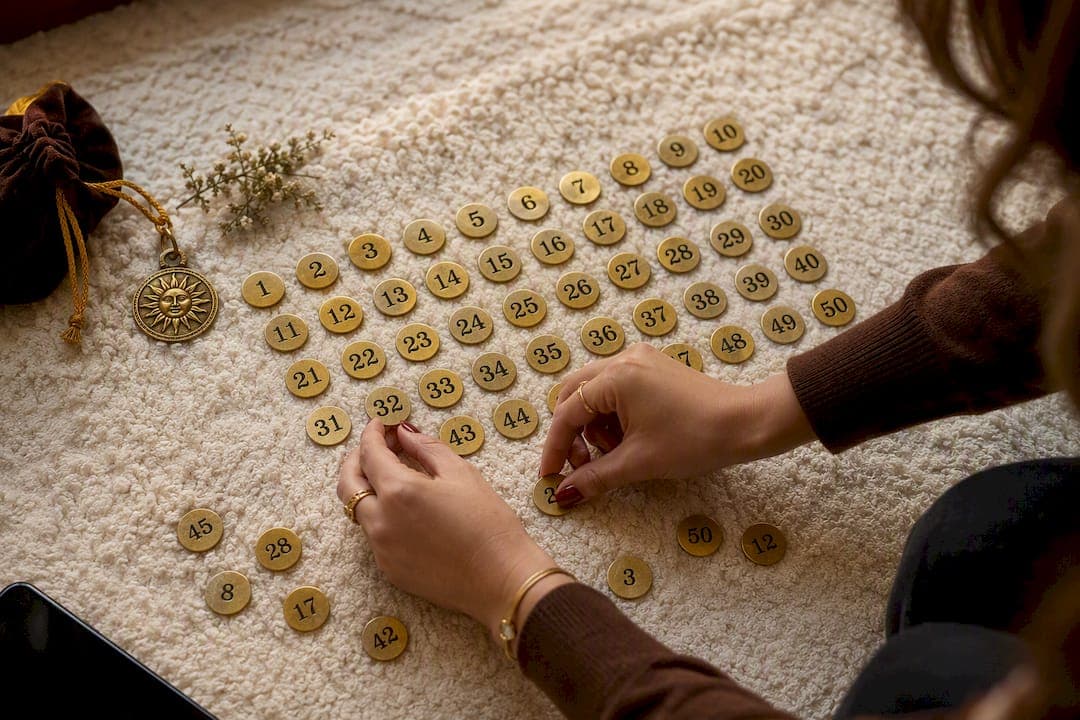
Lottery trend analysis, in the way Lottooracleapp builds it, means personalized number guidance that blends astrology, numerology, and algorithmic pattern tracking into a single daily pick. It doesn't touch the math behind a draw. What it does is help you diversify your numbers, dodge the same crowded picks everyone else plays, and lower your odds of splitting a jackpot if you win. Read on for how the three pillars work, what tactics actually help, and where the math draws a hard line.
TL;DR:
- Trend analysis cannot influence the actual probability of winning, as each lottery draw remains an independent event with no memory of past results.
- Using spread and alternation tactics can reduce ticket crowding, increasing potential payouts if a win occurs, but does not improve the chance of hitting the jackpot.
- Historical draw data reliably shows which numbers players choose most often but offers no predictive power for future draws.
- The app's combination of astrology, numerology, and trend tracking helps diversify selections and supports consistent play habits without overreliance on the data.
- Regularly updating trend data aligns with daily planetary shifts and recent draws, emphasizing behavior and disciplined routines over predictive certainty.
Table of Contents
- What Are the Three Pillars of Lottery Trend Analysis?
- How Do These Methods Work Together in Practice?
- What Tactics Actually Improve Your Play?
- Does Trend Analysis Change the Real Odds?
- Where Does the Lotto Oracle Approach Get Its Backing?
- How Reliable Is Historical Lottery Draw Data?
- What Algorithmic Methods Power Trend Tracking?
- Are There Real Case Studies Behind Trend-Based Picks?
- What Are the Limits of Astrology and Numerology Here?
- How Should You Read a Trend Signal Without Overreacting?
- How Often Does Trend Data Get Updated?
- What Do Regular Players Actually Report?
- How Does Lotto Oracle Put This Into Practice?
- Sources
What Are the Three Pillars of Lottery Trend Analysis?
A personalized pick isn't pulled from thin air. It runs through three distinct systems, each contributing a different kind of signal, before you ever see a number on your screen.
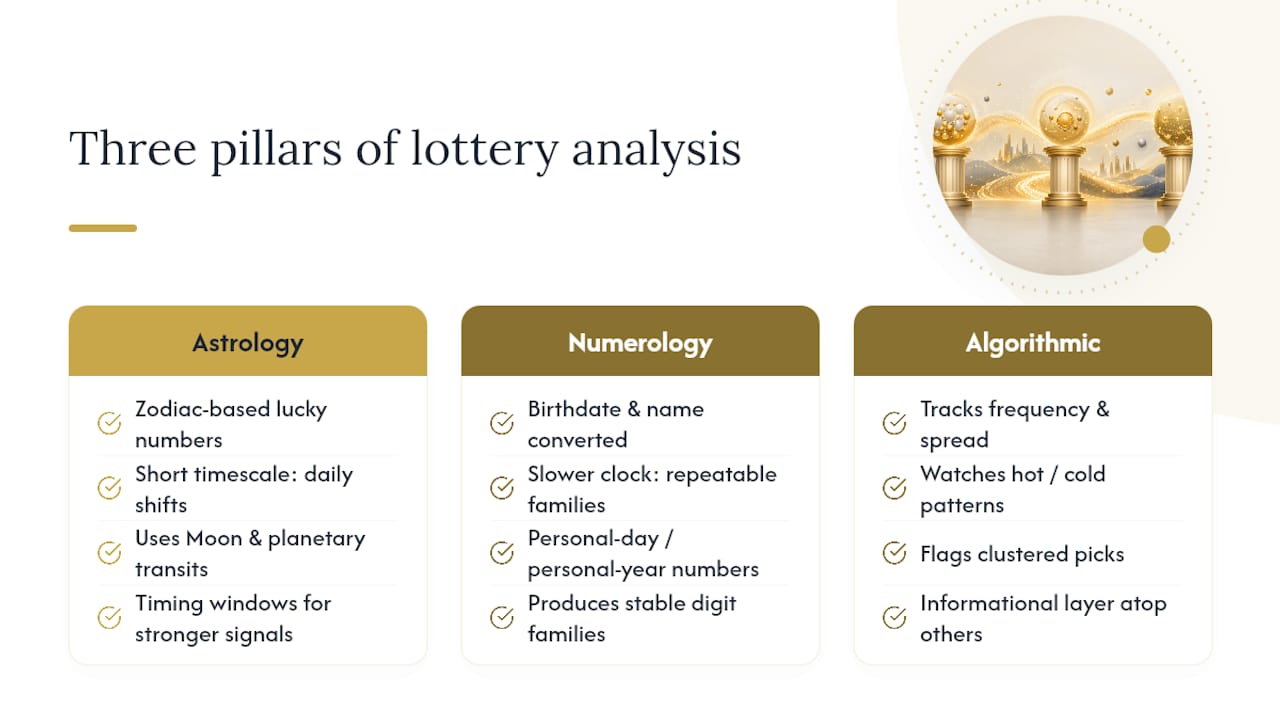
Astrology supplies zodiac-based lucky numbers, recalculated often because the Moon and other planetary positions shift day to day. That's why your daily lucky number can look nothing like the long-term numerology numbers, according to daily zodiac lucky-number platforms. Some apps also layer in transit-based timing windows, flagging stretches when your chart carries more weight than a random Tuesday.
Numerology works on a slower clock. It converts your birth date and name into life path numbers, name numbers, and personal-day or personal-year numbers. These tend to produce repeatable families of digits rather than a fresh number every morning.
Algorithmic trend tracking is the informational layer sitting on top of both. It watches frequency, spread, and hot/cold patterns across recent draws, not because a "cold" number is somehow due, but to flag when your astrology or numerology picks are clustering in an already popular zone.
A subscription app's job is orchestration: it takes the raw outputs from all three, checks them against each other, and hands you one clean, ready-to-play set.
How Do These Methods Work Together in Practice?
Here's the actual sequence, from raw inputs to the ticket you write down.
- Inputs. The app takes your birth date, full name, recent draw history for your chosen game, and any personal rules you've set, such as "no birthdays" or "favor higher numbers."
- Generation. Numerology and astrology rules produce a batch of candidate numbers, some from your life path calculation, some from your zodiac's current transit window.
- Filtering. The algorithm layer runs those candidates against recent draw data, checking for overcrowding in the 1 to 31 range and flagging any set that looks statistically identical to thousands of other tickets.
- Output. You get a primary pick set, a couple of alternates, a trend chart showing where your numbers sit relative to recent frequency, and sometimes a timing-window alert built on astrological research showing that jackpot-adjacent events cluster around layered planetary signatures. Though Vedic timing research is careful to frame that as potential, not certainty.
Say your numerology calculation hands you the number 7 as a core pick, and the app flags it as heavily played that week. Instead of forcing it in any way, you swap to one of the two alternates the algorithm generated, numbers that carry similar numerological weight but sit outside the crowded range. You keep the personal meaning. You lose the crowd.
Pro Tip: If your core numbers keep landing in the 1 to 31 range, ask the app for alternates specifically above 31. You keep the numerology intact while cutting your overlap with everyone else's birthday-based tickets.
What Tactics Actually Improve Your Play?
None of these tactics change your odds of matching the draw. What they change is how good your play is when you do win, and how consistently you show up to play at all.
- Spread your picks across the full number range. Concentrating in 1 through 31 means you're standing in the most crowded room in the building, since surveys show a significant portion of regular players lean on personally significant numbers like birthdays and anniversaries.
- Rotate your core numbers with data-driven alternates. One or two swaps per ticket, guided by the app's spread analysis, meaningfully thins your overlap with the crowd without abandoning your numerology entirely.
- Use timing-window alerts selectively. Treat them as an occasional nudge for a bigger play, not a daily requirement. Astrological timing frameworks stress that a real window needs multiple alignments stacking up together, not a single lucky-feeling day.
- Set a budget and a rhythm. Pick a consistent interval, weekly or twice a month, and stick to it. Trend analysis works best as a structure for a habit you've already decided to keep, not a reason to play more than you planned.
Pro Tip: Log which alternates you actually used over a month. Most players find their "gut" numbers and their app-suggested alternates converge more than they expected, which makes the swap easier to trust the second time around.
Combining a personal-number system with a frequency and spread overlay gives you a defensible way to skip crowded number sets while keeping the picks that feel like yours.
Does Trend Analysis Change the Real Odds?
No, and any tool that claims otherwise is selling you a myth. Each lottery draw is an independent event. The balls, or the random number generator behind a digital draw, carry no memory of what came before. Numbers that haven't hit in months aren't "due," and numbers on a hot streak aren't primed to repeat, because the machine doesn't track streaks. That's the gambler's fallacy, and it's the single most common misconception in this space.
The real lever isn't probability, it's payout distribution. If 10,000 people all pick the same birthday-based numbers and those numbers hit, the jackpot splits 10,000 ways. If you'd picked numbers outside that crowded range with the same objective odds of matching, a win means a bigger slice for you.
That's the entire case for trend analysis in one sentence: it can't make a number more likely to be drawn, but it can change how many people you're splitting the prize with if it is. Analytics genuinely affect choice diversity and payout distribution. They do not, and cannot, affect the raw probability of any single number appearing.
Where Does the Lotto Oracle Approach Get Its Backing?
None of this works as a black box. A useful trend-analysis tool should show you its reasoning, and Lottooracleapp's editorial content, credited to author amsd, lays out exactly how each layer functions and where its limits sit.
Start with Can You Really Track Lottery Patterns and Win More?, which walks through what pattern tracking can and can't tell you. Does a Repeat Number Lottery Strategy Actually Work? tackles the specific "hot number" question head on. For the math itself, Lottery Probability Basics for Astrology & Numerology Players breaks down independence and expected value in plain terms built for readers who use zodiac and numerology systems rather than statistics textbooks.
Players who lean into the zodiac side get the deepest coverage in the zodiac number guide, which explains how daily lucky numbers are actually calculated from lunar and planetary positions rather than pulled from a generic chart.
The consistent theme across all of it: engagement and habit-forming play matter as much as the numbers themselves. Users who stick with a consistent, budgeted routine report better satisfaction with the process, regardless of outcome, which lines up with what these internal breakdowns emphasize throughout.
How Reliable Is Historical Lottery Draw Data?
Historical draw data is about as reliable as data gets, in the narrow sense that official lottery operators publish exact, verified results for every draw. The reliability problem isn't the accuracy of the record. It's what people try to make that record do.
A perfectly accurate table of the last 500 draws still can't tell you what number 501 will be, because each draw is independent. Frequency counts, hot/cold labels, and "overdue number" charts are all built on real, correct data, and all of them carry zero predictive power on their own.
Where historical data earns its keep is on the player side of the equation, not the draw side. Frequency data tells you which numbers are chosen most often by other players (not drawn most often), and that's genuinely useful for the spread and crowding tactics covered earlier. A trend-tracking app that pulls from real draw archives and real play-pattern data is giving you an honest picture of the field you're playing in, even though it can't peek into the next draw. The distinction between "reliable record of the past" and "predictor of the future" is the one most casual trend-chasers miss.
What Algorithmic Methods Power Trend Tracking?
Underneath the astrology and numerology layers, the algorithmic side runs on fairly standard techniques borrowed from basic statistics and data mining, applied to a genuinely simple dataset: draw results over time.
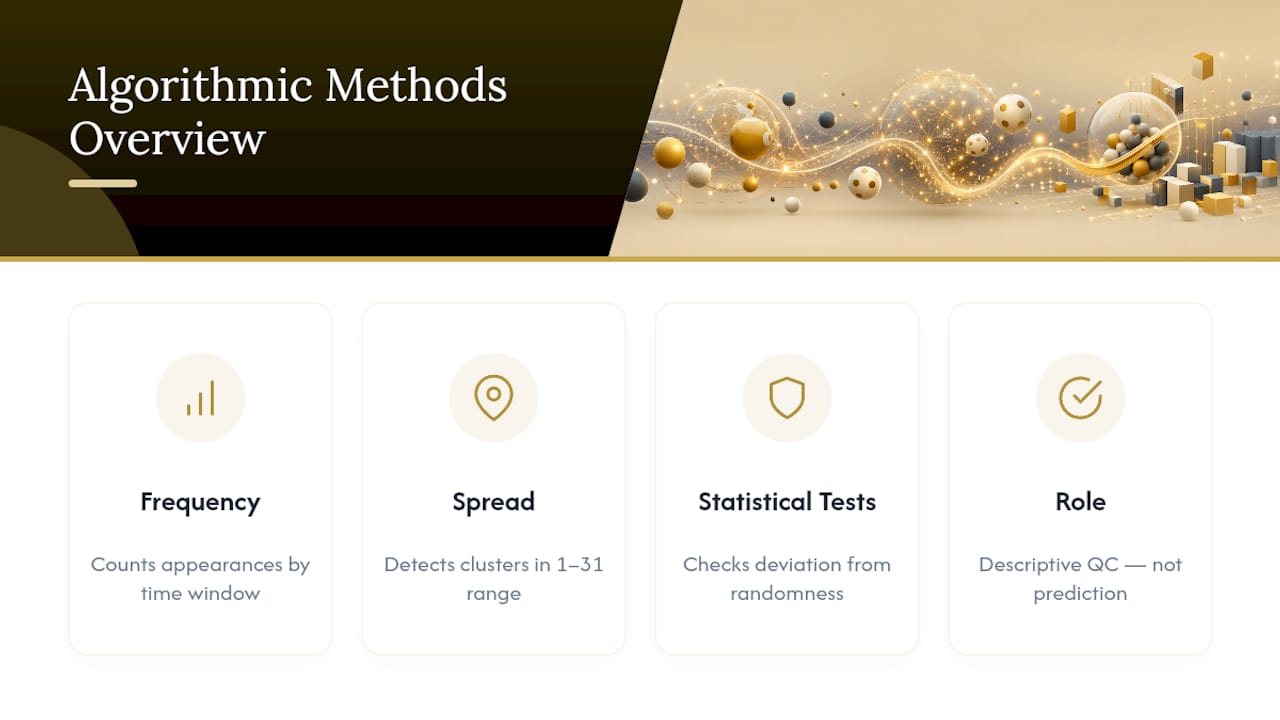
Frequency analysis counts how often each number has appeared across a chosen window, a month, a year, a decade. Spread analysis checks how picks (yours or the broader player pool's) distribute across the available range, flagging clusters in the 1 to 31 zone where birthdays live. Some tools apply light statistical modeling to detect whether a distribution of past draws deviates meaningfully from what pure randomness would produce, mostly as a transparency check on the game itself rather than a forecasting tool.
None of this qualifies as prediction in any real sense. It's descriptive statistics, not predictive modeling, because the underlying data has no exploitable structure to model. What separates a well-built trend-tracking algorithm from a gimmick is honesty about that limit: it should tell you what already happened and what other players are doing, and stop there. Combined with the astrology and numerology layers, the algorithm's real function is quality control, catching when your personalized picks accidentally match the most common ticket in the pool.
Are There Real Case Studies Behind Trend-Based Picks?
The honest answer is that verifiable, large-sample case studies proving astrology or numerology picks outperform random selection don't exist, because no such outcome is mathematically possible. What does exist is research into patterns among people who've already won.
One synthesis of roughly 70 winner birth charts found recurring planetary signatures and layered timing windows appearing more often than chance alone would suggest, though the researchers were careful to frame this as potential rather than certainty. That's a pattern worth noting, not proof of a repeatable formula. A chart correlation across past winners doesn't mean the same signature guarantees a future win, and no legitimate source in this space claims otherwise.
The more useful "case studies" are behavioral, not statistical. Players who use structured picks, consistent numerology numbers refined with algorithmic spread checks, report sticking to their play budget more reliably than players chasing random hunches. That's a real, observable outcome. It's just a different kind of win than the one the phrase "case study" usually implies in this space, and any tool claiming otherwise is overselling what pattern data can actually show.
What Are the Limits of Astrology and Numerology Here?
The biggest limitation is the one already covered: neither system can move the actual probability of a draw. That's not a criticism of astrology or numerology as belief systems, it's just math. A zodiac-based lucky number and a name drawn from a hat carry identical odds of matching six random balls.
A second, subtler limitation is convergence. Because numerology calculations run off birth dates and names, and because a large share of players lean on personally significant numbers already, numerology-driven picks can end up just as crowded as plain birthday picks if you don't cross-check them against spread data. The system that's supposed to make your ticket personal can accidentally make it generic.
Astrology's daily-lucky-number model has its own quirk: because it recalculates with lunar and planetary movement, it can feel inconsistent to a newer user who expects the same "lucky number" every day. That's by design, not a bug, but it takes some getting used to.
None of this means astrology and numerology have no place at the table. It means they function best as a framework for decision-making and personal meaning, not as a forecasting tool, and the tools built around them should say so plainly rather than implying otherwise.
How Should You Read a Trend Signal Without Overreacting?
Treat every alert, chart, and lucky-number notification as a suggestion layered onto a decision you'd be making anyway, not as a command.
A useful filter: ask whether the signal is changing your choice diversity (good) or your belief about the draw's odds (a trap). A timing-window alert telling you this week carries extra personal significance is fine grounds to play a bit bigger than usual. A timing-window alert convincing you a specific number is "guaranteed" this week is a sign to close the app and reset your expectations.
Watch for streak thinking, too. If a number hasn't appeared in your trend chart for weeks, that's interesting context, not a countdown to when it's "owed" to appear. The draw doesn't know or care what happened last week.
The healthiest way to use daily lucky numbers and trend dashboards is as a ritual that keeps your play consistent and intentional, checking in once, choosing your numbers, and moving on, rather than refreshing charts hoping for a different answer. If you notice yourself checking multiple times a day or increasing your spend based on an alert, that's overreliance, and it's worth stepping back regardless of what the chart says.
How Often Does Trend Data Get Updated?
Different layers of the app run on different clocks, and that's intentional rather than inconsistent.
Astrological inputs update daily at minimum, since planetary positions and lunar phases shift constantly, which is why a zodiac-based lucky number rarely repeats two days running. Numerology inputs are far more stable, since your life path and name numbers don't change, though personal-day and personal-year figures roll over on their own calendar. The algorithmic trend layer refreshes as new draw results post, typically right after each drawing closes, so frequency and spread charts always reflect the most current available data rather than a stale snapshot from weeks earlier.
Maintaining this on the back end means reconciling three update cycles into one output you see once a day. It also means the app needs fresh draw data pulled promptly after each official result, since a trend chart running on outdated results is worse than no chart at all. The practical takeaway for you: your daily lucky number is genuinely new each day, your numerology core numbers are stable unless your personal-day number rolls over, and your trend charts are only as good as the most recent draw the app has ingested.
What Do Regular Players Actually Report?
Trend analysis works best as structure and ritual. It gives your play a shape, a reason to pick these numbers today instead of a random scramble, and that structure is what keeps people coming back consistently rather than playing erratically.
The habits that hold up: a fixed budget, alternating between core and app-suggested picks, and leaning on alternates whenever a number looks overplayed. None of it promises income. Play it for the fun of the ritual, not as a financial plan.
— amsd
How Does Lotto Oracle Put This Into Practice?
If everything above sounds like a lot to track by hand, that's the exact gap Lotto Oracle was built to close. Instead of juggling a numerology chart, a horoscope site, and a spreadsheet of past draws yourself, you get all three pillars reconciled into one daily pick, automatically.
The app runs personalized picks through both zodiac and numerology modes, so you can lean harder into whichever system resonates with you, or blend them. Trend dashboards show you exactly where your numbers sit relative to recent play patterns, alternate picks are generated automatically whenever a core number looks overplayed, and timing alerts surface when your chart's layered signals line up rather than pinging you every single day. Every tactic covered above, spreading picks, rotating alternates, using timing windows selectively, is built into the workflow rather than left for you to calculate manually.
It's entertainment first, and the subscription model is upfront about that: no ticket sales, no gambling services, just sharper, more personalized guidance for numbers you were going to pick anyway. If you want to see how your own chart and numerology stack up against current trends, you can start with Lotto Oracle and check your first daily pick today.
Sources
- Dream Numbers and Numerology for Lottery: Fun Methods vs. Mathematical Reality
- Finding Windows to Win a Jackpot: What Vedic Astrology Actually Says | Vedtara
- Lottery Number Selection Myths Debunked: Numerology, Astrology & Systems
- Today's lucky number for all zodiac signs