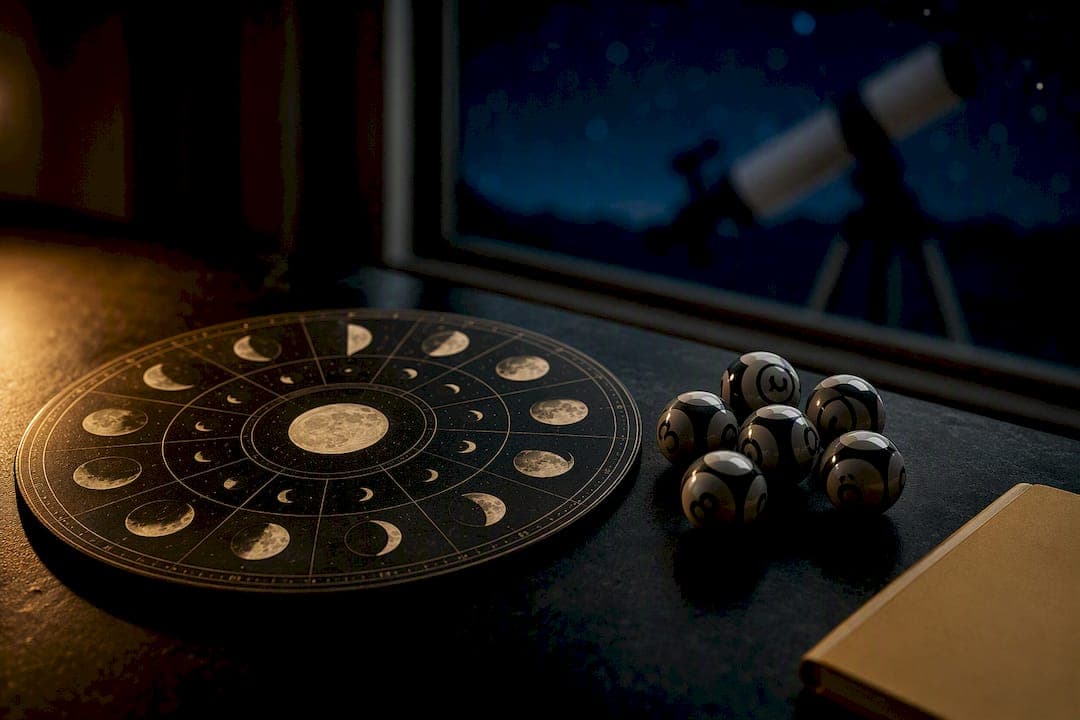
Lunar timing can work as a personal ritual for picking lottery numbers, but no moon phase changes the actual odds of a fixed-draw lottery. Enthusiasts favor waxing and full moon days for buying tickets, while new moon days get a lukewarm reputation. If you want to try it anyway, set a fixed budget and a stop-loss before you buy a single ticket, then treat the whole thing as a personal experiment rather than a system.
TL;DR:
- Moon phases influence the timing of ticket purchases, with waxing and full moon days considered more favorable than new or waning phases.
- Lunar calendars often combine moon phase and zodiac sign data to refine luck estimates, but these are purely symbolic and lack statistical backing.
- Converting lunar number sets into tickets requires consistent formatting, such as always taking last digits or dropping the highest numbers in multi-number sets.
- Four main methods for generating moon-based lottery numbers exist, including astrology, numerology, astronomical event matching, and historical hot-sheet tracking, but overfitting is a common risk.
- Scientific research shows no direct influence of moon phases on fixed-draw lotteries, with apparent correlations mainly arising from behavioral biases and sample size limitations.
Table of Contents
- What Moon Phases Do Lunar Calendars Call Lucky for Buying Lottery Tickets?
- How Do You Turn Moon Lucky Numbers Into an Actual Ticket?
- What Methods Do People Actually Use to Generate Moon-Based Numbers?
- Does Science Support a Link Between Moon Phases and Lottery Luck?
- How Do You Test a Moon Phase Lottery Strategy Yourself?
- Why Trust This Guide on Moon Phase Lottery Methods
- Is Lunar Timing Worth Building Into Your Lottery Routine?
- Turn Your Lunar Picks Into a Trackable Routine
- Sources
What Moon Phases Do Lunar Calendars Call Lucky for Buying Lottery Tickets?
Moon phase lottery calendars sort every day of the month into rough luck categories, and most of them borrow the same basic logic astrologers use for timing anything else: growth phases feel promising, release phases feel riskier, and the extremes (new and full moon) carry the most symbolic weight.
Here's how the four core phases typically get labeled on lunar lottery calendars:
- New moon — Seen as a "planting seeds" phase. Some calendars call it neutral for fresh starts; others mark it as weak for lottery luck because there's no visible light yet, symbolically nothing to "see" or attract.
- Waxing crescent to waxing gibbous — Widely considered the best stretch, roughly days 8 through 14 of the cycle. Energy is "building," which enthusiasts read as momentum toward a win.
- Full moon — The most talked-about phase. It gets credit as a high-energy, high-visibility day, and it's the phase most frequently cited in lunar gambling folklore.
- Waning gibbous to waning crescent — Generally labeled neutral to unfavorable. The moon's light is shrinking, which most lunar calendars interpret as a bad time to start anything new, including a ticket purchase.
Two simple timing rules cover most of what practitioners actually do. First, buy tickets during the waxing phase rather than the waning phase, on the logic that you want to purchase while energy is "increasing," not fading. Second, skip or minimize plays during the exact new moon, since that's the phase most calendars flag as dead time.
Beyond the phase itself, many lunar calendars add a "moon in sign" layer, noting which zodiac sign the moon is transiting. A moon in a fire sign like Aries or Leo gets tagged as bold and lucky, while a moon in a water sign like Cancer or Pisces gets tagged as emotional and less number-focused. Combining the phase and the sign gives a slightly more refined day, though it's still a symbolic overlay, not a mathematical one. If you want deeper sign-by-sign detail, zodiac-based number selection breaks down which signs pair with which number patterns.
How Do You Turn Moon Lucky Numbers Into an Actual Ticket?
Daily lunar number sets show up in a handful of standard formats, and knowing which one you're looking at matters before you fill out a playslip.
- Five or six-number sets. These mimic standard lotto formats directly. A published set like 4, 11, 19, 27, 33, 42 maps straight onto a 6/49-style game with no conversion needed.
- Pick 3 or Pick 4 strings. These are short digit sequences, something like 7-2-9 or 3-8-1-4, meant for daily numbers games where you're matching exact digit order or a "box" combination.
- Condensed single-digit strings. When a site publishes a longer number and you need a 3 or 4-digit play, the common shortcut is taking the last digit of each larger number. A set of 14, 27, 33, 8 condenses to 4-7-3-8 for a Pick 4 play.
- Full 6-number to single-line conversion. If you're handed six numbers for a game that only takes five, the standard move is dropping the highest number rather than picking randomly, since lunar sites usually rank output numbers by strength of the underlying calculation.
The most common mapping mistake is forcing a 6-number lunar set into a Pick 3 game by grabbing three numbers at random. That throws out whatever internal logic produced the set in the first place. If you're converting formats, condense consistently (always last digit, always same ranking order) so you're testing one method rather than a different improvised method every draw. For a broader look at how to translate any generated number set into an actual playslip, converting number sets to ticket formats covers the mechanics in more depth.
What Methods Do People Actually Use to Generate Moon-Based Numbers?
Four distinct approaches show up again and again among lunar lottery players, and they don't all work the same way.
- Moon phase and moon-in-sign astrology. The basic recipe: identify the current phase (say, waxing gibbous), identify the moon's zodiac sign, then assign each a number using a fixed conversion table (Aries = 1, Taurus = 2, and so on through the signs), combining phase-day count with sign number to build a short digit string.
- Numerology reduction. Practitioners take a birth date or the current calendar date, add the digits together, and reduce repeatedly until they land on a single digit, then assign that digit a "ruling number" using standard numerology charts that also link certain numbers to planets.
- Celestial coordinates and hot-sheet matching. A more formalized version of this exists as a documented method: a patent for generating lottery hot sheets describes matching historical draw dates against astronomical events like moon phases, planetary ingress, and aspects, then flagging numbers that co-occurred with similar events in the past.
- Historical hot-sheet approaches without astronomy. Older lottery folklore simply tracked which numbers hit most often on full moon dates specifically, without any deeper astrological layer, treating the moon purely as a calendar marker.
Pro Tip: Pick one method per lunar cycle and stick with it for the full cycle before switching. Mixing three methods in the same week makes it impossible to tell which one, if any, is actually producing your results.
The real risk with any of these methods is overfitting: hunting backward through past draws until you find numbers that happened to align with some lunar event, then treating that coincidence as a rule going forward. A pattern found by digging through history after the fact isn't the same as a pattern that predicts anything new.
Does Science Support a Link Between Moon Phases and Lottery Luck?
The honest answer is that some research finds lunar correlations in gambling-adjacent data, but nothing that applies to how a fixed-odds lottery draw actually works.
A thesis analyzing NFL point-spread betting from 1978 to 2007 found that home teams were statistically underpriced the day before a full moon, a real, measurable bias in a betting market. Separately, a 1996 Las Vegas Sun report on UNLV-linked research claimed casino payout percentages and major jackpots clustered on full moon days, with payout rates up to roughly 2 percentage points higher in that specific dataset.
Both of those findings come from markets where human behavior sets the price or the payout curve, sports betting lines and casino floor dynamics. A visible calendar event like a full moon can concentrate recreational bettors and shift how money moves, which changes outcomes in a betting market without changing the underlying math of a random draw.
A lottery drum or random number generator doesn't know what phase the moon is in. Any apparent full-moon pattern in lottery results specifically is far more likely to come from small sample sizes, cherry-picked comparisons, or players simply buying more tickets on notable dates, not a change in the draw itself. If discipline around any of this starts slipping, the National Council on Problem Gambling offers guidance on recognizing when play has crossed from entertainment into something that needs outside support.
How Do You Test a Moon Phase Lottery Strategy Yourself?
Treat this like a real experiment, not a hunch, and you'll actually learn whether your method does anything.
- Pick one method and lock it in. Choose either the astrology recipe, the numerology reduction, or a hot-sheet approach, and don't swap methods mid-test.
- Set a fixed stake per draw. Decide the exact dollar amount before you start, and never increase it because a losing streak feels "due" for a turn.
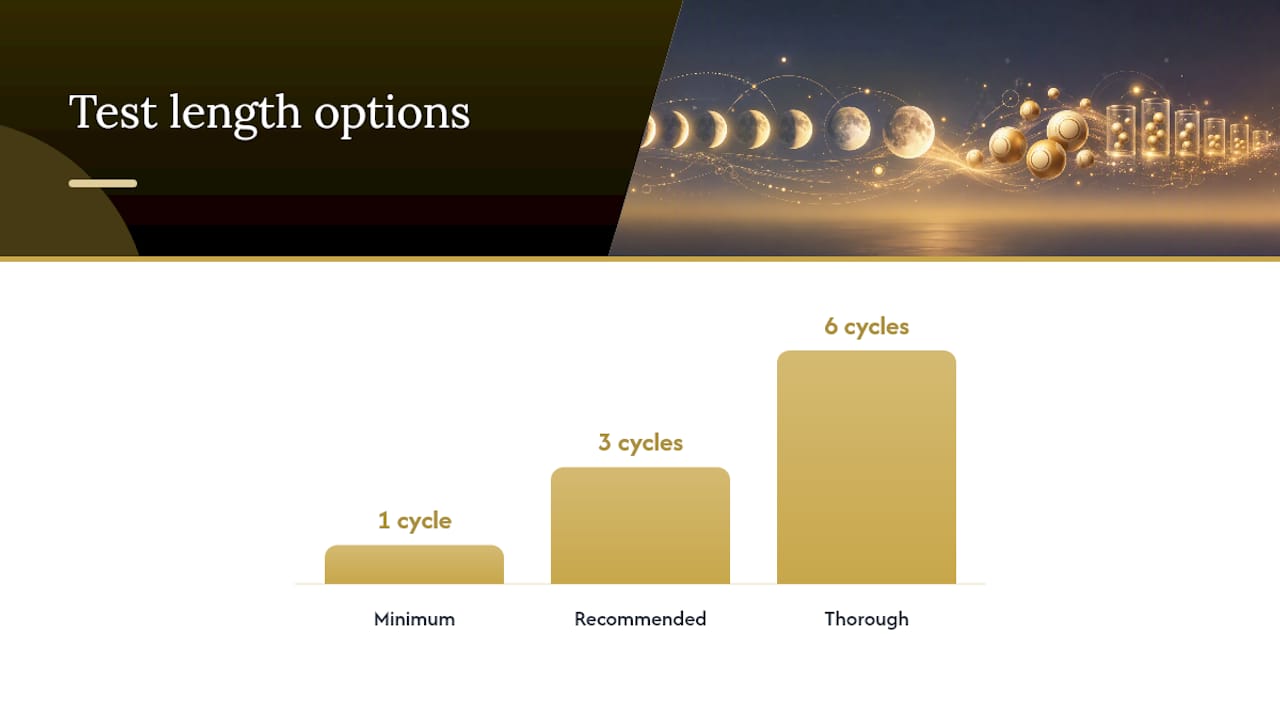
- Choose a sample-size goal in advance. A single lunar cycle (about 29.5 days) is a bare minimum; three to six cycles gives you a more honest read.
- Log every single draw. Record the date, moon phase, numbers played, numbers drawn, and outcome in a simple spreadsheet or notebook.
- Compare against a random control. Run the same stake and draw count using randomly generated numbers alongside your lunar picks, so you have a baseline to judge against.
What you're actually measuring is hit rate (how often you match any numbers), return on investment across the full test period, and how much of the swing looks like ordinary variance rather than a real signal. A short losing streak inside one cycle tells you almost nothing on its own; lottery outcomes are noisy by design, and a handful of draws won't separate luck from method.
Build in a cooldown rule from the start: if you hit your stop-loss for the cycle, stop playing until the next cycle begins, full stop — a principle explained in detail in When checking back is better than betting — Railbird. That single rule, borrowed directly from standard bankroll management guidance, does more to protect you than any number-picking method ever will. For a primer on why variance looks the way it does in lottery-style games, lottery probability basics is worth reading before you start logging results.
Why Trust This Guide on Moon Phase Lottery Methods
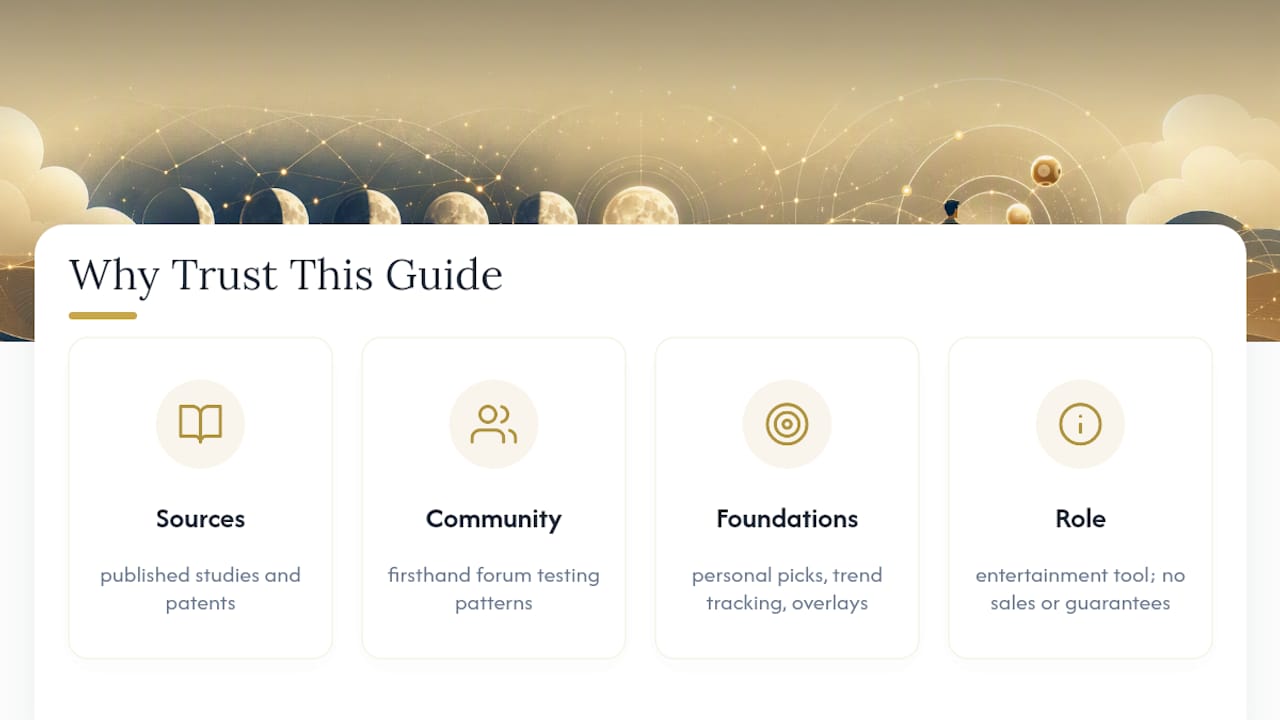
This guide was compiled by amsd, drawing on published research into lunar effects in betting markets, historical hot-sheet patent filings, and firsthand community testing patterns from lottery and astrology forums.
This guide draws on foundations of personalized number picks, trend tracking, and astrology and numerology overlays designed to support the kind of logging and testing described above. It's an entertainment and pattern-analysis tool. It doesn't sell tickets, and it doesn't promise wins.
Is Lunar Timing Worth Building Into Your Lottery Routine?
Lunar timing earns its place as a ritual, not a system. The moon gives your play a rhythm and a reason to log results, but the discipline of testing and tracking is what actually teaches you anything. Treat lunar phase as one variable in a bigger experiment, not the whole strategy, and run a real test before you trust it. Start small, log everything, and read further on conversion methods for ticket formats before your next cycle begins.
— amsd
Turn Your Lunar Picks Into a Trackable Routine
There are apps built to support the test-and-log approach this guide walks through, offering personalized number picks, trend tracking, and astrology and numerology overlays in one subscription, so instead of juggling a notebook, a moon calendar, and three separate websites, your lunar cycle testing can live in one place.
The platform does not sell lottery tickets or run any gambling service. It offers personalized insights including number generation and tracking, while users buy their own tickets and set their own limits. If you're serious about running the cycle-length test described above, consider starting a trial on the platform's website to access tools intended for that purpose.
Sources
- Research on NFL point-spread betting efficiency (thesis)
- Patent describing hot-sheet generation using astronomical events
- National Council on Problem Gambling — problem gambling resources