
Planetary hours won't change your lottery odds, since every draw runs on independent randomness explained in ticket lotteries. But they give you a structured, symbolic window for buying tickets, and many players use Jupiter or Venus hours for money intentions, or a Moon hour for quick, near-term luck. The real move: grab a planetary-hours calculator that reads your exact location, then check it against your lottery's ticket cut-off time before you buy anything.
TL;DR:
- Using planetary hours does not increase lottery odds but provides a structured window for buying tickets, with many players favoring Jupiter or Venus hours.
- Calculating hours requires precise local sunrise and sunset times, with seasonal and geographic variations making automatic geolocation-based calculators essential.
- Jupiter, Venus, and the Moon are the main planets associated with money and luck, but no timing method reliably outperforms random selection.
- A good planetary-hours app should automatically adjust for location, date, and timezone, and include alarms or notifications for accurate timing.
- The real benefit of planetary timing lies in establishing a ritual for focus and discipline, not in predicting or improving lottery outcomes.
Table of Contents
- What Are Planetary Hours in a Lottery Timing Context?
- Which Planets Rule Money and Luck?
- How Do You Calculate and Schedule a Planetary-Hour Lottery Play?
- What Should You Look for in a Planetary-Hours App?
- How Does Lotto Oracle Apply Planetary Hours in Practice?
- Lotto Oracle: An Automated Way to Handle Luck Calendars and Number Guidance
- Timing as Ritual, Not a Way to Beat Randomness
- Sources
What Are Planetary Hours in a Lottery Timing Context?
Planetary hours split each day into 24 unequal segments tied to sunrise and sunset rather than the clock. Daylight gets divided into 12 parts, and the night that follows gets its own 12, so a summer daytime hour might run 70 minutes while a winter one runs 40. This is the foundation of any astrology lottery system that claims to pinpoint a "lucky window."
The labeling follows a fixed sequence called the Chaldean order: Saturn, Jupiter, Mars, Sun, Venus, Mercury, Moon, repeating in that cycle. Calculating your own hours takes a few steps:
- Find today's exact local sunrise and sunset times for your coordinates.
- Divide the daylight span into 12 equal segments, and the night span into 12 more.
- Identify your weekday's ruling planet (Sunday is ruled by the Sun, Monday by the Moon, and so on).
- Assign the first daylight hour to that ruler, then move through the Chaldean sequence for each subsequent segment.
Because hour length shifts with the season and your latitude, a table calculated for New York in December won't work in Vancouver in June. That's why live calculators that auto-detect your geolocation and date matter more than a static chart pulled off an old blog post. A manual mistake in your sunrise time cascades through every single hour label for the rest of the day.
Which Planets Rule Money and Luck?
Not every planetary hour carries the same weight for lottery timing. Three planets dominate the money and luck conversation in astrology-based lottery guidance:
- Jupiter governs expansion, abundance, and windfalls, making it the planet most players target for lottery purchases.
- Venus rules comfort, pleasure, and favorable circumstances, which practitioners connect to smoother outcomes.
- Moon hours get used for short-term, fast-moving luck rather than long-range fortune.
One thing worth knowing: your natal chart's fifth house (traditionally linked to games and speculation) or your Part of Fortune placement can personalize which day or hour resonates for you specifically, beyond the generic "Jupiter is good for money" rule. Practitioners who go deeper look for congruence between the day's ruling planet, the hour's ruling planet, and your own chart rather than chasing one universal money hour.
None of this should be mistaken for a mathematical edge. No study has shown astrology-based number or timing choices reliably outperform random selection, and every serious guide to this topic treats it as entertainment layered onto a game of pure chance.
How Do You Calculate and Schedule a Planetary-Hour Lottery Play?
Turning theory into action takes about ten minutes once you know the sequence.
- Confirm your lottery's draw time and ticket cut-off first. Many retailers stop selling an hour or more before the draw, so build your planetary-hour window around that hard deadline, not around the draw itself.
- Pick your target planet and your reasoning. Jupiter for a growth-minded play, Venus if you want the hour tied to ease and favorable conditions, Moon if you're playing a same-day or near-term draw.
- Pull today's sunrise and sunset for your exact location, then divide day and night into 12 segments each and apply the Chaldean order starting from your weekday's ruler.
- Write down the exact local start and end time for your chosen planetary hour so you're not guessing later.
- Build in a buffer. Traffic, line length, and app loading time can eat 10 to 15 minutes; aim to complete your purchase in the first half of the window.
- Set your budget before you leave the house, and don't adjust it upward because the hour "feels right."
A midweek draw with an early evening cut-off gives you a tighter window than a weekend draw, where you might have both a morning Venus hour and an evening Jupiter hour to choose from. Map both before deciding.
Pro Tip: Set a phone alarm for the start of your planetary hour, not just a general reminder for "sometime today." Hours vary in length across the seasons, so a notification tied to the actual calculated time beats a rough guess by minutes that can push you past a cut-off.
What Should You Look for in a Planetary-Hours App?
A good calculator does the sunrise/sunset math for you and adjusts automatically as the seasons shift. Look for a few specific features rather than a slick interface:
- Automatic geolocation so the tool reads your actual coordinates instead of a default city.
- Date selection that recalculates hours for any day, not just "right now."
- Clear Chaldean order labeling on each hour segment, showing which planet rules it.
- Notifications or alarms that fire when a new hour begins.
- Time zone awareness, especially if you travel or live near a zone boundary.
Practitioner guidance on precision consistently points to geolocation and date awareness as the difference between a tool that's genuinely useful and one that quietly hands you the wrong hour. Web calculators work fine for occasional checks, mobile apps suit players who want push reminders, and watch widgets are worth it if you tend to miss cut-off windows entirely.
How Does Lotto Oracle Apply Planetary Hours in Practice?
In practice, the useful version of this system isn't a static chart. It's astrology, numerology, and pattern analysis working together to build a personalized luck calendar you can glance at instead of recalculating by hand every day. That's the approach behind Lotto Oracle's timing features: automated planetary-hour mapping paired with your own birth chart data, so the "good hour" you see is already filtered through your Jupiter and Venus placements rather than a generic table.
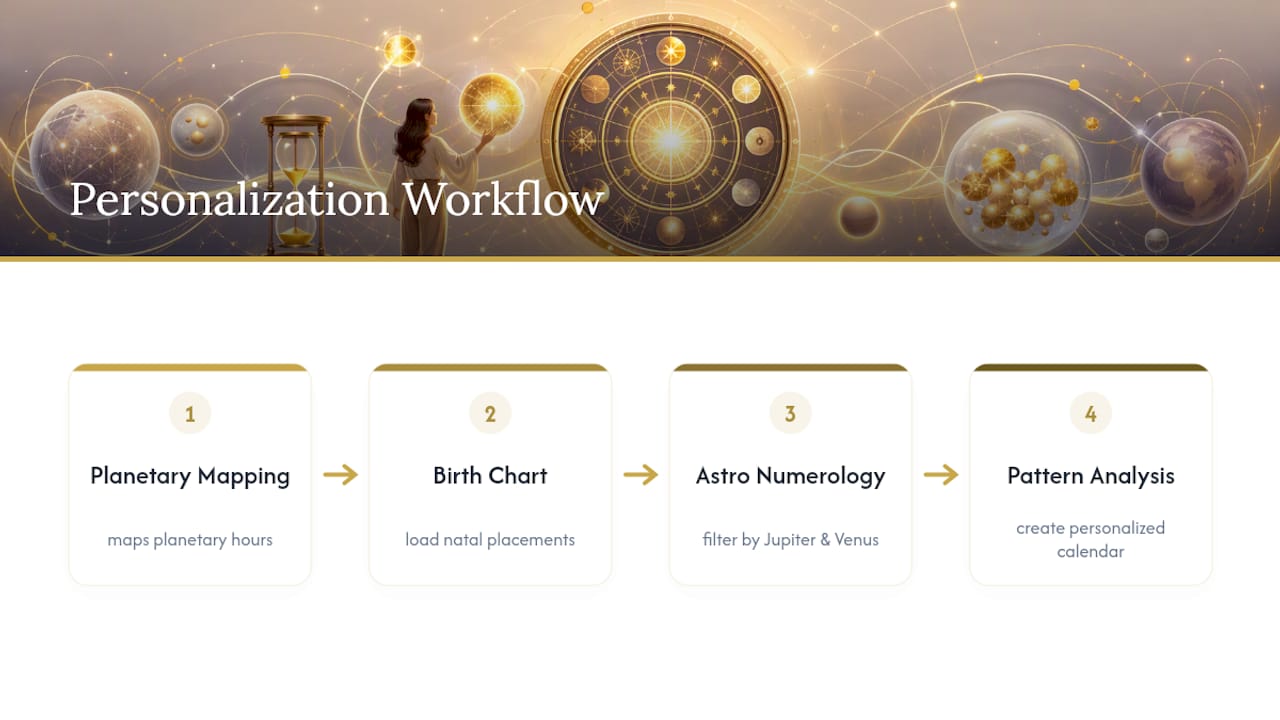
The behavioral payoff matters as much as the astrology. Planning a specific window ahead of time cuts down on impulsive, repeated ticket buying, and it works best paired with a spending limit you set before you ever check the calendar.
Lotto Oracle: An Automated Way to Handle Luck Calendars and Number Guidance
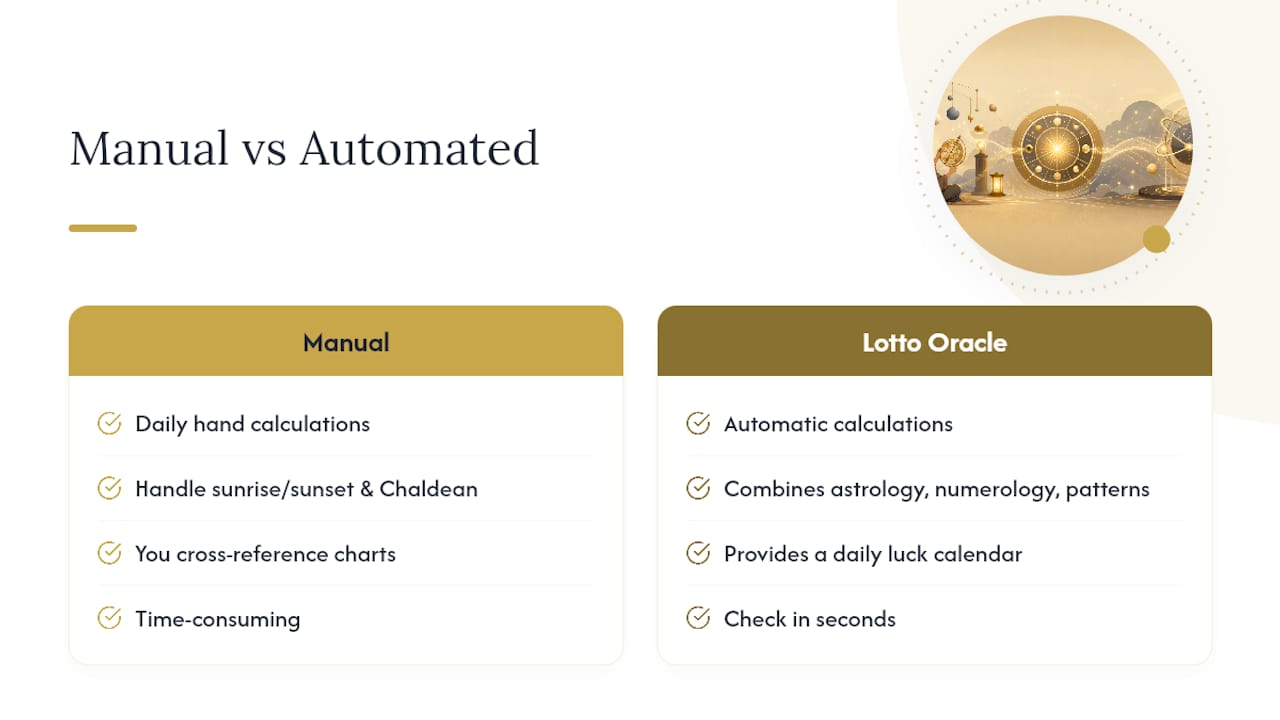
Calculating sunrise, sunset, and Chaldean sequences by hand every day gets old fast, especially once you're also trying to factor in your zodiac sign or numerology. A specialized app handles that math automatically, combining astrology, numerology, and historical pattern analysis into a personalized number and timing experience you check in seconds instead of building from scratch.
The luck calendar feature turns your birth data and current planetary positions into a daily readout, so you're not manually cross-referencing a Jupiter hour against your own chart every morning. Worth being clear about what this is: this is a subscription-based guidance app. It doesn't sell tickets or offer gambling services, and it won't change the odds on any draw. What it does is remove the manual calculation step and hand you a personalized starting point.
If you want your planetary-hour research turned into a daily habit instead of a weekly spreadsheet exercise, try Lotto Oracle and set a spending limit before your first session. Treat it as a tool for structure and enjoyment, not a prediction guarantee.
Timing as Ritual, Not a Way to Beat Randomness
Planetary hours give you something a lottery ticket alone never offers: a moment of intention before you spend money on chance. That's real value, even though it has nothing to do with the actual draw mechanics. A Powerball or Mega Millions drum doesn't know what hour you bought your ticket in, and no statistical analysis of jackpot timing has ever found a link between planetary alignments and winning numbers. What timing rituals actually deliver is discipline: a fixed window forces a fixed budget, and a fixed budget is the single most protective habit a lottery player can build.
Use planetary hours the way you'd use any pre-game ritual, for focus and enjoyment, and keep your spending inside limits you set in advance. If lottery play ever stops feeling entertaining, that's the signal to step back and seek support, not another calculation.
— amsd
Sources
- Planetary Hours Today – Free Live Calculator (Any Location)
- Horanow practitioner notes
- The Best Time to Play the Lottery
- Lucky Numbers Today — Astrology-Based Lottery Numbers