
There's no magic number of lines that cracks the code. The honest answer: set a fixed entertainment budget first, then decide your line count from what that budget allows, not the other way around. Buying more tickets does raise your odds in a straight line, but jackpot odds are so long that even doubling or tripling your usual line count barely moves the needle. Pooling with friends or coworkers, or using a system play, covers far more combinations than solo buying ever could on the same budget.
- Pick a weekly or monthly dollar limit you're fully comfortable losing.
- Buy only within that number, no exceptions.
- Consider a pool or syndicate before buying many lines alone.
Quick math: for a 6/49 draw, buying 10 lines instead of 1 takes your odds from about 1 in 13,983,816 to roughly 1 in 1,398,382. Better, yes. Still a long shot.
Key Takeaways
There is no universally optimal line count; the right number is whatever your fixed entertainment budget allows, since odds scale linearly but jackpot odds stay long regardless.
| Point | Details |
|---|---|
| No magic number | Set your budget first, then divide by ticket price to get your line count. |
| Odds scale linearly | Ten unique tickets move you from 1 in 13,983,816 to roughly 1 in 1,398,382 in a 6/49 draw. |
| Full coverage is unrealistic | 50% coverage of a 6/49 draw needs nearly 7 million tickets, costing roughly $13,983,816. |
| Pools beat solo buying | Syndicates and wheel systems expand coverage without raising your personal spend. |
| Personalize responsibly | Lotto Oracle adds astrology and numerology insights for entertainment value, not better odds. |
Table of Contents
- How Many Lottery Tickets Change Your Actual Odds
- How Many Lines Should You Buy Based on Your Budget?
- What Would It Cost to Cover Half a 6/49 Draw?
- Can You Cover More Numbers Without Spending More?
- The Mistakes That Cost Casual Players the Most
- Where Lotto Oracle Fits Into This Decision
- What the Math Actually Tells Casual Players
- Make Your Picks More Personal With Lotto Oracle
- Sources
How Many Lottery Tickets Change Your Actual Odds
Each unique line you buy is an independent shot at the jackpot, and those shots add up in a straight line, not a curve. Buy one ticket in a game with 13,983,816 possible combinations, and your odds are 1 in 13,983,816. Buy two different tickets and your odds become roughly 2 in 13,983,816. Ten unique tickets get you to about 10 in 13,983,816. This is basic addition, not some hidden multiplier effect casual players assume exists.
The math backs this up directly: buying k unique tickets gives you approximately a k/N chance at the jackpot, where N is the total number of possible combinations. That's a tenfold improvement in relative terms, but the absolute number barely budges. This is the part that trips people up.
- 1 ticket in a 13,983,816 combination game: 1 in 13,983,816.
- 10 tickets (unique numbers): about 1 in 1,398,382.
- 100 tickets (unique numbers): about 1 in 139,838.
There's a catch worth knowing before you grab a stack of quick picks. Random tickets can duplicate each other, especially if you're buying quick picks rather than choosing distinct number sets yourself. If two of your "10 tickets" land on the same six numbers by chance, you've effectively only bought nine unique entries. That's why estimates built on random-ticket purchasing always require a few more tickets than the pure unique-ticket math suggests to hit the same coverage target. If you want your money to buy actual distinct chances, check your numbers against each other before you leave the counter, or use a tool that tracks which combinations you've already claimed.
How Many Lines Should You Buy Based on Your Budget?
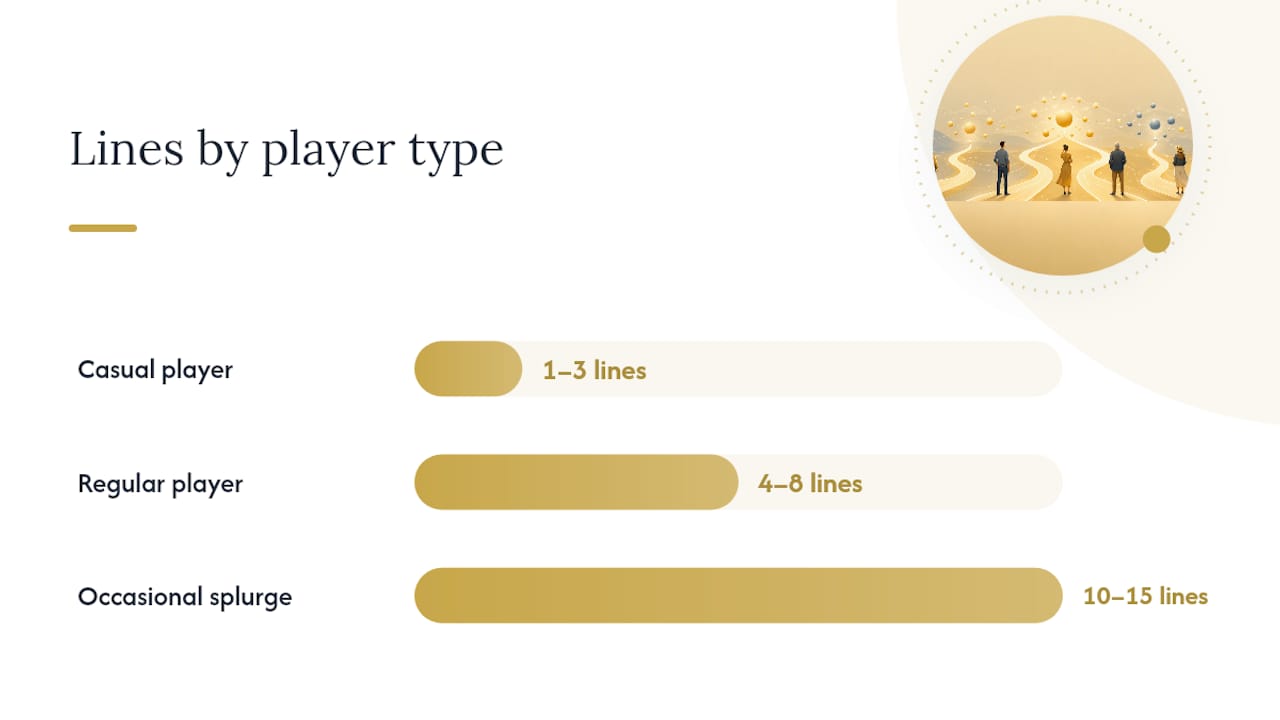
Your line count should come from your wallet, not from a gut feeling about lucky numbers. Here's how that breaks down by player type:
- Casual player: $5 to $10 per draw, which typically buys 1 to 3 lines depending on the game and ticket price.
- Regular player: $10 to $25 per draw, roughly 4 to 8 lines, often split across two draws per week rather than dumped into one.
- Occasional splurge: $30 to $50 for a single big-jackpot draw, maybe 10 to 15 lines, reserved for the rare Powerball or Mega Millions run where the jackpot has climbed into headline territory.
The conversion math is simple: take your weekly budget, divide by the ticket price, and that's your line count for the week. A $2 ticket and a $10 budget gets you 5 lines. Spread across two draws, that's 2 to 3 lines per draw rather than 5 in one shot, which keeps you playing consistently instead of blowing your whole allotment on a single ticket run.
Pro Tip: Decide your weekly number in advance and write it down somewhere you'll see it, like a note on your phone. The moment you're standing at the counter deciding on the fly, budgets tend to slip.
One overlooked wrinkle: if you're picking numbers based on common patterns like birthdays or lucky sequences, you increase your odds of splitting a jackpot if you win, since thousands of other players gravitate to the same low numbers. A tool for picking lottery numbers with less-common patterns won't improve your odds of winning, but it can improve your odds of keeping the whole prize if you do.
What Would It Cost to Cover Half a 6/49 Draw?
The gap between "a lot of tickets" and "enough tickets to meaningfully change your odds" is enormous, and seeing the real numbers side by side makes that gap impossible to ignore.
Reaching just a 50% shot at a 6/49 jackpot requires nearly 7 million unique tickets, costing almost $14 million at $2 apiece. No individual player is doing that. For deeper detail on how those odds break down draw by draw, this 6/49 odds breakdown walks through the combinatorics.
Now scale up to Powerball or Mega Millions, where the combination pool runs into the hundreds of millions. The ticket count and dollar figure needed for the same 50% coverage jump by more than an order of magnitude compared to 6/49, which is exactly why you see long lines forming during billion-dollar jackpot runs even though the math makes full coverage laughably out of reach for any single buyer.
One more distinction matters here: unique-ticket estimates assume no overlap. Random-ticket estimates (quick picks) run higher because duplicates eat into your effective coverage, meaning the real-world cost of hitting a given odds threshold with quick picks is always somewhat higher than the clean math suggests.
Can You Cover More Numbers Without Spending More?
Yes, and this is where most casual players are leaving value on the table. You don't need millions of dollars to meaningfully expand your coverage. You need other people.
- Pools and syndicates split the cost of many tickets across a group, so ten people chipping in $5 each buy the coverage of a $50 individual purchase, with the prize split proportionally if you win.
- System plays (wheels) let you pick more numbers than a standard line and automatically generate every combination from that set, guaranteeing coverage across your chosen numbers at a higher per-entry cost. Our wheel systems guide breaks down when this actually pays off versus when it's just spending more for a smaller psychological edge.
- Game diversification spreads a fixed budget across lotteries with different odds and prize structures, which won't improve your jackpot shot but can improve your overall shot at winning something.
Pro Tip: If you're running a pool, put the rules in writing before the first draw: contribution amounts, who holds the physical tickets, how prizes split, and what happens if someone forgets to pay. A five-minute conversation prevents every dispute you've ever read about in the news.
The Mistakes That Cost Casual Players the Most
Treating lottery spending like an investment is the single most common and most expensive mistake players make. Every ticket carries the same fixed long odds regardless of how much you've already spent this month, this year, or ever. There's no "due" jackpot and no number that's overdue for a win.
- Don't chase losses by buying more lines after a losing streak. The odds haven't changed, only your spending has.
- Set a hard weekly or monthly cap and track it, even loosely, in a notes app or budget spreadsheet.
- Never borrow money or dip into essential funds to buy extra lines for a single draw, no matter how large the jackpot headline reads.
- If you've hit your budget for this draw, stop. The next draw will still be there.
Pro Tip: Treat your lottery budget the same way you'd treat a movie ticket or a night out. Once it's spent, the entertainment is over until next time.
Where Lotto Oracle Fits Into This Decision
Lotto Oracle gives you personalized number suggestions built from astrology, numerology, and pattern analysis, layered on top of the straightforward math above. It doesn't change your odds. No app can. What it changes is how you engage with the process of picking numbers.
- Personalization turns a random quick pick into something that feels connected to you, whether that's a daily luck reading or a numerology profile tied to your birth date.
- Trend and pattern tracking helps you avoid the most commonly played number clusters, which matters for prize-splitting risk even though it doesn't touch jackpot probability.
- For readers curious about frequency patterns generally, our guide on lottery hot numbers covers the thinking behind pattern-based picks.
The entertainment value is real. The odds math never changes.
What the Math Actually Tells Casual Players
The conventional lottery advice you'll find most places either oversells "smart" number strategies or undersells the fact that pooling is genuinely the most efficient lever a casual player has. Neither extreme is honest. Buying more lines does help, in a strictly linear way, but for anyone spending under $50 a week, that improvement stays small in absolute terms no matter how you slice it.
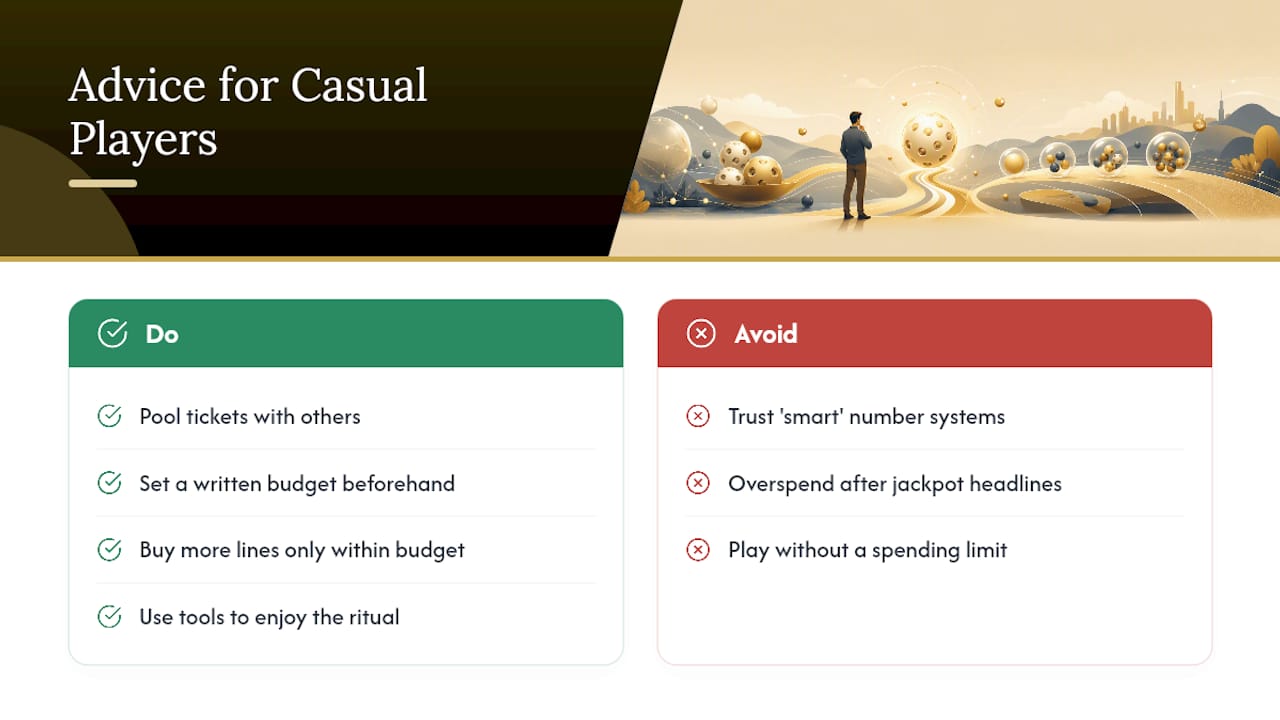
What gets underrated is the psychological side of budgeting. Most players don't overspend because they misunderstand probability. They overspend because there's no pre-set limit stopping them when a jackpot headline hits nine figures. A written budget, decided before you're standing at the counter, does more for your wallet than any number strategy ever will.
Where a tool like Lotto Oracle earns its place isn't in the odds column. It's in making the ritual of picking numbers feel personal and enjoyable rather than arbitrary, which is a legitimate reason to spend entertainment money on lottery tickets in the first place, as long as you already know your limit going in.
— amsd
Make Your Picks More Personal With Lotto Oracle
Skip the arbitrary quick pick and get numbers that actually mean something to you. Lotto Oracle is a subscription app for players who've already set their budget and want their picks to reflect more than a random number generator, blending your numerology profile, daily luck readings, and pattern tracking into a personalized pick each time you play.
You get a personalized number profile built from your own numerology and zodiac data, ongoing trend tracking across your favorite games, and tools that help you plan and organize lines if you're running a system play or splitting picks across a pool. It's entertainment-first: Lotto Oracle doesn't sell tickets and it won't promise a jackpot, but it does make the process of choosing numbers feel less like guesswork and more like something built around you. If your budget's already set and you're ready to make your next pick more personal, check out Lotto Oracle and see what your profile reveals.
Sources
- Lottery Ticket Estimator: Tickets Needed for 50%, 90% or 99% Odds
- How Lottery Odds Change When You Buy Multiple Tickets | DrawAnalytics Lottery Blog