
A machine learning lottery app is a subscription tool that turns your birthdate, play history, and favorite games into personalized number suggestions by blending astrology, numerology, and historical pattern tracking with algorithmic randomization. It exists to make picking numbers more personal and more fun, not to change your odds of winning. Tools like Lotto Oracle sit squarely in this category, built for entertainment and self-expression rather than statistical edge.
TL;DR:
- Personalized lottery apps do not improve your odds but can help you avoid crowded number combinations favored by other players.
- These apps analyze astrology, numerology, and past patterns but treat all combinations with equal probability, offering no predictive advantage.
- Many players cluster picks around birthdays and anniversaries, increasing the likelihood of splitting jackpots if those numbers win.
- Using these tools as fun rituals with a fixed budget and diversified strategies can keep gambling responsible and enjoyable.
- Look for transparent app features like unlimited number generation and split-risk alerts, and avoid platforms promising guaranteed wins or direct ticket purchases.
Table of Contents
- How Personalized Number Apps Actually Work
- What These Tools Can Change, and What They Can't
- Why Your Brain Wants to Believe Patterns Exist
- How to Use a Lottery Prediction App Without Losing Your Shirt
- What to Look for Before You Subscribe
- An Insider's Take on Reading the Numbers
- Try Lotto Oracle for Daily Number Guidance
- Sources
How Personalized Number Apps Actually Work
The term "machine learning lottery" gets tossed around loosely, but the mechanics behind a personalized number app are pretty straightforward once you see the pipeline. You feed the system a handful of personal inputs, it runs them through a few analytical layers, and it hands you back numbers that feel tailored to you.
The inputs usually include:
- Your birthdate and birth details (for astrology mapping)
- Your play history and which lotteries you follow
- Preferences you've set, like favorite numbers or avoided digits
- The specific draw or game you're checking numbers for
From there, three layers do the real work. Astrology looks at current planetary transits against your natal chart to flag "resonant" days or numbers. Numerology reduces your birthdate and name into single-digit or master numbers using classic reduction methods, similar to what you'd find in a daily numerology guide. Historical pattern tracking scans past draws for frequency trends, cold streaks, and repeat digits, though it never predicts the next draw with any certainty.
Algorithmic randomization is the final step. It takes the astrology and numerology outputs and reshuffles them within a randomized structure, so you're not just getting the same "lucky number" every day. The result shows up as daily number sets, trend dashboards, and, for subscribers, unlimited regenerations whenever the mood or the moon shifts.
What These Tools Can Change, and What They Can't
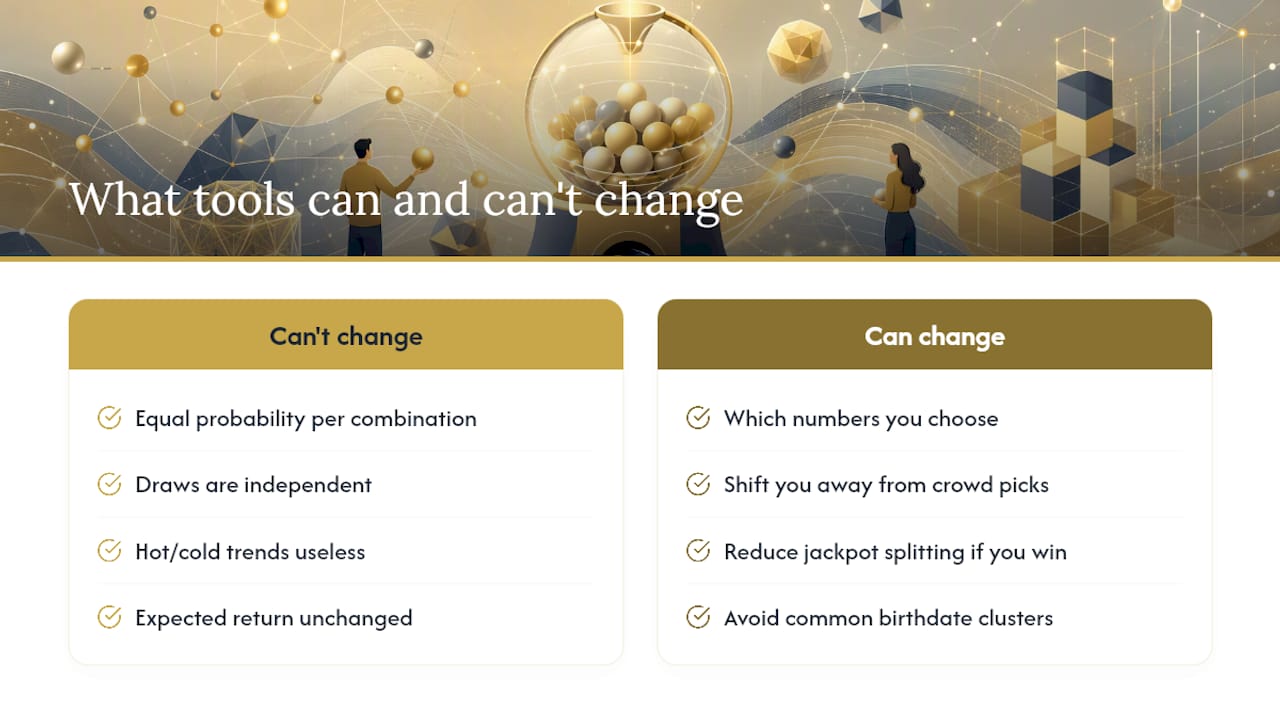
Every valid combination in a fair lottery draw carries identical probability. That's not a marketing caveat. It's how random drawing machines and number generators work. A combination like 1, 2, 3, 4, 5 has the exact same chance of hitting as any "balanced" spread of high and low numbers.
No pattern-tracking feature changes that math. Hot numbers don't become more likely because they hit twice last month. Cold numbers aren't "due." Each draw is independent, and expected return stays fixed no matter how many trends you layer on top.
The real signal isn't in the odds. It's in the choices. Large-sample studies of national lotteries show players pick numbers in wildly non-uniform patterns, favoring birthdates and clustering around certain positions on the ticket form.
That clustering matters more than most players realize. If thousands of people all pick the same "meaningful" combination, and it wins, the jackpot splits more ways. Personalization from an app doesn't boost your win probability, but it can shift you away from the crowd's default picks. That's a real, practical benefit even though it's not a statistical one. Odds resources like the probability primer for astrology and numerology players or a general odds explainer lay this out in more depth if you want the full math.
Why Your Brain Wants to Believe Patterns Exist
Two mental shortcuts explain almost every lottery habit you've ever had. The first is the representativeness heuristic: your brain assumes a "random-looking" spread of numbers (mixed odds and evens, no obvious sequence) is more likely to be drawn than something like 2, 4, 6, 8, 10, even though both have identical odds. Field experiments on lottery ticket choices confirm players consistently avoid "unnatural-looking" sequences for exactly this reason.
The second is the gambler's fallacy, the belief that a number "owed" a win after a cold streak. Neither belief holds up mathematically, but both shape real behavior in predictable ways:
- Players cluster picks around birthdates and anniversaries (numbers 1 through 31)
- Frequent players often avoid numbers that hit in recent draws, assuming they're "used up"
- Center-of-form picks and midrange numbers get chosen far more than edge numbers
These habits drive up split risk more than they drive up luck. When a popular date-based combination wins, more tickets share the prize.
Pro Tip: If part of your number set leans on a birthdate or anniversary, let the app's randomization layer fill in the rest instead of rounding everything to numbers under 31. It keeps the personal meaning while spreading your picks away from the most crowded combinations.
How to Use a Lottery Prediction App Without Losing Your Shirt
Personalized numbers work best as a fun ritual, not a financial plan. Here's how to keep it that way:
- Set a monthly entertainment budget before you subscribe or play, and treat it as fixed. Never add "just one more" ticket to chase a loss.
- Use app suggestions as inspiration, not gospel. Pair your astrology or numerology picks with a quick-pick or a small syndicate to naturally spread out your split risk.
- Test the free tier or demo first. Get a feel for how daily numbers, trend dashboards, and unlimited regeneration actually work before paying for a full subscription.
- Watch for split-reduction alerts if the app offers them. They flag when your picks overlap heavily with popular combinations.
- Set app-level spending limits if the platform supports them, and know where to find responsible gambling resources if play ever starts to feel less like fun and more like pressure.
What to Look for Before You Subscribe
A trustworthy entertainment app makes its limitations obvious instead of burying them. Look for a visible author bio or team credentials, a plain-language explanation of how astrology, numerology, and pattern data combine, and a privacy policy that spells out what happens to your birth details and play history.
On the feature side, a solid subscription should include:
- Personalized natal and numerology profiles, not one-size-fits-all number lists
- Unlimited number generation so you're not capped at a handful of tries per day
- Trend and pattern dashboards you can actually read at a glance
- Split-reduction logic that nudges you away from overcrowded combinations
- Mobile access for daily luck readings on the go
Pricing should feel proportionate to what you're getting: a low-cost entry tier for casual use, a higher tier for full personalization and unlimited generations. Walk away from anything promising guaranteed wins, hiding its methodology, or asking you to buy tickets directly through the app. That's a legal and trust red flag, not a feature.
An Insider's Take on Reading the Numbers
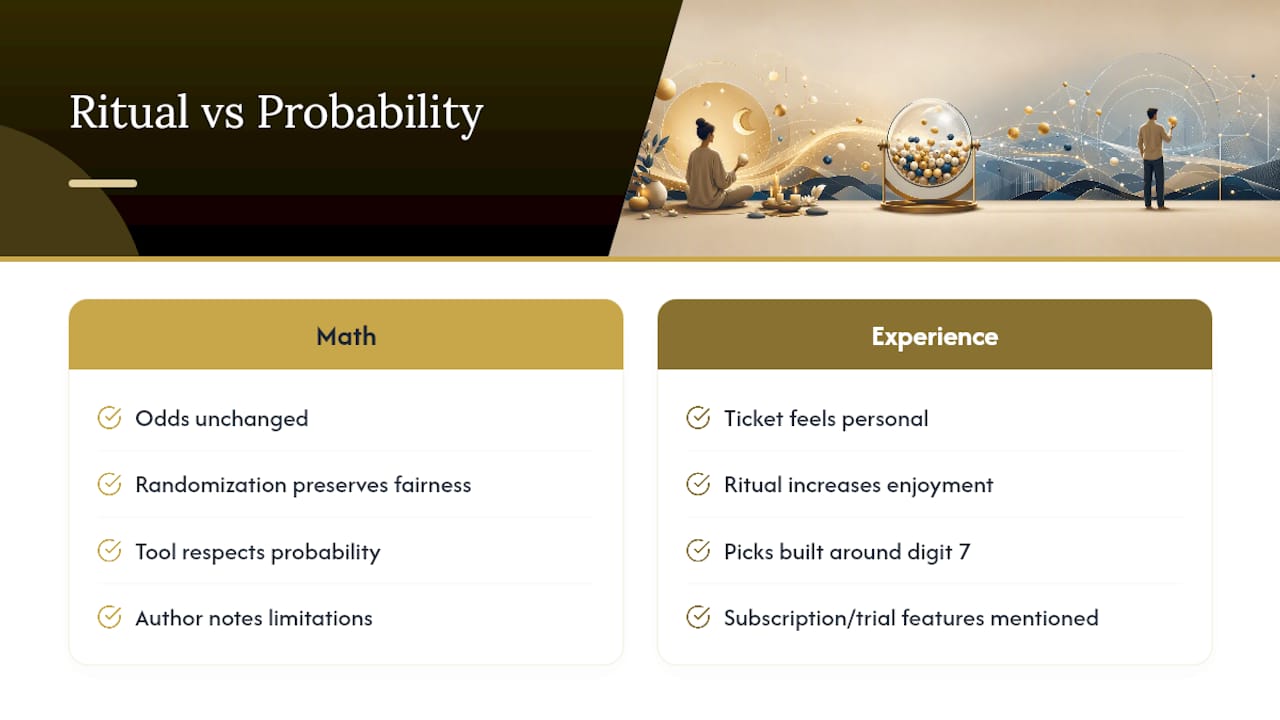
I check my numerology reduction and daily transit alignment most mornings before picking numbers, mostly because it turns a five-second task into a small ritual I actually enjoy. Last month, my numerology day-number kept landing on 7, so I built my picks around that digit and let the app's randomization handle the rest instead of forcing every number toward my birthdate. Did it change my odds? No. Did it make Tuesday's ticket feel more like mine? Absolutely, and that's the entire point of a tool like this.
Author expertise / author bio; transparency about limitations; privacy and data handling; subscription features and trial/free tier; educational content about odds.
— amsd
Try Lotto Oracle for Daily Number Guidance
Lotto Oracle gives you what a spreadsheet of past draws never could: numbers that feel personal, delivered daily, without pretending to beat the math. Subscribers get personalized natal and numerology profiles, daily luck readings, trend dashboards for the games they follow, and unlimited number regeneration whenever inspiration strikes.
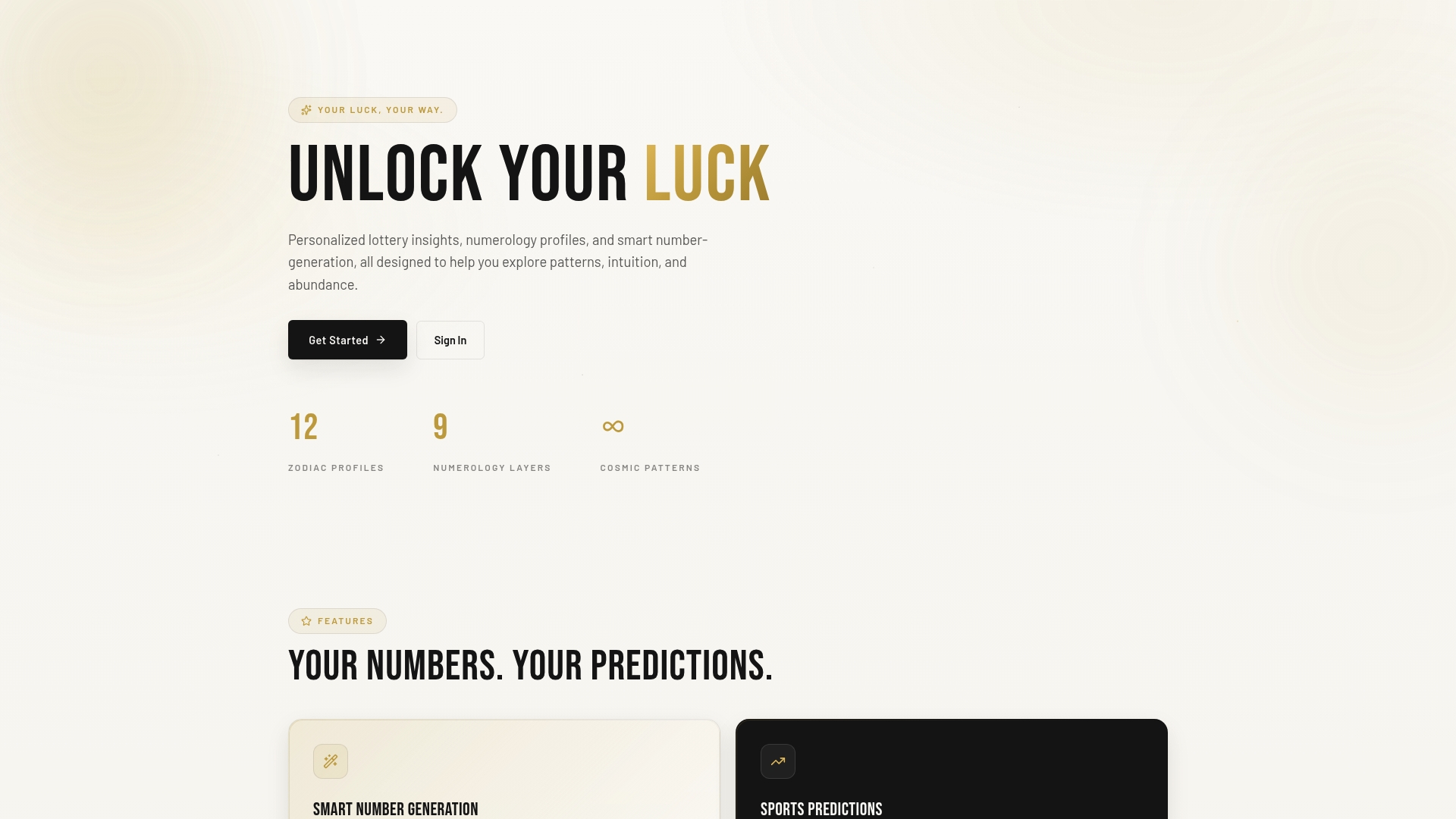
It's built for players who want the ritual and the fun of astrology-based picks alongside a straight-up education on how odds actually work, including split-risk awareness baked right into the suggestions. If you're ready to swap random guessing for numbers that at least feel like yours, start with Lotto Oracle and try the free tier before you commit to anything bigger.
Sources
- Number preferences in lotteries (Cambridge Journal article)
- The representativeness heuristic and the choice of lottery tickets: A field experiment
- The psychology of lottery gambling (research review)