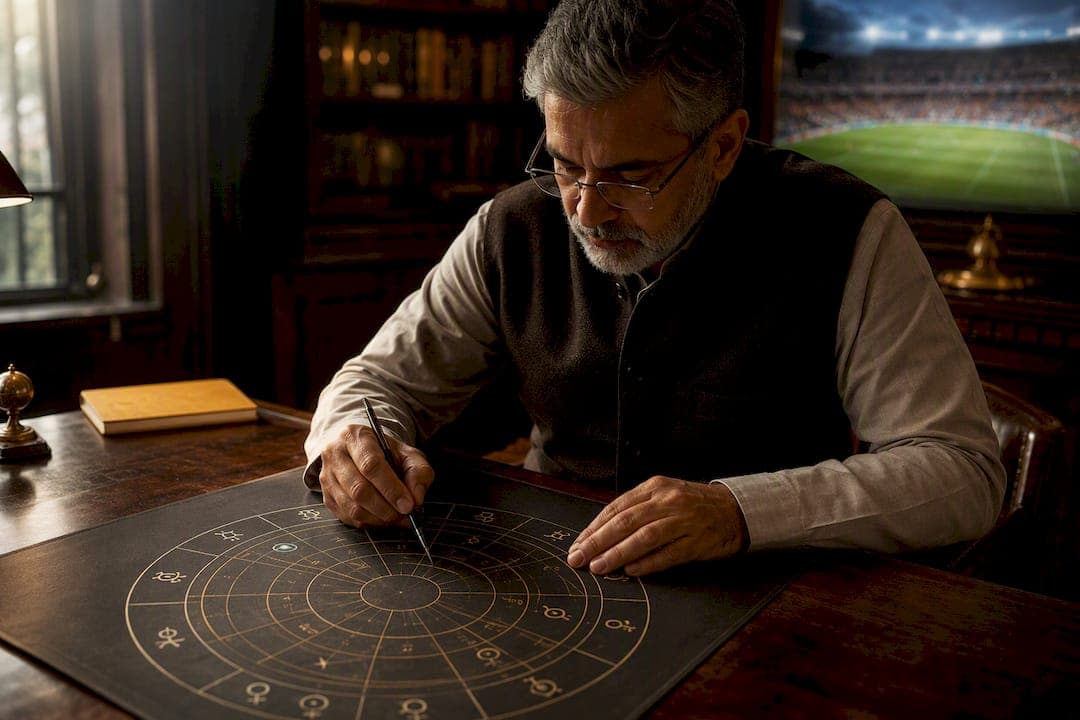
Astrology can sharpen how you read a matchup, but it won't beat the bookmaker's margin on its own. Practitioners use event charts, planetary rulerships, and Moon timing to gauge which side has the edge, and some claim 70 to 80% accuracy on specific one-on-one contests using Vedic techniques. Treat every signal as a probability nudge, size your stakes accordingly, and never chase a loss because a chart looked favorable.
TL;DR:
- Contest charts are essential for single-game predictions because they capture real-time conditions more accurately than long-term natal charts.
- The strongest signals come from analyzing the rulers of the first and seventh houses, their dignity, aspects, and the Moon's condition at the start.
- Vedic techniques emphasize precision when casting charts and measuring planetary strength, but these methods lack controlled scientific validation.
- Using astrology as an overlay alongside conventional data improves decision-making, yet it should not lead to bigger bets without agreement or confirmation.
- Automated tools can streamline chart generation, pattern logging, and timing analysis, but disciplined bankroll management remains crucial.
Table of Contents
- What Is Sports Betting Astrology: Contest Charts vs. Natal Charts
- Core Techniques: Vedic and Horary Methods Bettors Use
- Applying Astrology to Betting: A Pragmatic Workflow and Risk Controls
- Evidence and Limitations: Accuracy Claims, Bias, and How to Judge Results
- How Practitioners and Tools Turn These Methods Into Everyday Overlays
- Historical Background and Cultural Context of Astrology in Sports Betting
- Sports Betting Astrology vs. Statistical Models and Expert Opinion
- Documented Examples of Astrology Applied to Sports Predictions
- Common Misconceptions About Sports Betting Astrology
- A Practitioner's Honest Take on Astrology and Betting Discipline
- Try Astrology-Based Sports Overlays Without Doing the Chart Work Yourself
- Sources
What Is Sports Betting Astrology: Contest Charts vs. Natal Charts
Sports betting astrology is the practice of reading an event's own astrological chart, not the birth chart of any player, to judge which side is favored. That distinction trips up almost everyone new to the method. A player's natal chart tells you about their lifetime tendencies: durability, temperament, career highs and lows. It's useful background, but it can't tell you who wins a specific match on a specific Tuesday. For that, practitioners build what's called a contest chart, sometimes labeled an event chart or horary chart, cast for the exact time, date, and location the game begins.
The logic is that a contest is its own event, a "space-time" entity with a character all its own, separate from the biographies of the people playing it. Once you cast that chart, you assign one side to the 1st house and the opposing side to the 7th house, the axis astrologers have long used for confrontations and partnerships. From there, you look at which house has stronger planetary rulership, better aspects, and fewer afflictions.
Why event charts dominate over natal charts for bettors:
- Natal charts show long-term patterns (career peaks, injury-prone periods), useful for season-long prop bets or futures, not single-game calls.
- Event charts capture the specific conditions of one contest, which is what a single-game or single-fight wager actually needs.
- Team charts (built from an organization's founding date) sit somewhere between the two, useful for gauging a franchise's broader cycle but too slow-moving for game-day decisions.
- Horary charts, cast the moment a question is asked ("who wins tonight's game?"), work as a substitute when you don't have precise event data.
Several houses matter more than others once the chart is up. The 5th house governs games, competition, and speculative risk, making it the natural home for gambling-related questions. The 6th house relates to effort, service, and struggle, which some astrologers read as the "grind" side of a competitive event. The 7th house is the opponent's seat. The 8th touches sudden reversals and hidden factors, the kind of late injury or turnover that flips a game. The 3rd house connects to short journeys, communication, and coordinated effort, relevant for team chemistry. The 11th house, tied to gains and outcomes, often gets checked last as a kind of confirmation signal.
The Moon carries outsized weight in this system because it moves fast, changing sign roughly every two and a half days, which makes it the chart's real-time mood indicator. A well-placed Moon at the moment a game starts is one of the more commonly cited quick reads practitioners use before deeper rulership work. Translating any of this into an actual betting signal means asking a specific question: does the 1st house ruler sit stronger, by dignity and aspect, than the 7th house ruler? If yes, that side gets the nod, not as a certainty, but as a lean worth weighing against the odds on the board.
Core Techniques: Vedic and Horary Methods Bettors Use
The most detailed public breakdown of these methods comes from Simon Chokoisky's book, "Gambler's Dharma," which outlines five distinct techniques for predicting winners using Vedic astrology, all built around contest-chart analysis rather than player biographies. Vedic astrology, or Jyotish, differs from Western astrology mainly in its zodiac system (sidereal instead of tropical) and its heavier reliance on planetary periods called dashas, along with a more rigid system for measuring planetary strength.
Here's a simplified sequence of how a practitioner typically works through a contest chart:
- Cast the chart for the exact start time, date, and venue location of the event. Precision matters here; a chart cast ten minutes off can shift house cusps enough to flip a reading.
- Assign the houses. The favorite or home side usually takes the 1st house, the underdog or visiting side the 7th, following the same axis used in horary astrology for any confrontation.
- Identify the house rulers. Every house has a ruling planet based on which sign occupies its cusp. Find both rulers and note their sign placement, house position, and any aspects they're receiving.
- Measure planetary strength. This is where Vedic technique gets specific: dignity (is the ruler in its own sign, exalted, or debilitated?), house placement (angular houses like 1, 4, 7, and 10 carry more weight), and aspects from benefics (Jupiter, Venus) versus malefics (Saturn, Mars, Rahu).
- Check the "body, mind, and soul" of each side. Practitioners often break the analysis into three layers: physical strength and stamina (read through Mars and the 1st/6th houses), motivation and mental sharpness (Mercury and Mars aspects), and a deeper karmic or fated quality (Jupiter and Saturn placements, sometimes cross-checked against dasha periods).
- Look at the Moon's condition. A waxing, well-aspected Moon in a strong house adds confidence to whichever side it favors; a debilitated or heavily afflicted Moon is treated as a warning sign.
- Cross-reference with transits. Current planetary transits over the natal or team chart can reinforce or contradict what the contest chart shows, and practitioners weigh agreement between the two more heavily than either signal alone.
That "body, mind, and soul" framework is worth sitting with, because it's the part most beginners skip. Physical strength alone doesn't decide a contest. A side can have overwhelming natal talent (strong "body" signals) but a contest chart showing a weak or afflicted ruler for that day, which some practitioners read as low motivation or bad timing ("mind" and "soul" out of sync with the body). When all three layers point the same direction, that's treated as a stronger signal than when they're split.
Pro Tip: Don't just check who "wins" the rulership battle. Check the margin. A house ruler that's exalted and aspected by two benefics is a very different signal from one that's merely in its own sign with no other support. Weight your confidence, and your stake, accordingly.
Consider a hypothetical one-on-one contest, say a title fight, cast for the opening bell. Suppose the 1st house (Fighter A) is ruled by Mars, and Mars sits exalted in Capricorn in the 10th house, aspected by Jupiter. The 7th house (Fighter B) is ruled by the Moon, and the Moon is in its debilitated sign, afflicted by Saturn. Under this method, Fighter A shows the stronger contest-chart profile: an exalted ruler in an angular house with benefic support against an opponent's debilitated and afflicted house ruler. That doesn't guarantee the outcome. It's a lean, the same way a statistical model might lean toward a team based on efficiency metrics, not a promise.
One-on-one events like boxing, tennis, or MMA tend to produce cleaner readings than team sports, because there's no third party diluting the 1st/7th house axis. Team sports introduce more variables, injuries to role players, coaching changes, weather, that a chart alone won't flag, which is exactly why astrology works best layered on top of other analysis rather than standing in for it.
Applying Astrology to Betting: A Pragmatic Workflow and Risk Controls
A workable process runs in a specific order, and skipping steps is where most beginners get burned. Start with event selection: pick a contest with a known, precise start time and location, since imprecise data produces an unreliable chart. Cast the contest chart and note the rulership battle exactly as described above. Then, critically, pull the conventional handicapping picture: current form, injury reports, head-to-head history, and the odds themselves.
This is where astrology functions as an overlay, not a replacement. If the contest chart favors one side and the conventional data also favors that side, you've got agreement, which is a stronger position than either signal alone. If the chart favors one side but the injury report and market odds strongly favor the other, that's a signal to sit out or reduce stake size, not to bet against the market on astrology alone.
A simple pre-bet checklist:
- Confirm event time and location are accurate before casting the chart; a wrong time invalidates the whole reading.
- Check the Moon's sign and condition for the event window; a poorly placed Moon is one of the more commonly cited caution flags in gambling horoscope guidance.
- Cross-check astrological lean against injury news and line movement before finalizing a stake.
- Avoid placing bets on days astrologers flag as personally ill-disposed for you, separate from the event chart itself.
Timing carries its own layer of nuance. Because the Moon changes sign roughly every two and a half days, that window is often treated as a practical operational cycle: a stretch where general gambling luck is read as trending up or down for a given sign. Horoscope columns built around lucky betting days lean on this cycle heavily, publishing sign-by-sign guidance on which days to lean in and which to hold back. It's worth treating that guidance as a soft filter, not a hard rule; skipping a bet you'd otherwise like because the Moon looks rough is a reasonable caution, but betting purely because a horoscope column says today's lucky is a weaker basis for risking money.
Bankroll discipline matters more here than in almost any other betting approach, precisely because astrology can generate false confidence.
Recording results is where astrology-based betting either proves itself or gets exposed. Log every pick: the event, the chart-based lean, the conventional handicap, the odds taken, the stake, and the outcome. Over a large enough sample, you can calculate a straightforward hit rate and return on investment, and compare that against what you'd expect from random chance at the odds you're taking.
Practitioners who claim strong results on specific one-on-one techniques point to sample sizes built over years of tracked contests, not a handful of lucky calls, which is the honest benchmark to hold your own results against.
Evidence and Limitations: Accuracy Claims, Bias, and How to Judge Results
The most cited accuracy claim in this space comes from practitioner literature suggesting certain Vedic techniques hit 70 to 80% accuracy on one-on-one sports competitions specifically. That figure comes from a practitioner's own record-keeping and book-length case studies, not from an independent, peer-reviewed, controlled trial. It's a meaningful data point from someone who has clearly logged results over time, but it isn't the same evidence tier as a clinical study or an academic replication.
A few structural issues are worth understanding before you weight that number too heavily:
- Selection bias. Practitioners tend to publish and discuss their hits more than their misses, and case studies in books are often chosen because they illustrate the method working cleanly.
- Small samples relative to a full betting career. A few dozen or even a few hundred logged contests is meaningful for a hobbyist but small compared to the sample sizes statisticians use to claim genuine predictive edge.
- No controlled comparison group. There's no published study running astrology-based picks against a random-pick baseline or against a pure statistical model on the same slate of games.
- Market efficiency works against everyone. Bookmaker margin (the "vig") means even a genuinely skilled predictor needs to clear that margin before turning a real profit, and variance can mask a real edge or fake one over any short stretch.
None of that means the technique is worthless. It means the honest framing is "a coherent, practitioner-tested method with a plausible logical structure and anecdotal support," not "scientifically proven." If you want to actually test it for yourself, the protocol is simple: record every pick before the event happens (never after, to avoid hindsight bias), note the odds and stake, track outcomes over at least 50 to 100 contests, and calculate your realized ROI against your hit rate at the odds you actually took.
Pro Tip: Run a basic significance check once you've got enough data: compare your hit rate against what pure chance would predict at your average odds. If your results aren't meaningfully better than a coin flip adjusted for the odds, the method isn't adding value for you personally, whatever the book claims.
How Practitioners and Tools Turn These Methods Into Everyday Overlays
Casting an accurate contest chart by hand, checking rulerships, dignity, and current transits, takes real time, which is exactly the gap an app can close. Lottooracleapp's Lotto Oracle platform builds personalized astrology and numerology overlays and tracks patterns over time, which is the same underlying logic practitioners use manually, just automated for speed.
If you want to see the reasoning applied directly to sports contexts, three posts on the site are worth reading in sequence: "Can Astrology Actually Predict Sports Outcomes?" walks through the core question skeptics raise, "Bet Smarter for Bettors" covers numerology overlays alongside the 1% to 3% staking rule, and "Your Luck Calendar for Gambling" breaks down Moon-window timing in plain terms.
What an app genuinely speeds up:
- Chart generation. Instead of manually casting a contest chart, a platform can generate the rulership and house data instantly for any event you enter.
- Pattern logging. Tracking your picks against outcomes over months is tedious by hand; a subscription tool can hold that history and surface trends in it.
- Numerology cross-checks. Combining a zodiac-based read with numerology signals gives you a second, independent data point to weigh against the astrological one.
- Daily luck context. A running luck calendar gives you the Moon-window and personal-day context without you having to check an ephemeris yourself.
None of that replaces judgment, and no app should claim it does. Speed and organization make it easier to test a method honestly, log results, and stay disciplined about staking, but the outcome of any single contest stays genuinely uncertain.
Historical Background and Cultural Context of Astrology in Sports Betting
Astrology's connection to games of chance and competition stretches back long before modern sportsbooks existed. Ancient Babylonian and later Hellenistic astrologers used horary questions, chart-based answers to specific questions asked at a specific moment, for everything from military outcomes to personal fortune, and that horary tradition is the direct ancestor of today's contest-chart method.
Vedic astrology carried its own parallel tradition in India, where timing auspicious moments (muhurta) for competitions, journeys, and contracts has been practiced for centuries, independent of any Western influence. That's part of why modern practitioners like Chokoisky lean specifically on Vedic technique rather than Western tropical astrology for sports prediction; the dasha and strength-measurement systems were built with exactly this kind of applied, outcome-focused question in mind.
The modern crossover into commercial sports betting is much newer, tracking the broader mainstream normalization of both astrology (daily horoscope apps, zodiac-based content across social media) and legal sports wagering over the past decade. Publications now regularly run event-based predictions for major tournaments, analyzing team and player charts against current transits ahead of events like the World Cup, which shows how far the practice has moved from a niche practitioner activity into mainstream sports media content.
Sports Betting Astrology vs. Statistical Models and Expert Opinion
Statistical models, the kind built on efficiency metrics, historical scoring data, and regression analysis, aim for objectivity through large, verifiable datasets. Their strength is reproducibility: anyone can rerun the same model on the same data and get the same output. Their weakness is that they struggle with genuinely novel situations, a key injury announced an hour before tip off, a coaching change mid-season, that haven't shown up enough times in the historical data to be weighted properly.
Expert opinion, the beat writers and former players who dominate sports media predictions, brings context statistics miss: locker room chemistry, a coach's tendencies in big moments, a player's history in similar pressure situations. Its weakness is inconsistency and personal bias; two experts watching the same matchup often land on opposite picks for reasons that don't survive scrutiny.
Astrology sits in a third lane entirely. It doesn't use historical performance data at all, and it doesn't rely on subjective feel for the matchup either; it reads the symbolic structure of the moment the event begins. That makes it fundamentally different in kind from the other two, not necessarily better or worse. The strongest practical approach treats all three as separate, independent inputs and looks for agreement between them, rather than picking one system and ignoring the others.
Documented Examples of Astrology Applied to Sports Predictions
The clearest documented record of astrology applied specifically to sports outcomes lives in practitioner books rather than academic journals. "Gambler's Dharma" builds its case around contest-chart examples and anecdotal betting records drawn from real matches the author tracked over time, walking through the rulership analysis for specific events and comparing the chart-based lean against the actual result.
John Frawley's earlier work on sports astrology takes a similar case-study approach from a traditional Western horary background rather than a Vedic one, showing that the underlying contest-chart logic, assigning sides to opposing houses and judging which ruler comes out stronger, shows up across different astrological traditions independently.
More casual documentation shows up constantly in mainstream astrology media: tournament preview articles that chart competing teams against current transits and publish a lean before the event happens, which is at least a testable, dated prediction rather than a vague after-the-fact claim. The honest caveat across all of this material is that none of it comes from a controlled study design. It's practitioner record-keeping, useful as a demonstration of method and logic, but not equivalent to scientific proof of predictive power.
Common Misconceptions About Sports Betting Astrology
The biggest misconception is that astrology claims certainty. No serious practitioner argues a chart guarantees an outcome; the entire framework is built around probability and favorability, the same language a statistician would use about a model's edge. Treating any single chart reading as a lock is a misuse of the method, not a feature of it.
A second common error is using a player's birth chart to predict a single game's outcome. Natal charts describe long-term character and tendencies, not the outcome of a specific contest happening on a specific day; that's what contest charts exist for, and conflating the two produces bad predictions that then get blamed on astrology generally.
Skeptics often point out, fairly, that there's no controlled trial proving astrological methods beat chance at scale. That's an accurate criticism of the evidence base, not necessarily of the internal logic of the technique itself. The reasonable position sits between blind acceptance and blanket dismissal: treat contest-chart analysis as one input worth testing against your own tracked results, weighted no more heavily than form, injury data, or market odds, and let your own logged outcomes tell you whether it's earning its place in your process.
A Practitioner's Honest Take on Astrology and Betting Discipline
The temptation with any chart reading is to treat a strong signal as permission to bet bigger than usual. Resist that. The method's own internal logic argues against it: even a clean rulership win for one side is a lean, not a lock, and the "body, mind, soul" framework exists precisely because agreement across multiple layers is rarer than a single strong signal.
The method they used mattered less than the discipline they kept around staking and record-keeping.
If a stretch of results goes badly, the ethical move is to step back, not chase losses with bigger stakes to recover faster. Some practitioners suggest setting aside a small portion of any winnings for charitable giving, a habit that keeps betting framed as entertainment with edges, never as a solution to financial pressure.
— amsd
Try Astrology-Based Sports Overlays Without Doing the Chart Work Yourself
Casting a contest chart by hand, checking rulerships and dignity, cross-referencing transits, takes real time even once you know the method. Lotto Oracle builds those same astrology and numerology overlays automatically and keeps a running log of your patterns, so you spend your time reviewing signals instead of calculating them.
Personalized insights, a daily luck calendar, and trend tracking offer a faster starting point for the described workflow: generate the overlay, weigh it against form and odds, and log the result. This does not replace injury reports, line shopping, or your own bankroll rules, nor is it a lottery ticket seller or gambling service. It serves as a tool for the analysis layer. If you want a zodiac-number angle alongside your sports picks, the site's zodiac number guide is worth pairing with your overlay. Head to the Lotto Oracle landing page to start a subscription and try the sports and numerology overlays on your next tracked event.
Sources
For deeper technique, read Simon Chokoisky's "Gambler's Dharma" and John Frawley's "Sports Astrology." For staking and tracking basics, see Lottooracleapp's lottery probability primer.
- Gambler's Dharma (Google Books entry)
- Gambler's Dharma: sports betting with Vedic astrology (Internet Archive)
- Horoscope: Lucky betting days and numbers for each Astrological sign (Yahoo Life)
- Casinos
- Astrology