
Numerology can sharpen how you pick and time sports bets, but it never changes the actual odds on a game. Treat it as a confirmation layer: calculate a matchup's numbers, see if they align with your handicapping, and only then consider betting. Lotto Oracle automates the number crunching so you spend your time on analysis, not arithmetic. The methods, real-world examples, and risk controls below explain exactly how to build that process.
TL;DR:
- Numerology works as a confirmation tool, not a predictor, requiring numbers to align with traditional handicapping before placing a bet.
- Calculations involve reducing birthdates, names, and event dates to single digits or master numbers like 11, 22, or 33, which are used selectively for big games.
- Betting based on numerology should be conservative, limiting wagers to 1-3% of the bankroll and tracking every prediction for future analysis.
- Numerology systems in sports primarily use Pythagorean reduction, while other methods like Chaldean or Kabbalistic are less common and more complex.
- It is crucial to predefine signals, avoid chasing losses, and remember that numerology cannot influence odds or outcomes but can serve as a psychological discipline aid.
Table of Contents
- How Numerology Works for Sports Predictions
- Applying Numerology to Matchups: Two Worked Examples
- Building a Numerology Workflow Into Sports Betting
- What Numerology Can't Do: Limitations and Responsible Gambling
- Lotto Oracle's Approach to Sports Numerology
- Numerology vs. Traditional Sports Analytics: What the Numbers Actually Show
- Myths About Numerology in Sports Forecasting
- Numerology Systems Used in Sports Prediction
- Treat It as Structure, Not a Crystal Ball
- Turn Your Numbers Into a Repeatable Sports Overlay
- Sources
How Numerology Works for Sports Predictions
Numerology reduces names and dates into single digits, and each digit supposedly carries a distinct energy. The core calculations bettors borrow from personal numerology are straightforward once you know the formulas.
Life path number: add every digit in a birthdate until you reach a single digit (or a master number). A player born March 14, 1998, calculates 3+1+4+1+9+9+8 = 35, then 3+5 = 8.
Expression number: convert a full name to numbers using the Pythagorean chart (A=1, B=2, C=3, and so on through I=9, then repeating), sum the digits, and reduce.
Personal-year number: add the current year's digits to a birth month and day to find where an athlete or team sits in a nine-year cycle.
Event or power number: reduce the game date itself. A November 22, 2026 matchup becomes 1+1+2+2+2+0+2+6 = 16, then 1+6 = 7.
Most sporting numerology systems use Pythagorean reduction, but they stop reducing at 11, 22, or 33, since these "master numbers" are believed to carry amplified meaning.
- Use birthdates for individual athlete cycles (fighters, golfers, tennis players)
- Use team founding dates or franchise names for expression numbers
- Use the event date itself for the power number that supposedly governs the whole matchup
- Reserve master numbers for standout games, not every regular-season matchup
Once you've got these baseline numbers, the next step is applying them to actual games and seeing what patterns, if any, emerge.
Applying Numerology to Matchups: Two Worked Examples
Here's how the calculations play out on real dates, with the caveat up front: these are illustrations of method, not proof the method works.
Example one: A boxing match set for June 18, 2026. The event number reduces as 6+1+8+2+0+2+6 = 25, then 2+5 = 7. If one fighter's life path number is also 7, numerologists would call this alignment a strong signal favoring that fighter. Whether the fighter actually wins depends entirely on skill, weight cut, and matchup styles, none of which the number 7 accounts for.
Example two: A hockey franchise founded in 1967 (Philadelphia Flyers-style example) reduces to 1+9+6+7 = 23, then 2+3 = 5. Facing a team on a game date that also reduces to 5 would be read as a double alignment. Large-scale event breakdowns, like the kind built around major tournaments, follow this exact template: assign each team an expression number, reduce the tournament date, and flag overlaps.
- Calculate the event date's power number first, since it applies to both sides equally
- Calculate each team's or athlete's expression number from their full legal or franchise name
- Flag a match only when at least two separate numbers align, not just one
- Write down the prediction and the reasoning before the game, not after
Pro Tip: Screenshot or write down every numerology-based pick before kickoff. Reviewing picks after the final score almost always tempts you to reinterpret a "close enough" number as a hit.
Keno draws highlight this same numerology appeal in a purer form, since the player's only real decision is which numbers to select, but keno also carries a house edge often between 20% and 35%, which no numerology system changes. That single fact should temper how much confidence you assign to any alignment you spot in a matchup, tournament, or draw.
The retrospective trap is real: once you know who won, it's tempting to find some number that lines up and call it validation. Guard against that by locking in your prediction and reasoning before the event, every time.
Building a Numerology Workflow Into Sports Betting
Numerology should enter your process last, not first, as outlined in this sports-collection investing guide that highlights the importance of measured, layered approaches. Start with standard handicapping: injury reports, line movement, matchup history, and advanced metrics specific to the sport. Only after you've formed a baseline opinion should you calculate the numerological overlay and check for alignment.
Practitioners who use numerology profitably treat it strictly as a confirmation filter, betting with more conviction only when the numbers and the stats agree, and passing entirely when they conflict.
Stake sizing needs hard limits before numerology ever touches your bankroll:
- Cap any single wager at 1% to 3% of your total bankroll, regardless of how strong the alignment looks
- Use a flat unit system (1 unit = 1% of bankroll) rather than scaling up on "lucky" numbers
- Set a separate, smaller sub-bankroll specifically for numerology-influenced bets so it never bleeds into your core handicapping bankroll
- Never increase stake size because a master number (11, 22, 33) appeared
Record-keeping turns this from a hobby into a testable system. Log the date, the calculated event number, the team or athlete numbers, your stats-based pick, whether numerology agreed or disagreed, your stake, and the result. Review that log every 25 to 50 bets, and don't draw conclusions about accuracy until you've logged at least a few hundred outcomes. A structured wheel-style tracking approach built for lottery number coverage applies the same discipline to organizing multiple picks at once.
What Numerology Can't Do: Limitations and Responsible Gambling
Numerology cannot change the mathematical probability of any single sporting outcome. A coin flip stays 50/50 no matter what number the date reduces to, and numerology used in gambling contexts works as a selection or timing framework, not a probability adjustment.
The real risk is cognitive, not mathematical. Confirmation bias makes you remember the alignments that hit and forget the ones that missed. Selection bias creeps in when you only calculate numbers for games you already wanted to bet.
- Predefine your numerology signal before the game, never after
- Track every prediction, including the ones you didn't act on
- Set a strict loss limit per week and stop when you hit it
- Avoid chasing losses by upping your stake on the next "aligned" game
Approaches that hold up in keno and similar number games lean on budget limits, not number theory, and that principle carries over directly to sports betting.
Lotto Oracle's Approach to Sports Numerology
Lotto Oracle automates the calculations covered above, so you get a matchup's power number, team expression numbers, and personal-year cycles without doing the reduction math by hand. The sports overlay features track alignments across a schedule and log your history so you can review hits and misses over time, the same record-keeping this article recommends you do manually.
Lotto Oracle runs on a subscription model, and it's built and marketed as an entertainment and decision-support app, not a guarantee system. No numerology tool, including this one, promises wins. What it offers is structure: consistent calculations, saved history, and a faster way to test the confirmation-filter approach described here.
Numerology vs. Traditional Sports Analytics: What the Numbers Actually Show
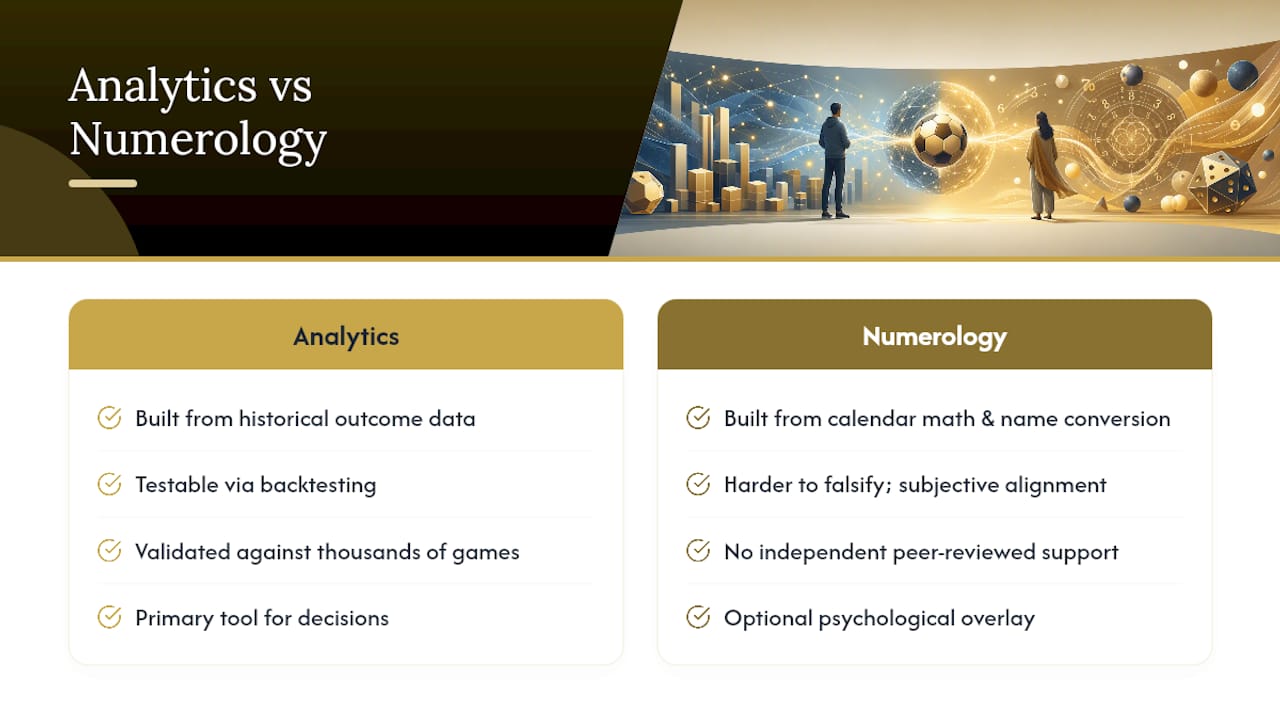
Traditional sports analytics, things like expected goals, adjusted efficiency ratings, and injury-weighted power ratings, are built from historical outcome data and validated against thousands of games. Numerology calculations are built from calendar math and name conversion, with no outcome data feeding the formula at all.
That's the fundamental difference worth sitting with: analytics models are testable and falsifiable in a direct way, since you can back test a metric against ten years of box scores and see exactly how it performs. Numerology signals are harder to falsify because "alignment" is subjective. Did the numbers really match, or did you round generously to make them match?
No independent, peer-reviewed study has demonstrated that numerology-based signals predict sports outcomes better than random selection. That doesn't mean the exercise is worthless. It means the honest comparison isn't "numerology versus analytics" as if they compete on equal footing. It's "analytics as your primary tool, numerology as an optional psychological overlay that helps you commit to a decision and stay disciplined about recording it." Bettors who blend the two successfully almost always weight the split heavily toward stats, using numerology as a tiebreaker at most, never as the deciding factor on its own.
Myths About Numerology in Sports Forecasting
The biggest myth is that a strong numerological alignment predicts a win with any real reliability. It doesn't. Numbers describe a pattern in the calendar and in names; they don't describe form, matchups, or injuries.
A second myth: master numbers (11, 22, 33) always signal a bigger outcome, like an upset or blowout. There's no evidence tying master numbers to game variance. They're simply unreduced totals that some systems treat as more significant, a convention, not a finding.
A third myth worth killing: that numerology and astrology are the same thing. They're related practices that often get bundled together, but numerology works from dates and names reduced to digits, while astrology works from planetary positions and birth charts. Treating them as interchangeable muddies both.
Last myth: that a numerology "hit" on one game proves the system works going forward. One aligned pick that wins is not a pattern, it's a single data point. The birthdate-based picking guide covers a parallel version of this myth in the lottery context, where players assume a birthdate combination that hit once is inherently luckier than any other.
Numerology Systems Used in Sports Prediction
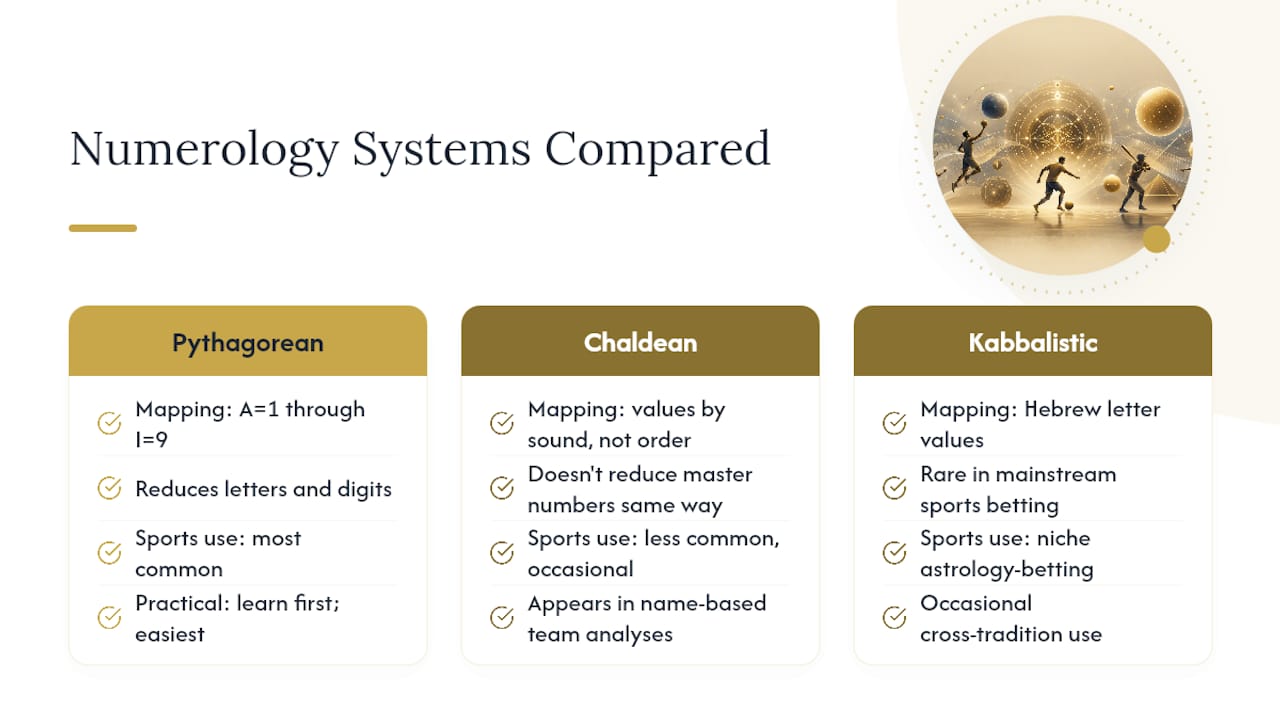
Pythagorean numerology, the version most common in Western sports numerology, reduces every letter and digit using the A=1 through I=9 chart. It's the system behind the life path, expression, and event-number calculations covered earlier in this article.
Chaldean numerology assigns different values to letters (based on sound rather than strict alphabet order) and doesn't reduce master numbers the same way. It's less common in sports applications but shows up occasionally in name-based team analyses.
Kabbalistic numerology, rooted in Hebrew letter values, rarely appears in mainstream sports betting content but occasionally surfaces in niche astrology-betting communities that blend multiple esoteric traditions.
For practical purposes, Pythagorean reduction is the system worth learning first. It's the most widely documented, the easiest to calculate by hand or with an app, and the one behind nearly every public sports numerology breakdown, including the tournament-style analyses built for major events like World Cup brackets. Learn that system cleanly before layering in variations, since mixing systems inside a single prediction just adds noise to a method that already leans heavily on subjective interpretation.
Treat It as Structure, Not a Crystal Ball
If you want to actually test whether numerology adds anything to your betting, run it like an experiment: pick one sport, calculate the numbers for every game over a full season, log the alignment status and the result, and don't touch your stake sizing based on the outcome. Pair it with real handicapping the whole time. The value isn't in prediction accuracy. It's in the discipline of recording a pick before the game and checking your reasoning after, something most bettors never do consistently. Have fun with it, but let the stats carry the real weight.
— amsd
Turn Your Numbers Into a Repeatable Sports Overlay
Lotto Oracle is the faster alternative to doing every reduction by hand, whether you're calculating a fighter's life path number at midnight before a card or checking a tournament bracket for aligned event numbers across a dozen matchups at once. Instead of manually converting names and dates every week, the app runs those calculations automatically and keeps a running history so you can see which alignments you actually acted on and how they played out.
The Lotto Oracle subscription unlocks daily power numbers, personalized numerology and zodiac profiles, and sports overlay tracking, all built on the same combination of astrology, numerology, and historical pattern analysis described throughout this guide. It's an entertainment and decision-support tool, not a betting service, and it doesn't sell tickets or guarantee outcomes. If you've been running these calculations manually and want to see them automated, check the current plans and start tracking your first matchup today.