
No strategy beats the base odds of Ontario 49. What you can control is how much you'd take home if you win, and how efficiently you spend your entertainment budget getting there. That's the honest version of an ontario 49 strategy worth using.
Here's what's actually worth doing:
- Balance your ticket between odd and even numbers, a balanced mix.
- Spread picks across the full 1 to 49 range instead of clustering low numbers.
- Skip birthdays, straight sequences, and other patterns thousands of other players also pick.
- Try modest wheel coverage if you're playing multiple lines regularly.
None of this raises your odds of hitting the jackpot on a single ticket. It changes what happens if you do.
Key Takeaways
No selection method changes the base odds of Ontario 49, but choosing less-common numbers and tracking results systematically improves both your expected payout and your understanding of the game.
| Point | Details |
|---|---|
| Odds stay fixed | Every Ontario 49 ticket faces roughly 1 in 13,983,816 odds for the jackpot, regardless of picks. |
| Avoid popular numbers | Skipping birthdays and sequences reduces the odds of splitting a prize with other winners. |
| Frequency data needs context | Hot and cold numbers reflect sample-size variation, not predictive signals. |
| Test before trusting | Backtest a selection rule against OLG draw history before committing budget to it. |
| Track experiments with Lotto Oracle | Lotto Oracle logs personalized picks and results so Canadian players can compare strategies over time. |
Table of Contents
- Understanding the Ontario 49 Strategy Math Behind the Odds
- Reading Ontario 49 Frequency Data Without Overreacting
- Practical Ontario 49 Strategy Tactics You Can Try Tonight
- Testing Your Ontario 49 Strategy Like a Real Experiment
- Debunking the Biggest Ontario 49 Myths
- Playing Ontario 49 Responsibly
- Why Small, Testable Experiments Beat Expensive Systems
- How Lotto Oracle Helps You Run a Real Ontario 49 Strategy
- Sources
Understanding the Ontario 49 Strategy Math Behind the Odds
Ontario 49 asks you to pick 6 numbers from a field of 49. The official odds of matching all six sit at 1 in 13,983,816. Match 5 of 6 and your odds improve dramatically, but they're still long. Every draw is a fresh, independent event. The machine doesn't know what happened last Wednesday, so no combination is "overdue" and no sequence of past results shifts your odds this time around.
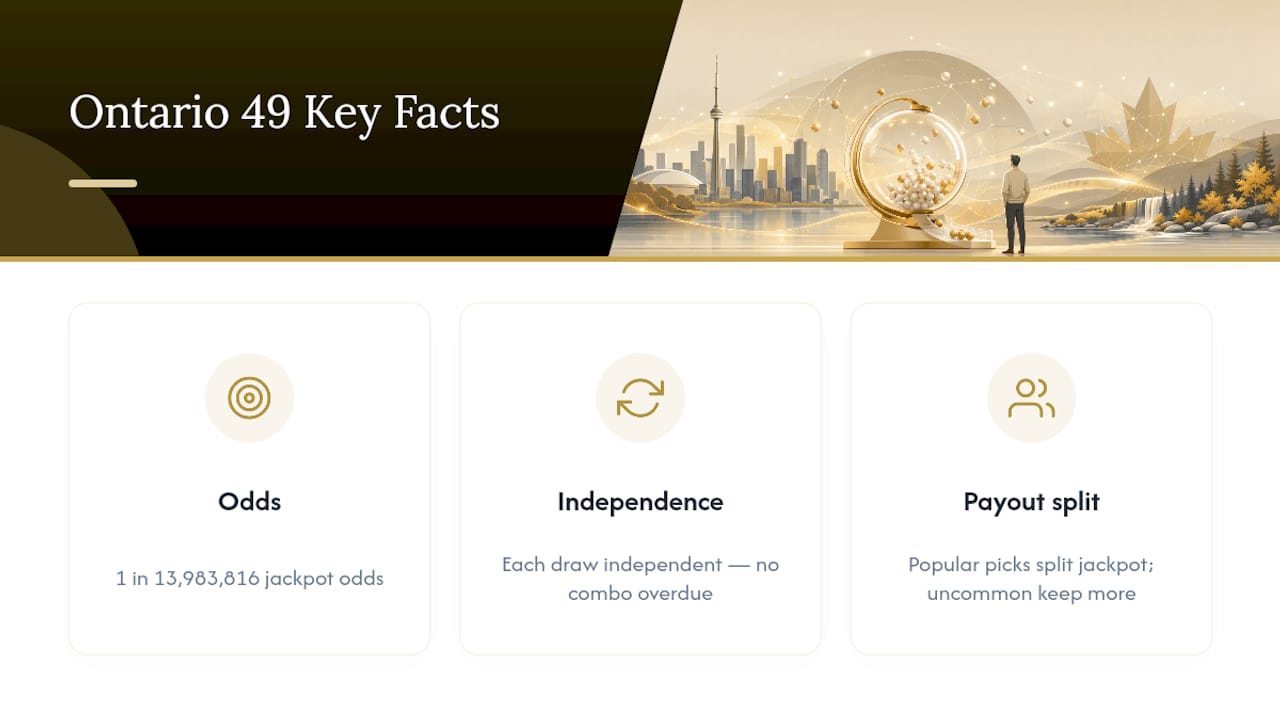
1 in 13,983,816 is the number that should anchor every decision you make about strategy. That's roughly the odds of flipping a coin heads 24 times in a row.
What a strategy can influence is your expected payout if you win. Popular number combinations, think 1 through 6, or dates under 31, get picked by huge numbers of players. If one of those combinations hits, you're splitting the jackpot with everyone else who chose it. Picking less common numbers doesn't improve your chance of winning, but it can meaningfully raise how much you keep if you do, a point CTV News has highlighted when surveying what statisticians actually recommend to Canadian players.
Reading Ontario 49 Frequency Data Without Overreacting
Frequency tables show how often each number has appeared over some stretch of draws. They look convincing. They're also easy to misread if you don't account for sample size.
A number that has appeared frequently in recent draws isn't "hot" in any predictive sense, it's just what random variation looks like over a limited window. Flip a fair coin 200 times and you'll see streaks and clusters that mean nothing about the next flip. The same logic applies to lottery balls. A number's supposedly "cold" or "due" simply because it hasn't shown up in a while, but a ball has no memory. This is regression to the mean doing its thing, not a signal.
Here's a simplified way to think about how frequency data typically looks over a large sample:
| Frequency Category | What It Means | Safe Use |
|---|---|---|
| Hot numbers | Appeared more often in your sample window | Fine to include, not to over-rely on |
| Cold numbers | Appeared less often in your sample window | Not "due," just under-sampled |
| Balanced mix | Roughly even representation across ranges | Reflects most real winning tickets |
Aggregator sites like LotteryExtreme publish pair and triplet tables for Ontario 49 that plenty of players study closely. They're interesting for spotting what combinations other people are likely playing, which matters for the prize-splitting reason above, but treat them as descriptive, not predictive.
Pro Tip: Avoid copying the exact top 5 most-frequent numbers as your entire ticket. If they hit, you're one of thousands who had the same idea, and your jackpot share shrinks accordingly.
For a deeper walkthrough of how to interpret these tables safely, our frequency guide breaks down sample-size sensitivity in more detail.
Practical Ontario 49 Strategy Tactics You Can Try Tonight
None of these tactics change your jackpot odds. They shape ticket quality and reduce your chance of an unpleasant shared prize.
- Balance odd and even numbers. A balanced split mirrors the distribution seen in the majority of historical winning tickets, since an all-odd or all-even combination is statistically rare.
- Mix high and low numbers. Split your six picks across the 1 to 25 and 26 to 49 ranges rather than clustering everything under 31 (a common trap since so many players pick birthdays).
- Target a mid-range sum. Winning combinations for a 6-of-49 game tend to sum over a moderate to high range. A ticket totaling 21 (like 1, 2, 3, 4, 5, 6) is mathematically valid but statistically rare, and heavily played.
- Skip predictable patterns. Straight sequences, multiples of a single number, and calendar-based picks all get chosen disproportionately by other players.
- Consider a compact wheel. A partial wheel lets you play a set of numbers across multiple lines to guarantee a minimum win if enough of them hit. Our wheel systems guide walks through the cost-versus-coverage math for Ontario 49 specifically.
How many lines should you actually play? It depends on your budget, not your confidence level:
- One line per draw: pure entertainment, minimal cost, same odds either way.
- Three to five lines: modest wheel coverage becomes viable, giving you a small guaranteed-match safety net.
- Ten or more lines: worth tracking results carefully, since you're now running a real experiment rather than a casual play.
Testing Your Ontario 49 Strategy Like a Real Experiment
You don't need to guess whether a selection method works. You can test it against real history.
Start with official OLG draw archives, which are the most reliable data source for Ontario games. Pick a selection rule (say, always balanced 3/3 odd/even with a mid-range sum), then check how it would have performed against, say, the last 100 draws.
Track these metrics as you go:
- Match rate at each prize tier, not just the jackpot.
- Instances where your hypothetical combination would have split a prize.
- Cost per line tested versus hits generated.
Pro Tip: Log your experiments the same way you'd track a fitness routine, weekly, with real numbers, not vibes.
Lotto Oracle gives Canadian players a straightforward way to run this kind of test without building a spreadsheet from scratch. The app generates personalized number sets, tracks trends over time, and logs your experiment results so you can compare selection rules side by side.
Debunking the Biggest Ontario 49 Myths
A lot of confident-sounding advice online doesn't survive contact with basic probability.
- Astrology or AI "predicting" numbers: there's no reproducible evidence any predictive method beats random chance for outcomes governed purely by mechanical draws.
- A number being "due": each draw is independent, so a number's past absence has zero bearing on this week's odds.
- Guaranteed-win systems: any system claiming to guarantee a jackpot misunderstands expected value. The math doesn't change no matter how the numbers are dressed up.
Experts cited by CTV News are consistent on this point: nothing beats the odds, but smarter number selection can affect what you keep.
Playing Ontario 49 Responsibly
Treat your lottery budget the way you'd treat a movie ticket, not a retirement account.
- Set a fixed entertainment amount per month and never exceed it, regardless of how a previous draw went.
- Never chase losses by increasing spend after a losing streak.
- Schedule your "strategy experiments" for specific days instead of buying impulsively.
- If play starts to feel compulsive, OLG's ConnexOntario line and provincial health resources are there specifically for that.
Why Small, Testable Experiments Beat Expensive Systems
I favor small, documented experiments over anything sold as a guaranteed system, because the math never lies and the sales pitch always does. Track your picks, review what happened, adjust. That habit teaches you more about probability than any paid course ever will.
— amsd
How Lotto Oracle Helps You Run a Real Ontario 49 Strategy
Building and tracking a strategy manually means spreadsheets, stale frequency lists, and guesswork about what you already tried last month. Lotto Oracle replaces that with a single dashboard built specifically for players who want to treat number selection like a documented process rather than a hunch.
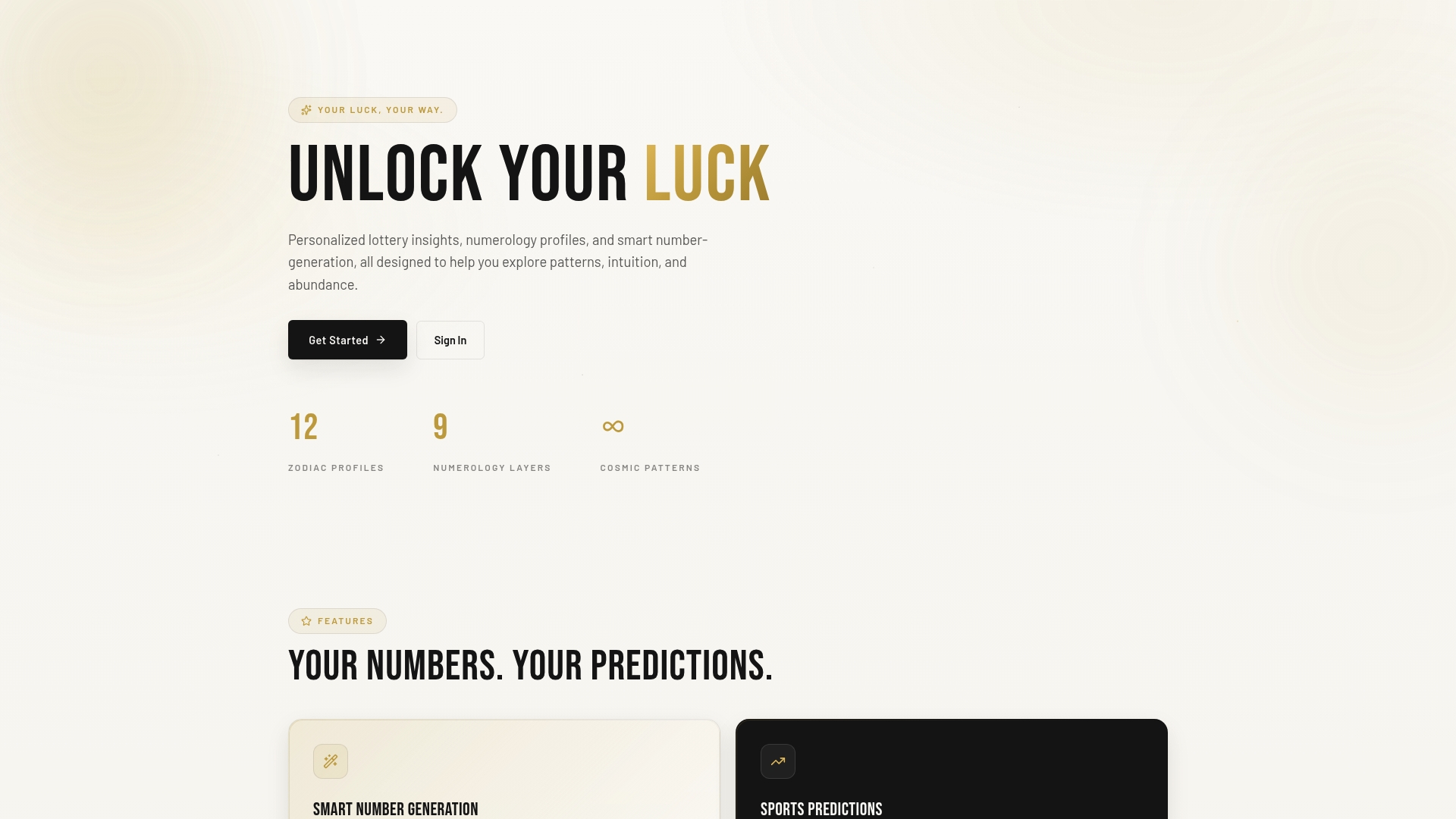
The flow is simple: sign up, generate a personalized number set based on trend tracking and your own numerology or zodiac profile, then log the draw result against your pick. Over a few months, you build a real record of what you've tried, whether it's balanced odd/even splits, mid-range sums, or wheel-based coverage, without re-explaining your logic to yourself every time. Lotto Oracle doesn't sell tickets or claim to beat the odds. It gives you the tracking and pattern layer that turns "I have a feeling about these numbers" into an actual, reviewable experiment. Start your first tracked pick at Lotto Oracle.