
Sum-range checks won't make a ticket more likely to be drawn. Every combination in a standard lottery has the exact same odds, no matter what its digits add up to; understanding these odds is key to smart play as explained in What Is a Ticket Lottery? How It Works and Your Odds. What sum-range analysis does is steer you away from crowded, popular combinations, which can mean a bigger payout if you do win.
TL;DR:
- Sum-range analysis guides players away from crowded, popular number patterns but does not improve actual chances of winning the lottery.
- Most winning combinations fall within a central range around the mean sum, such as 115 to 185 in a 6/49 game, covering roughly 70% of winners.
- Applying sum-range checks is most effective when used with a large sample of past draws, ideally over 100, to establish reliable statistical zones.
- The primary benefit of sum-range strategies is reducing the likelihood of sharing the jackpot, not increasing the odds of winning itself.
- Mixing sum-range filtering with odd/even balance and higher-than-birthday numbers can modestly improve payout size by avoiding common, crowd-based selections.
Table of Contents
- What Is the Sum Range Lottery Strategy, Exactly?
- How Do Lottery Sums Actually Distribute?
- How Do You Apply Sum-Range Checks to Your Ticket?
- What Do Sum Ranges Look Like for Different Games?
- What Sum-Range Strategies Actually Change (and What They Don't)
- Who's Behind This Analysis and How Lotto Oracle Fits In
- The Perspective Worth Taking on Sum-Range Strategy
- Sources
What Is the Sum Range Lottery Strategy, Exactly?
Add up the six (or five) numbers on your ticket. That total is the sum. Plot every possible sum for a given lottery, and you get a bell curve, not a flat line, because there are far more ways to build a middle-of-the-road total than an extreme one.
Think of it like rolling two dice: there's only one way to roll a 2 (snake eyes) but six ways to roll a 7. Lottery sums work the same way, just with more numbers involved.
The practical payoff isn't magic prediction. It's pattern avoidance. Tickets built entirely from low numbers (like birthdays) or entirely from high numbers tend to cluster with other players' picks, and that clustering is what a sum-range check helps you sidestep.
How Do Lottery Sums Actually Distribute?
A standard 6/49 lottery has 13,983,816 possible combinations, and not every one of those combinations produces a unique sum. Many different sets of six numbers land on the same total, and the number of ways to hit each total is exactly what creates the bell shape. The mean sum for a 6-number draw from a 1 to 49 pool works out to 150, and the full exact-sum table lists every possible total from 21 up to 279, along with how many combinations produce it and the probability of each.
Here's what that looks like at a few points along the curve:
| Sum total | Relative frequency | What it tells you |
|---|---|---|
| 21 (minimum) | Extremely rare | Only one combination produces this |
| 100 | Below average | Fewer combinations than the middle band |
| 150 (mean) | Most common zone | Highest concentration of combinations |
| — | Below average | Mirrors the 100 range in rarity |
| 279 (maximum) | Extremely rare | Only one combination produces this |
The ten-second test is simple: add your six numbers, then check where that total sits relative to 150. If you're within roughly 30 to 40 points of the mean, your ticket sits in the statistically typical zone. If you're closer to 21 or 279, you've picked a ticket shape that almost never gets drawn, historically speaking, which usually means either all-low or all-high numbers.
How Do You Apply Sum-Range Checks to Your Ticket?
Run through this sequence before you hand over your slip:
- Add your numbers. Write down the sum of every number on the ticket.
- Check the zone. Compare that sum against your game's known 70% band (for 6/49, roughly 115 to 185; more on game-specific ranges below).
- Balance odd and even. Aim for a 3/3 or 4/2 split rather than all-odd or all-even, since lopsided splits are rarer in real draws.
- Push past 31. Include at least two or three numbers above 31 so you're not overlapping with birthday-based tickets, a habit tied directly to reducing split-jackpot risk.
- Consider Quick Pick. A terminal-generated set tends to spread more evenly across the full number pool than self-picked numbers, which skew low.
Pro Tip: Don't build your sum-range expectations off ten or twenty draws. Zone-based tools generally recommend at least 100 draws before treating a range as statistically stable, because small samples can make a random cold streak look like a real pattern.
There's a real trade-off here worth naming honestly. Sum-range filtering pulls you toward numbers that feel less personal, less like your kid's birthday or your anniversary. That's a psychological cost some players aren't willing to pay, even when the statistical logic for spreading picks is sound. You're trading sentiment for a modestly better shot at not splitting the pot.
What Do Sum Ranges Look Like for Different Games?
For a 6/49 lottery, the theoretical minimum sum is 21 and the maximum is 279, with a mean around 150. The Wizard of Odds exact-sum table shows the heaviest concentration of winning combinations sitting between roughly 115 and 185, which lines up with the rule that roughly 70% of winning combinations fall within this range.
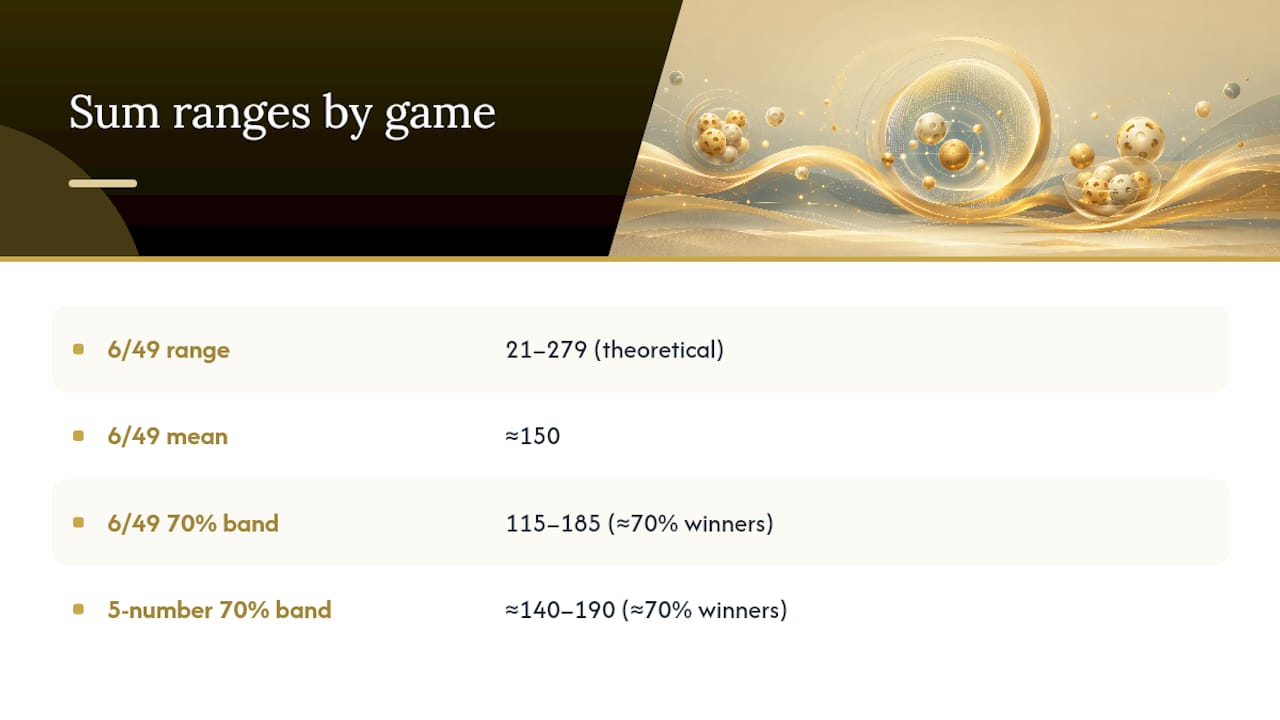
Five-number games built on a larger pool, the style used in Powerball-type draws, shift that window higher. One analysis of historical Powerball white-ball draws found that about 70% of jackpot winners fell into a sum range of roughly 140 to 190, with totals below 100 or above 230 showing up rarely.
Those two examples aren't interchangeable. A 6/49 range and a 5/69 range come from different pools and different draw sizes, so plugging one game's numbers into another's chart will mislead you. If you play a game not covered here, calculate your own mean by adding the lowest and highest possible sums and dividing by two, then treat draws close to that midpoint as your target zone.
What Sum-Range Strategies Actually Change (and What They Don't)
No sum-range check, no matter how well built, changes the mathematical odds of your ticket getting drawn. Lottery draws are pari-mutuel and completely random, and every legitimate strategy source, including CTV News' review of lottery-winning strategies, confirms this point plainly. What changes is your exposure to co-winners, because jackpots get split equally among everyone who matches, and avoiding the same crowded combinations other players gravitate toward can improve your expected payout if your numbers hit.
A few habits undercut the strategy fast:
- Basing your range on a handful of recent draws instead of a hundred or more.
- Applying a sum chart from one game format to a completely different one.
- Chasing an "overdue" sum the way some players chase overdue numbers.
- Assuming a mid-range sum improves your odds of winning, rather than just your odds of a bigger share if you do.
Who's Behind This Analysis and How Lotto Oracle Fits In
This piece was researched and written by amsd, drawing on published combinatorics data and lottery-strategy analyses rather than personal testing claims. The math here isn't proprietary. It's public probability theory applied to public lottery structures.
Some apps take that same pattern-aware thinking, layer in numerology and astrology-based overlays, and generate personalized number suggestions without selling tickets or claiming to alter your odds. It's a tool for organizing pattern analysis, not a shortcut around probability. Whether you use an app or a pencil, the checklist above works the same way: run your numbers through it before you buy.
The Perspective Worth Taking on Sum-Range Strategy
The math behind sum ranges is solid. Middle-band sums really do have more combinations behind them, and that's not debatable. Where most lottery advice goes wrong is in implying this improves your chance of winning. It doesn't, and any source that suggests otherwise is either confused about pari-mutuel math or being deliberately vague to sell a system.
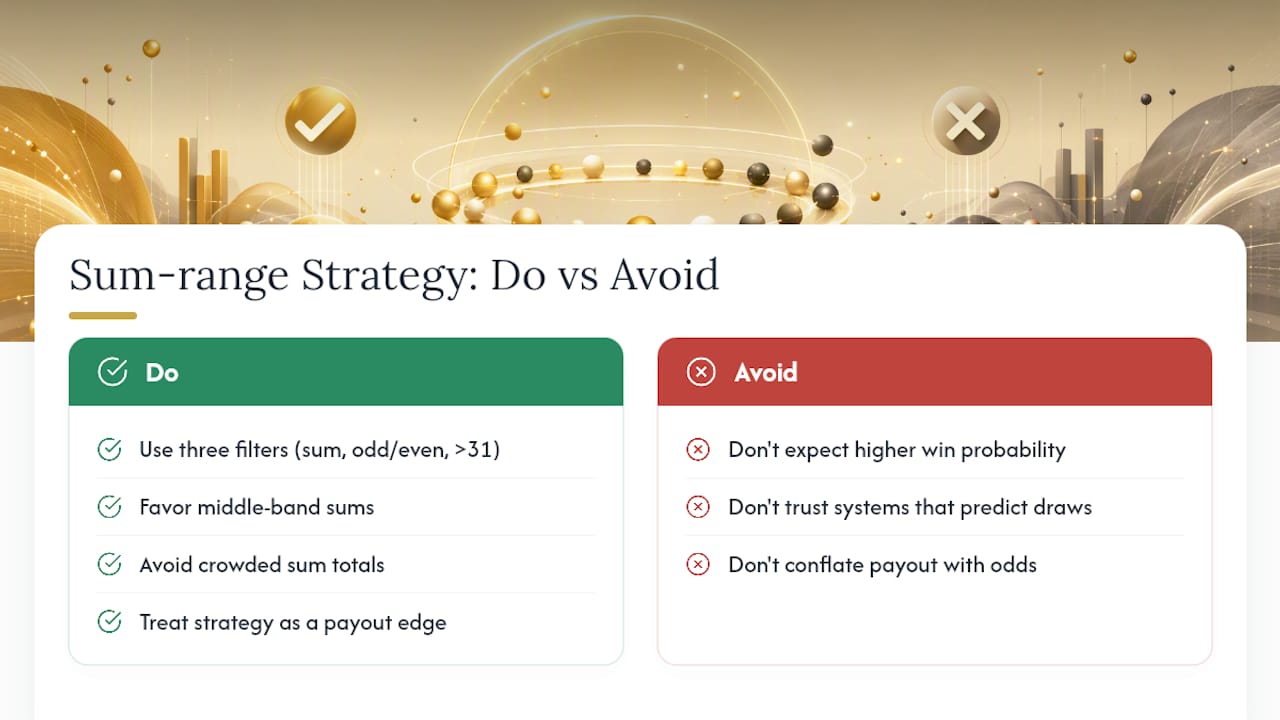
What the sum-range check actually buys you is a smarter bet on the same odds. If you're going to play, you might as well avoid the sum totals and low-number clusters that thousands of other players gravitate toward. That's a real edge on payout size, even with zero edge on winning probability, and conflating the two is the single biggest mistake in this space.
Prioritize the three-filter combination first: sum zone, odd/even balance, and pushing past 31. Skip anything promising more than that. If a system claims it can predict which numbers get drawn, that claim contradicts the randomness every regulated lottery is built on.
— amsd
Ready to put pattern-aware picks on autopilot? Lotto Oracle runs the sum-range, odd/even, and clustering checks for you, layered with personalized numerology and astrology insights, so you can spend less time doing math by hand and more time deciding which numbers feel right.
Sources
- Strategies for winning the lottery: What experts and stats suggest (CTV News)
- Lottery sums (Wizard of Odds)
- Why the sum of your numbers matters more than you think (MixTech)