Mirror numbers map each digit 0 through 4 to its partner from 5 through 9 (0↔5, 1↔6, 2↔7, 3↔8, 4↔9), turning one base number into several playable variations for Pick 3 and Pick 4 games. Use them as a coverage tactic to expand your ticket options and stay consistent with a system, not because they change the lottery's actual odds. Every combination in a random drawing has the same probability regardless of how you found it.
TL;DR:
- Mirror numbers do not improve your chances of winning; all combinations have equal probability regardless of how they are generated.
- Generating mirror variants of a base number creates up to 48 different formats, which can be used to expand coverage on a ticket.
- Using mirror systems mainly helps organize your play and track patterns but may lead to crowded numbers, reducing payout size if a win occurs.
- Betting strategies include playing all mirror variants as box bets for broader coverage or selecting specific variants for higher payouts with straight bets.
- Regularly tracking and limiting bets keeps the risk manageable, as mirror numbers attract more players and can increase prize splits.
Table of Contents
- What Are Mirror Numbers, Exactly?
- From One Number to 48 Playable Tickets
- Putting Mirrors Into Play: Box, Straight, and Workouts
- The Math Doesn't Care About Mirrors
- How to Build a Mirror Number Ticket Plan Step by Step
- How Lotto Oracle Treats Mirror Numbers
- Should You Actually Use Mirror Numbers?
- Sources
What Are Mirror Numbers, Exactly?
Every mirror number system starts with a simple split. Digits 0 through 4 are treated as the "core" set, and digits 5 through 9 are their mirrored counterparts. Swap one for the other, and you get a mirrored version of any digit.
The mapping never changes:
- 0 mirrors to 5
- 1 mirrors to 6
- 2 mirrors to 7
- 3 mirrors to 8
- 4 mirrors to 9
A full mirror flips every digit in a number. A partial mirror flips only some of them, leaving the rest untouched. Some players call the flip itself a "mirror flip," but it is the same operation: replace a digit with its counterpart from the mapping above, according to Pick3s' breakdown of the core-and-mirror model. Once you know the five pairs, you can build a mirror by hand in seconds, no chart required.
From One Number to 48 Playable Tickets
Take the Pick 3 number 032. Apply the mapping digit by digit: 0 becomes 5, 3 becomes 8, 2 becomes 7. That gives you the full mirror 587, according to Lottery Post's explainer on mirror numbers.
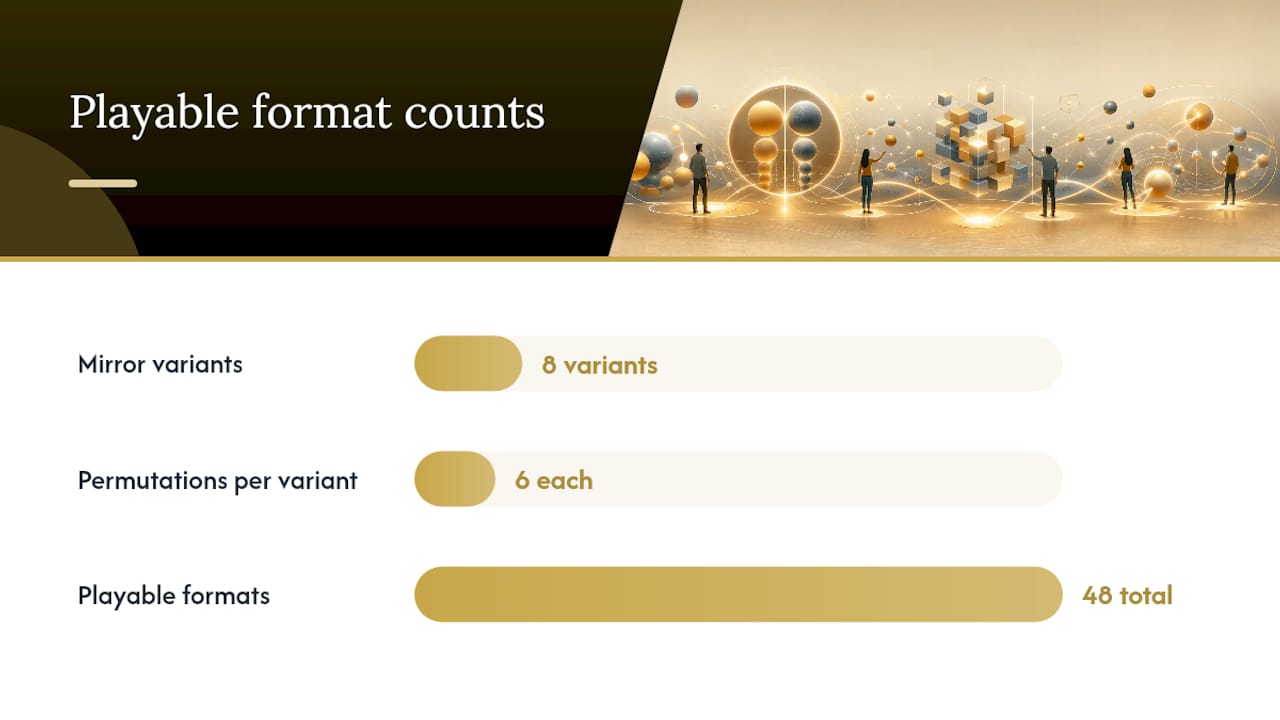
But full mirroring is only the start. Because you can flip each digit independently, a three-digit base number produces 8 distinct mirror variants: every combination of flipped and unclipped digits, including the original. Each of those 8 variants can then be arranged in up to 6 different digit placements (permutations of three digits), which is how a single base number expands into 48 playable formats total.
| Step | What happens | Result count |
|---|---|---|
| Start with a base number | 032 | 1 |
| Apply full or partial mirror flips | Every digit combination flipped or not | 8 variants |
| Arrange each variant in different orders | 3-digit permutations | 6 per variant |
| Total playable formats | 8 × 6 | 48 |
VTracs mirror-combination charts group these outcomes visually, so you're not doing permutation math by hand every time you sit down to pick numbers.
Pro Tip: Write your base number's 8 mirror variants down first, before you think about order. Sorting the digits (ascending) makes it obvious when two "different" mirrors are actually the same combination in box play, which saves you from paying for a duplicate.
Putting Mirrors Into Play: Box, Straight, and Workouts
Knowing the math is one thing. Deciding how to bet it is another. Most Pick 3 and Pick 4 players build what's called a "workout," a small cluster of numbers derived from one seed, like the classic 646 workout, then layer mirror flips on top to widen coverage without starting from scratch.
Here's a simple sequence for turning a mirror set into an actual ticket plan:
- Pick your base number. Use a birthday, a repeat number you've noticed, or a number from your own tracking notes.
- Generate the mirror set. Apply full and partial flips to get up to 8 variants.
- Choose box or straight. Box bets pay less but cover any digit order; straight bets require the exact sequence and pay more.
- Decide how many variants to play. Playing all 8 box variants gives full coverage of that base's mirror family for a fixed cost per draw.
Box coverage suits players who want more shots at hitting something. Straight bets suit players chasing the bigger payout on a specific gut feeling. Some players also track whether recent draws are running "mirror heavy," a pattern shift some forum threads describe watching over a run of draws, and shift their allocation toward mirror-based box plays when that pattern shows up. Tracking trend shifts this way is more about discipline than prediction.
The Math Doesn't Care About Mirrors
Here's the part every mirror-number guide owes you straight: mirror systems do not change your odds of winning. Each possible combination in a lottery drawing carries the exact same probability as every other combination, whether you derived it from a mirror flip, a birthday, or a random pick. DrawAnalytics' review of numerology-based methods makes this point plainly: these systems are entertainment and organizational tools, not odds-improvement tools.
The real risk isn't losing more. It's splitting a prize with more people, because mirror pairs and other popular number patterns tend to attract crowds of players thinking the same way.
That's the practical danger worth planning around:
- Popular digit patterns (birthdays, repeats, mirrors of well-known numbers) draw more players to the same combinations.
- A win split among more ticket holders means a smaller payout per person.
- Checking frequency data against your mirror picks, an approach covered in Lotto Oracle's guide to hot number analysis, helps you spot when your "personal" number is actually a crowd favorite.
- Keep individual bets small and consistent rather than betting big on any single mirror set.
How to Build a Mirror Number Ticket Plan Step by Step
- Choose your base digits. Pull from something personal (a birthday, an anniversary) or from a number you've been tracking in recent draws.
- Apply the mirror mapping. Flip each digit using the 0↔5, 1↔6, 2↔7, 3↔8, 4↔9 pairs to generate your full and partial mirror variants.
- Pick a placement strategy. Decide box versus straight, then calculate your total bet cost based on how many of the 48 possible formats you actually want to play.
- Set a spending limit and log results. Track which variants hit, how often, and whether mirror-heavy stretches actually showed up in your own draws.
Pro Tip: Keep your mirror plays to one base number per ticket cluster and play its full mirror set as a box combination. It's the most compact way to maximize coverage per dollar without your playbook sprawling into dozens of unrelated numbers. Reviewing your own results against known crowding risks after a few weeks tells you more than any single draw ever will.
How Lotto Oracle Treats Mirror Numbers
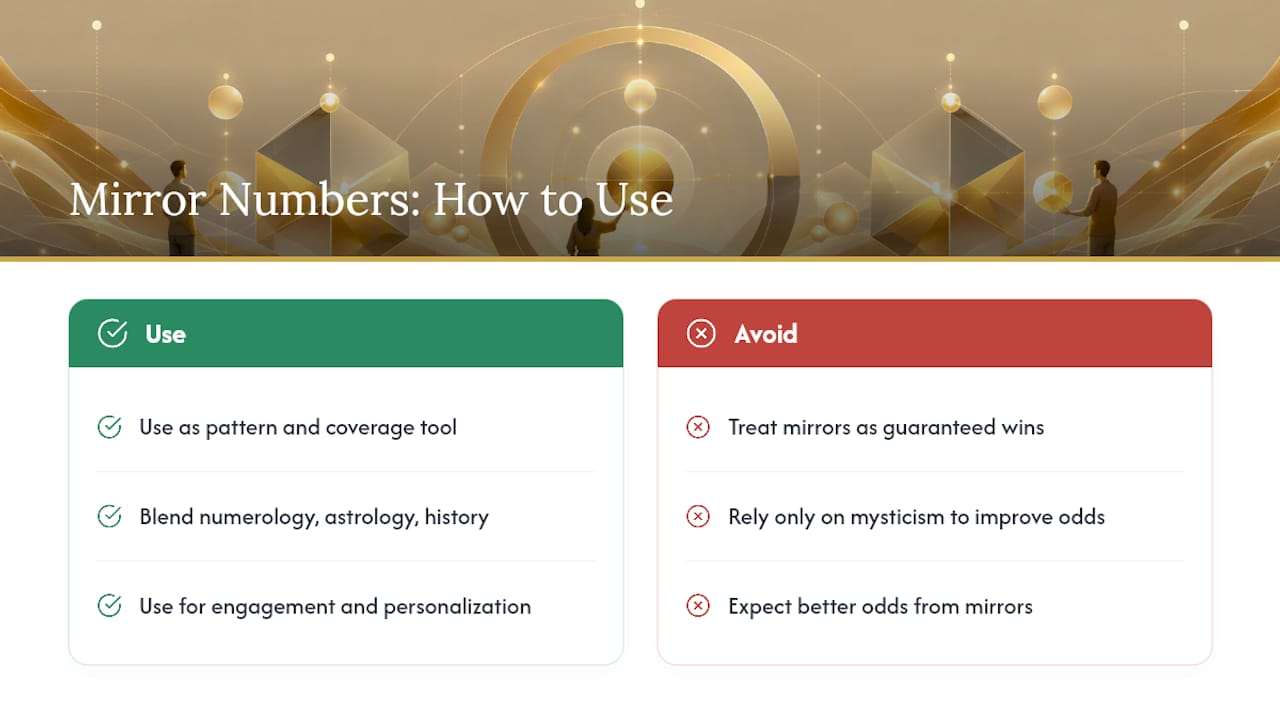
We treat mirror numbers as a pattern-and-coverage tool, not a shortcut to guaranteed wins. Some approaches blend numerology, astrology, and historical pattern tracking to provide a more engaging, personalized way to pick numbers, without promising better odds. If you want to go deeper on the numerology side, our post on angel numbers and the lottery covers where mystical number meaning fits in and where it doesn't.
Should You Actually Use Mirror Numbers?
Mirror numbers work best if you enjoy the ritual of a system and want organized coverage, not if you're expecting them to beat the math. Treat it as structured fun: pick your base, flip it, log what happens, and keep your bets small enough that a losing streak doesn't sting.
— amsd
Sources
- Understanding Mirror Numbers | Lottery Post
- Pick3s
- Dream Numbers and Numerology for Lottery: Fun Methods vs. Mathematical Reality | DrawAnalytics