
The best move is to build tickets around balanced parity splits, like 3 odd/3 even in a six-number game, because those splits are among the largest share of possible combinations. This isn't a way to boost the math odds of any single ticket you buy. It's a way to avoid clustering your picks into a rare, structurally unlikely category that other bettors also tend to ignore.
TL;DR:
- Choosing balanced parity splits like 3/3 in 6/49 increases your chances of avoiding rare, unlikely combinations that many players tend to ignore.
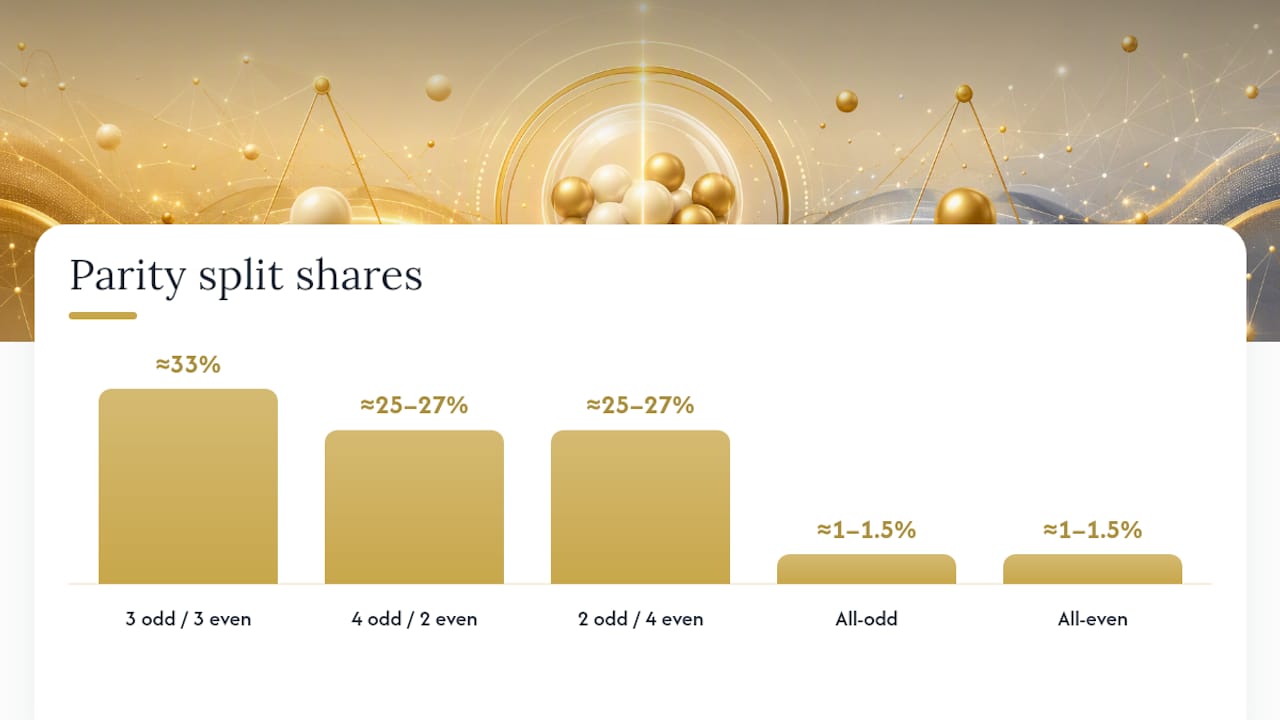
- Most common splits are around 33% for 3/3 and about 25-27% for 4/2 or 2/4, regardless of game size, while extreme splits are much less frequent.
- Using tools like Lotto Oracle can automate parity preferences, sum range, and trend checks, helping you build tickets aligned with historical draw patterns.
- Overall, parity strategies shift the neighborhood you play in rather than changing individual ticket odds, making them a risk reduction rather than a prediction tool.
Table of Contents
- What Is an Odd/Even Lottery Strategy, Exactly?
- How Parity Splits Break Down by Game Size
- Building a Ticket: A Step-by-Step Parity Process
- How Parity Trackers Work and When to Trust One
- Why Balanced Tickets Don't Change Your Ticket's Odds
- How Lotto Oracle Applies Parity to Number Generation
- A Data-First Take on Parity Strategy
- Try a Parity-Aware Approach With Lotto Oracle
- Sources
What Is an Odd/Even Lottery Strategy, Exactly?
An odd/even lottery strategy sorts your number picks by parity split, then favors the splits that occur most often across a game's full range of possible combinations. In a 6/49 game, a "split" just means how many of your six numbers are odd versus even. There are several possible splits including 6/0, 5/1, 4/2, 3/3, 2/4, 1/5, and 0/6. Each one contains a different number of possible combinations, and that count is the key factor.
Here's the combinatorics behind it. A standard 6/49 pool has 25 odd numbers (1, 3, 5... 49) and 24 even numbers (2, 4, 6... 48). To find how many 3-odd/3-even combinations exist, you calculate C(25,3) × C(24,3), where C(n,r) is the binomial coefficient for "choose r items from n." That works out to 2,300 × 2,024, or roughly 4.66 million combinations, against a total pool of 13,983,816 possible six-number tickets.
That's the category probability, and it's the whole basis for the strategy:
- Balanced splits like 3/3 dominate the combination space because there are simply more ways to arrange three odds and three evens than there are to arrange six of one parity.
- Extreme splits (all-odd, all-even) exist in far smaller numbers because there's less room to build them from a pool that's roughly half-and-half.
- Category probability is not the same as ticket probability. Every individual six-number combination, whether it's 3/3 or 6/0, has exactly the same one-in-13,983,816 chance of being drawn in a 6/49 game.
Parity strategy works on the category level, not the ticket level. You're choosing which neighborhood of combinations to live in, not changing the odds of the specific house you pick.
How Parity Splits Break Down by Game Size
Parity math shifts depending on how many numbers you pick and how big the pool is, so a strategy tuned for 6/49 won't map cleanly onto a Pick-5 or Pick-4 game. The Odd/Even Balance breakdown from DrawInsights puts hard numbers on this for a standard 6/49 pool: 3-odd/3-even accounts for about 33% of all combinations, 4/2 and 2/4 splits each land around 25 to 27%, and all-odd or all-even combinations show up in only about 1 to 1.5% of the total.
Smaller games behave differently because there's less room to spread numbers across parity categories.
Pattern-analysis work from DrawAnalytics confirms the same pattern across historical draws: balanced combinations dominate, and extreme splits stay rare no matter the game. The smaller the pool, the tighter the "most common" split clusters around dead-even. That's why a 2/2 split matters more in Pick-4 than a 3/3 split matters in 6/49, proportionally speaking, since there are fewer parity categories to divide the space into.
Building a Ticket: A Step-by-Step Parity Process
You don't need a spreadsheet to apply this. You need five decisions, made in order, every time you fill out a ticket.
- Pick your target parity split. For 6/49, that means favoring 3/3 or leaning toward 4/2/2/4 rather than extremes. Check the table above for your specific game format.
- Check your sum range. Balanced parity tickets tend to land in a mid-range sum band naturally, but verify your six numbers don't cluster unusually low or high, since that skews away from typical historical draws.
- Balance high and low numbers. A 3/3 parity split with all six numbers under 25 is still a lopsided ticket. Spread across the full number range, not just the parity axis.
- Avoid common pitfalls. Picking only numbers between 1 and 31 (a common trap for players anchoring on calendar dates) shrinks your effective pool and raises the odds you'll share a jackpot if that combination hits. Our breakdown on reducing split risk by avoiding 1–31-only picks covers this in more depth.
- Decide your line count. More lines spread across different valid parity splits reduce your exposure to any single unlucky pattern, but budget should drive this decision more than superstition. Our guide on how many lines actually make sense to buy walks through the math on that tradeoff.
Pro Tip: Test your parity rules against a small sample of past draws for your specific game before committing real money to them. Track outcomes over 20 to 30 draws and see whether your chosen splits actually show up as often as the combinatorics predict. If they don't, your game's number pool or draw mechanics might differ from the standard model.
How Parity Trackers Work and When to Trust One
An odd/even bias tracker plots how often recent draws have leaned odd or even against the long-term expected average, giving you a visual read on short-term skew. Tools like the Odd Even Bias Tracker described by SmartLuck are built for exactly this: spotting whether a game has been running heavier on even numbers over the last handful of draws than its history suggests it should.
The trap is treating every skew as a signal worth chasing.
- Compare a short window (the last 25 draws) against a longer one (the last 100 or more) before adjusting anything.
- If the skew only shows up in the short window, it's most likely random noise that will revert toward the historical average.
- A skew that persists across both windows is worth a small tactical adjustment, not a total rebuild of your parity strategy.
Remember the baseline you're comparing against: in a standard 6/49 pool, a 3-odd/3-even split shows up in roughly 33% of all possible combinations. Any tracker reading should be judged against that number, not against a gut feeling about what "balanced" looks like.
Why Balanced Tickets Don't Change Your Ticket's Odds
Every specific six-number combination in a 6/49 draw carries the exact same probability: 1 in 13,983,816. That includes 1-2-3-4-5-6 just as much as it includes a carefully balanced 3/3 split like 7-14-22-31-38-45. The math doesn't play favorites once you're down to a single ticket.
What changes is the size of the neighborhood you're standing in. Community combinatorics discussions on Math StackExchange walk through this distinction carefully: a parity category being common across history doesn't lift the odds of any one ticket inside it. Balanced splits just win more often across all draws combined, purely because there are more of them to win with.
- Picking a 3/3 split doesn't make your specific numbers more likely to be drawn.
- It does put you in the largest group of possible outcomes, which matters if you're trying to avoid splitting a jackpot with an unusually large number of other players chasing rare patterns.
Our piece on common lottery myths and what actually changes your payout goes deeper into this gap between pattern frequency and ticket-level probability, if you want the full breakdown.
How Lotto Oracle Applies Parity to Number Generation
A number generator can let you set a preferred parity split before it builds your lines, so you're not manually checking odd/even counts against a chart every time you play. It can layer that parity filter alongside trend overlays and options to screen out common pitfalls like all-numbers-under-32 picks.
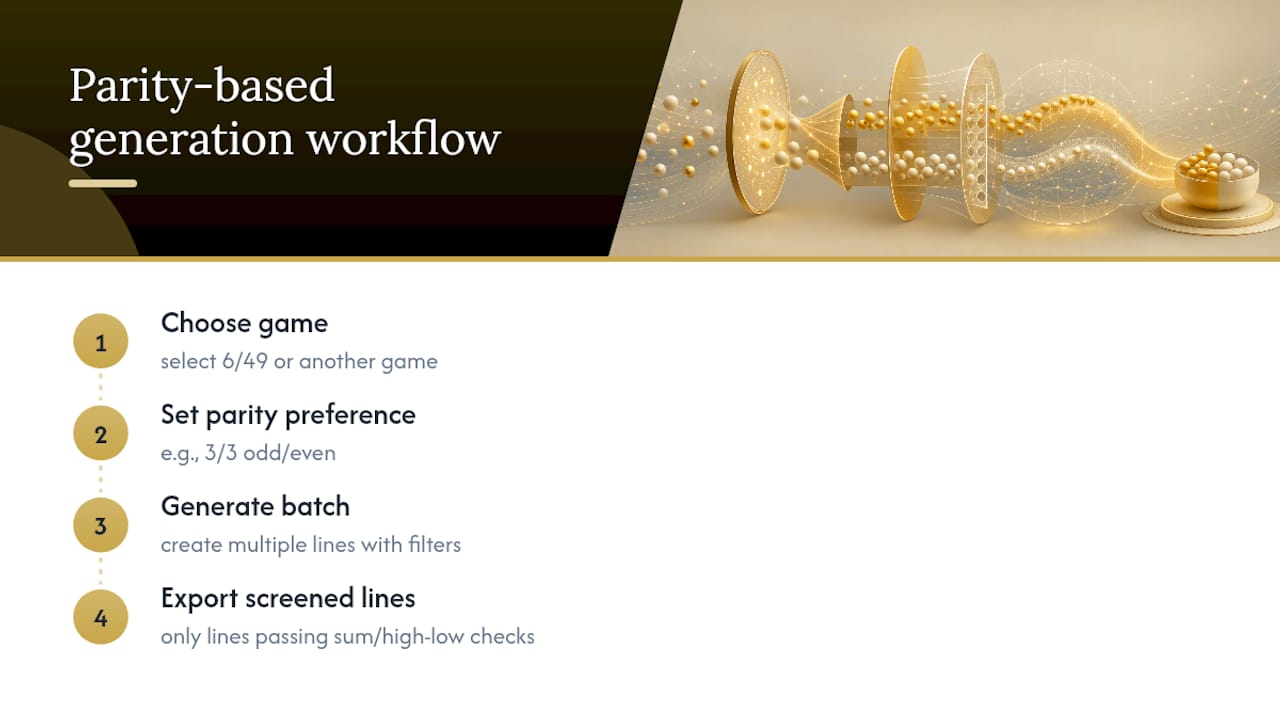
A typical workflow looks like this: choose your game, set a parity preference (say, 3/3 for a standard 6/49 draw), generate a batch of lines, then export the ones that also clear your sum-range and high/low checks. It's the same process laid out in the step-by-step section above, just automated instead of done by hand. For the full math behind why these filters matter, our post on lottery probability basics works through the calculations in more detail.
A Data-First Take on Parity Strategy
Parity strategy earns its keep as a risk-management tool, not a prediction engine. Favoring balanced splits aligns your tickets with how lottery draws actually distribute historically, and it keeps you out of the same rare corner (all-odd, all-even, or 1-through-31-only picks) that a surprising number of other players wander into by accident.
Where this goes wrong is when players start chasing a tracker's short-term wobble like it's a signal instead of noise. Treat every rule you adopt as testable. Track it, keep your spend modest, and let the sample size talk before you trust any pattern that feels too good.
— amsd
Try a Parity-Aware Approach With Lotto Oracle
If you've been eyeballing parity splits on paper or juggling a spreadsheet to check sum ranges, some tools can cut that manual work down to a few taps. Set your preferred parity split, and a generator can build lines that already clear the balance checks covered above, alongside trend overlays pulled from historical draw patterns.
The Lotto Oracle platform also layers in numerology and daily luck readings if you want that on top of the pure combinatorics approach, all through one subscription instead of piecing together separate tools. Worth knowing before you dive in: understanding expected value in games with fixed payout structures is a useful companion read, since parity strategy manages which combinations you play, not the underlying payout math.
One honest limitation worth repeating: none of this changes the mathematical odds of any single ticket you buy. What it does is help you build tickets that avoid rare, crowded patterns and match how draws have actually played out. Head to the Lotto Oracle landing page to generate a sample set of parity-aware lines and see how the filters apply to your game.
Sources
- Odd / Even Balance — DrawInsights
- Lottery Odd/Even and High/Low Strategy: Pattern Analysis Guide
- Choosing lottery numbers strategy (based on heuristics ...)
- Odd Even Bias Tracker in Lotto